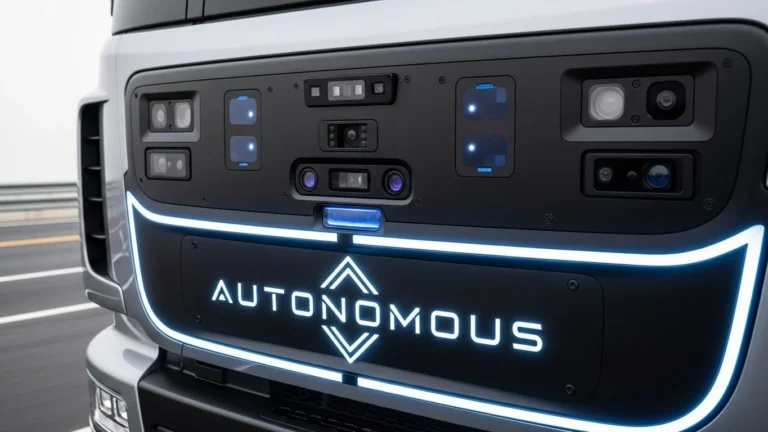
The push to deploy driverless trucks without a human operator has reignited a national debate over safety, jobs, and regulation—drawing unions, tech companies, and federal lawmakers into a conflict that could redefine the future of U.S. freight transportation.
The rapid advancement of autonomous trucking has once again ignited a fundamental debate within the U.S. freight industry: can technological innovation move forward without a human driver on board, or must safety and employment concerns set clear limits? The issue gained renewed momentum this week after the CEO of Aurora, one of the country’s leading autonomous truck developers, publicly rejected a demand from the Teamsters union that all autonomous trucks be required to carry a human operator with a commercial driver’s license (CDL).
The Technology Industry’s Case
Aurora’s position is straightforward. According to the company, mandating a full-time human driver would significantly undermine the economic and operational advantages of autonomous trucking. Aurora argues that its technology is specifically designed to operate safely without direct human intervention, particularly on long, predictable freight corridors such as interstate highways connecting major distribution hubs.
Safety and Jobs at the Heart of the Union’s Position
The Teamsters see the issue very differently. For the union, the demand for a human operator is not only about protecting jobs, but about public safety. Union leaders argue that heavy trucks traveling without a trained driver capable of responding to unexpected events—such as severe weather, accidents, road construction, or system failures—pose unacceptable risks on public roads.

A Structural Tension Across the Freight Sector
This clash highlights a deeper structural tension within the trucking sector. On one side, technology companies and some large fleets see automation as a necessary evolution to keep freight moving in an increasingly complex logistics environment. On the other, labor groups and parts of the political establishment caution that the rush to automate may overlook real-world risks that only emerge outside controlled testing conditions.
Washington’s Growing Role
The debate is no longer confined to corporate boardrooms or union halls. In Washington, the controversy is drawing growing attention from federal lawmakers, many of whom are concerned about the fragmented regulatory landscape governing autonomous vehicles. Today, autonomous trucks operate under a patchwork of state-level rules, with varying requirements for human supervision, testing protocols, and liability in the event of a crash.
The Push for Federal Standards
As a result, pressure is mounting for the federal government to establish uniform national standards. The trucking industry is calling for regulatory clarity and consistency to support long-term investment, while unions are pushing for minimum safety and labor protections to be embedded into any federal framework.
Why Hybrid Models Are Gaining Attention
At the same time, the debate reflects a strategic reality: automation is not advancing evenly across all segments of trucking. While autonomous systems appear most viable on long, repetitive highway routes, they continue to face significant challenges in dense urban environments, complex delivery zones, and unpredictable traffic conditions. This has fueled discussion around hybrid operating models, where autonomous trucks handle highway segments and human drivers manage urban driving, loading, unloading, and emergency situations.
What This Means for Drivers and Fleets
For drivers and trucking companies alike, the stakes are high. Decisions made today will shape what trucking jobs look like over the next decade, which skills will be most valuable, and how the human role in freight transportation evolves alongside rapidly advancing technology.
A Turning Point for U.S. Trucking
Ultimately, what is at stake is more than a single innovation. The outcome of this debate will determine how the U.S. balances efficiency, safety, and employment in one of the most critical pillars of its economy. As companies like Aurora push toward a driverless future and the Teamsters seek to slow what they view as a premature transition, Congress may soon find itself acting as the referee in a conflict set to redefine American trucking.

Autonomous Trucks vs. Human Drivers: The Showdown Reshaping U.S. Trucking
The push to deploy driverless trucks without a human operator has reignited a national debate over safety, jobs, and regulation—drawing unions, tech companies, and federal lawmakers into a conflict that could redefine the future of U.S. freight transportation.

Trucking faces continued job losses as 2026 uncertainty looms
The U.S. trucking industry continues to lose jobs and reduce capacity, will this trend continue in 2026? The U.S. trucking industry continues to lose jobs

U.S. Allocates $1.5 Billion for Truck Road Infrastructure
The 2026 BUILD Grants program will invest $1.5 billion in truck road infrastructure across highways, ports, and truck parking facilities, with direct impact on logistics and freight transportation in the United States.

Wall Street Record: Transportation Stocks Boost Confidence in the Economy and Logistics
Transportation stocks in the United States have staged a strong rally so far in 2025, reflecting growing market confidence in the real economic activity behind logistics, freight movement, and mobility services more broadly.

The meaning of Hanukkah and how to celebrate it on the road
Hanukkah is a celebration of resilience and hope, and here are some ways you can take this on the road. December is one of the

Waymo under investigation for potential safety risk in school zones
A recent wave of videos has shown that some Waymo vehicles are not complying with safety regulations in school zones. The autonomous vehicle company Waymo,