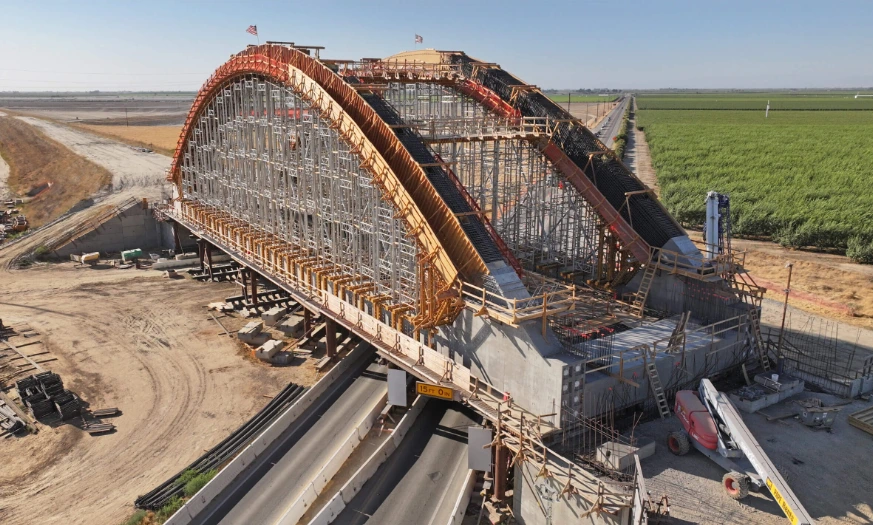
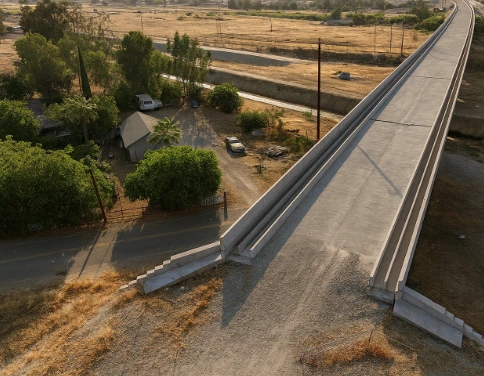
The U.S. Department of Transportation has canceled $175 million in federal funding for four critical components of California’s high-speed rail project, deepening doubts about the future of the ambitious plan to connect Los Angeles and San Francisco in just three hours.
A Project at the Center of Debate
The California high-speed rail project was conceived more than a decade ago as a symbol of modernization, sustainable mobility, and emission reduction. Yet the project has become entangled in a web of delays, cost overruns, and constant political disputes between federal authorities and state leadership.
This latest cancellation follows the earlier revocation of roughly $4 billion in federal grants, a significant blow to its financing. The rescinded funds were intended for overpasses, design planning, and the construction of a rail station in Madera, in the heart of the Central Valley, where much of the initial work has been concentrated.
Ballooning Costs and Distant Deadlines
A major criticism of the project is its escalating price tag. Recent estimates place the cost between $89 billion and $128 billion, several times higher than original projections. In addition, the full completion of the Los Angeles–San Francisco corridor is now forecast for 2033, though many experts believe that timeline may also slip further.
These challenges have fueled both public and political skepticism. Critics argue that resources should instead be allocated to highways, road infrastructure, or urban transit systems, rather than sustaining what they consider an unrealistic and excessively costly initiative.

Political Clash
The dispute over California’s high-speed rail also highlights tensions between the federal government and state authorities, led by Democratic Governor Gavin Newsom. While the Biden administration has shown some openness to maintaining support, Republican lawmakers have questioned the project’s feasibility and pushed for redirecting funds toward other transportation priorities.
For Newsom and project supporters, the train remains a transformative vision for the state’s mobility. They argue that it would significantly reduce reliance on cars and planes—two of the largest sources of greenhouse gas emissions in California.
Mixed Reactions
The Department of Transportation’s decision triggered swift reactions. Environmental organizations and several Democratic lawmakers criticized the move, claiming it slows progress toward cleaner transportation alternatives. For them, high-speed rail is not just an infrastructure project but a strategic investment in combating climate change.
Opponents, however, welcomed the cancellation, interpreting it as a recognition of the project’s weaknesses and unsustainable costs. In their view, continuing with the train amounts to wasting taxpayer money on a venture destined to fail.
National Implications
The California case resonates far beyond the state. The project is widely seen as a bellwether for the development of future high-speed rail systems in the U.S. Unlike Europe or Asia, where bullet trains are commonplace, America’s investment in high-speed rail has historically been limited.
By cutting funds, the federal government risks chilling private investment and discouraging other states from pursuing similar ventures, reinforcing the perception that such projects face overwhelming financial, technical, and political hurdles in the U.S.
What Lies Ahead
Despite the setbacks, California officials remain committed to moving forward. Construction is currently focused on a 119-mile stretch in the Central Valley, between Merced and Bakersfield, intended as the first operational segment of the broader corridor. Still, without sustained federal funding, the viability of the entire Los Angeles–San Francisco route looks increasingly uncertain.
The debate will continue: should the U.S. double down on high-speed rail as part of its long-term mobility and sustainability strategy, or prioritize more immediate, lower-cost improvements in roads and public transit?
For now, the decision to cancel $175 million marks another significant setback, leaving California’s high-speed rail project at a crossroads—caught between the transformative vision of modern infrastructure and the hard reality of soaring costs and shrinking support.

Cargo theft report 2025: $725 million in losses
Verisk CargoNet reports that cargo theft crime volumes remained stable, with a sharp increase in total losses. Verisk CargoNet’s 2025 report stated that the total

Ground and Air Transportation Brace for a Weekend of Cancellations and Delays
A historic cold wave is set to disrupt ground and air transportation across the United States, bringing cancellations, delays, and operational restrictions to highways, airports, and essential services throughout the weekend. Federal authorities have activated emergency plans in response to a major winter storm expected to deliver snow, ice, and extreme temperatures to large portions of the country.

Geopolitical tensions and the dispute between Trump and the Federal Reserve
The United States is going through a complex geopolitical environment along with internal tensions between President Donald Trump and the Federal Reserve. In the latest

Polar Vortex Puts U.S. Roads on Alert
A powerful polar vortex outbreak is triggering a widespread winter storm across the United States, bringing snow, ice, and extreme cold to major freight corridors. The event poses a serious risk to trucking operations, road safety, delivery schedules, and commercial vehicle insurance exposure.

DOT unveils possible AI strategy to enforce CDL regulations
The DOT is looking to adopt AI and advanced data analytics to improve the accuracy and effectiveness of enforcement measures. On January 14, the 105th

U.S. Trucking Defies the January Slowdown
Contrary to seasonal patterns, the U.S. trucking market entered 2026 without the traditional January slowdown. Capacity, pricing, and demand indicators suggest the industry remains tighter than expected, driven by inventory shifts, resilient consumer spending, and a reconfiguration of supply chains.