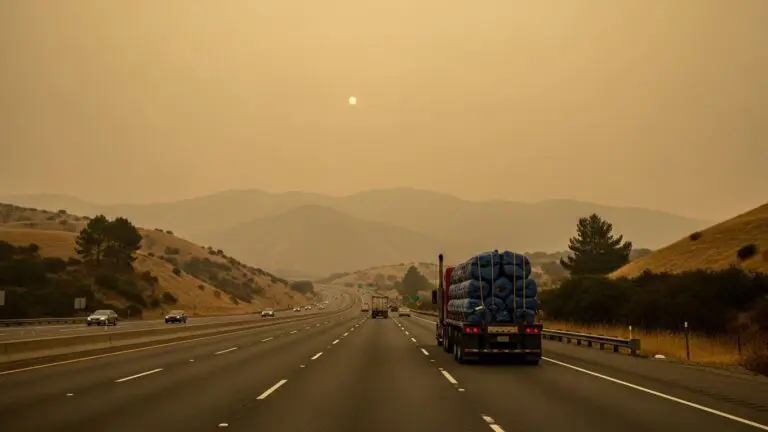
Air quality alerts urging residents to stay indoors have become a recurring reality across northern and eastern California.
Air quality alerts urging residents to stay indoors have become a recurring reality across northern and eastern California. While these warnings are often framed as public health advisories for local communities, they also carry important implications for the trucking industry, freight movement, and professional drivers who operate daily in affected corridors.
In recent episodes, the Air Quality Index (AQI) exceeded 150 points in multiple areas of northern California, placing air conditions in the “unhealthy” category due to elevated concentrations of fine particulate matter (PM2.5). According to data from the Environmental Protection Agency (EPA) and the AirNow monitoring platform, these conditions have repeatedly affected towns such as Summerville, Lewiston, Hayfork, Weaverville, as well as eastern California locations including Keeler, Lone Pine, and Cartago.
For trucking companies and owner-operators, these alerts are not isolated events—they are part of a broader pattern that increasingly shapes operational planning, driver health considerations, and compliance decisions.
Understanding AQI Alerts and Why They Matter for Trucking
The Air Quality Index is a standardized system used nationwide to measure and communicate pollution levels. When AQI values surpass 150, air quality is classified as “unhealthy,” meaning that everyone may experience adverse effects, not only sensitive groups.
For truck drivers, who spend long hours outdoors at loading docks, terminals, rest areas, and roadside inspections, this threshold is particularly relevant. Prolonged exposure during high-PM2.5 events can increase respiratory strain, fatigue, and discomfort—especially during physically demanding tasks such as securing loads, coupling trailers, or handling freight.
Regulatory agencies do not typically halt freight movement during air quality alerts, but they do advise reducing prolonged outdoor exertion where possible. This places responsibility on fleets and drivers to manage exposure proactively.
PM2.5: An Invisible Risk Along Freight Corridors
PM2.5 particles are among the most dangerous air pollutants due to their microscopic size—less than 2.5 micrometers in diameter. These particles can be inhaled deep into the lungs and, in some cases, enter the bloodstream.
For drivers, symptoms linked to PM2.5 exposure may include coughing, throat and eye irritation, shortness of breath, chest tightness, and reduced stamina. Over time, repeated exposure can exacerbate asthma, chronic obstructive pulmonary disease (COPD), and cardiovascular conditions.
The Centers for Disease Control and Prevention (CDC) warns that prolonged exposure to high particulate levels increases the risk of serious respiratory and heart-related complications—an important consideration for an industry already facing elevated health risks due to sedentary work and long shifts.
Why Air Quality Alerts Keep Repeating in California
From a logistics perspective, the recurrence of air quality alerts in California is not accidental. Several structural factors contribute to repeated pollution episodes:
Geography and weather: Temperature inversions, limited wind circulation, and mountainous terrain can trap pollutants near the ground.
Freight density: California hosts some of the busiest freight corridors in the U.S., with heavy truck traffic supporting ports, agriculture, and interstate commerce.
Multiple pollution sources: PM2.5 can originate from vehicle emissions, industrial activity, dust from unpaved roads, agricultural operations, and wildfire smoke.
Seasonal conditions: Winter months often see reduced atmospheric dispersion, allowing pollution to accumulate overnight and into early morning hours—prime driving times for many haulers.
The California Air Resources Board (CARB) has repeatedly noted that adverse meteorological conditions combined with residual smoke are common drivers of sudden AQI spikes.

Operational Impacts for Fleets and Drivers
While air quality alerts do not typically trigger road closures, they can influence daily operations in several ways:
Driver health management: Fleets may need to encourage drivers to limit unnecessary outdoor exposure during stops and inspections.
Scheduling considerations: High AQI conditions can coincide with early-morning or overnight hours, affecting shift planning.
Compliance and safety culture: As environmental scrutiny increases, companies are under growing pressure to demonstrate attention to worker health and environmental conditions.
Equipment decisions: Cab air filtration systems and well-maintained HVAC units become more critical during high-pollution events.
Owner-operators, in particular, must balance delivery commitments with personal health, often without the institutional support available to larger fleets.
Preventive Measures During Unhealthy Air Events
Health agencies consistently recommend several precautions that are especially relevant for truck drivers:
Minimize time spent outside the cab when AQI levels are high.
Avoid strenuous physical activity during loading or unloading when possible.
Keep cab windows closed and rely on filtered air systems.
Monitor symptoms such as shortness of breath or chest discomfort and seek medical attention if they worsen.
Check real-time AQI updates via official platforms like airnow.gov before and during routes.
A Long-Term Challenge for the Freight Industry
Recurring air quality alerts highlight a growing intersection between environmental conditions and freight transportation. As climate variability, wildfire risk, and emissions pressures continue, unhealthy air episodes are likely to remain a recurring operational factor for trucking in California.
For the industry, adapting to these conditions is no longer optional. Air quality is becoming another variable—alongside weather, congestion, and regulation—that fleets and drivers must factor into daily decision-making to protect both productivity and health.

California’s Unhealthy Air: Impacts on Trucking and Freight
Unhealthy Air Quality in California: What Repeated Pollution Alerts Mean for Trucking and Freight Operations

Global Road Freight on Track to Hit USD 5 Trillion by 2033
Global Road Freight on Track to Hit USD 5 Trillion by 2033 as e-commerce growth, supply chain restructuring, and technology adoption accelerate demand for road-based cargo transport worldwide.

California misses DOT deadline risking $160 million in federal funding
The state of California has reached the deadline set by the DOT to take action regarding the situation involving the number of non-domiciled CDLs issued

Health on Wheels: How to Prevent the Most Common Conditions on the Road
Health on wheels matters for anyone who spends long hours on the road. How to prevent the most common physical and mental conditions and maintain healthier routines while working behind the wheel.

More Roadside Controls in 2026: What Truckers Need to Know
The U.S. trucking industry will face More Roadside Controls in 2026, with tighter inspections, data-driven enforcement, and stricter oversight of hours of service, licensing, and vehicle maintenance—what truckers need to know to stay compliant.

$118M in FMCSA Grants Boost Road Safety, Truck Enforcement, and Driver Training
More than $118 million in FMCSA grants will be distributed nationwide to improve road safety, commercial vehicle enforcement, CDL integrity, and truck driver training, with a strong focus on data-driven oversight and veterans entering the trucking workforce.