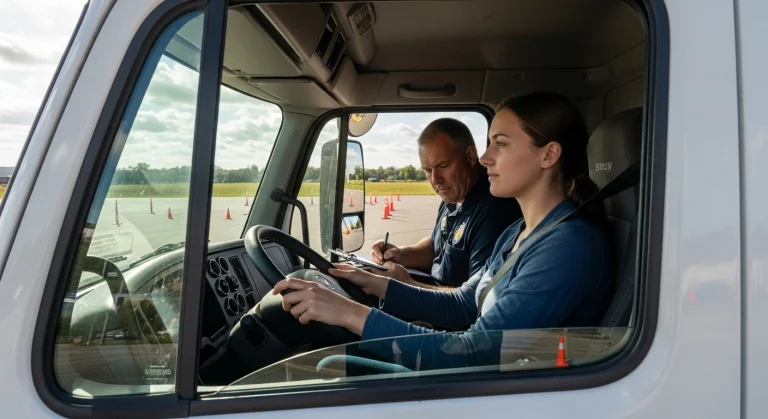
The Department of Transportation unveiled a sweeping set of safety measures, including English-only CDL exams, state audits, closure of noncompliant training schools, and a biometric registration system aimed at cracking down on so-called “chameleon carriers.”

The U.S. Department of Transportation (DOT) has announced that all applicants seeking a Commercial Driver’s License (CDL) will be required to take their exams exclusively in English. The policy is part of a broader initiative designed to raise safety standards in the trucking and passenger transportation industries and ensure that commercial drivers fully comply with federal requirements.
The announcement was made by Transportation Secretary Sean P. Duffy, alongside officials from the Federal Motor Carrier Safety Administration (FMCSA), the agency responsible for overseeing interstate commercial transportation.
Although federal regulations already require commercial drivers to be able to read and speak English sufficiently to converse with the public, understand traffic signs and signals, and respond to official inquiries, several states had continued to offer CDL exams in other languages. Under the new directive, the language requirement will now be applied uniformly nationwide.
According to Secretary Duffy, the goal is to ensure that drivers can clearly understand road signage, official instructions, and effectively communicate during roadside inspections or safety checks.
Expanded Oversight and State Audits
The English-only CDL exam requirement is part of a comprehensive review of the CDL issuance system. The DOT has launched nationwide audits to verify that states are properly enforcing federal standards, particularly concerning non-domiciled CDLs.
Federal officials reported identifying compliance deficiencies in several states, leading to administrative reviews and procedural adjustments in licensing processes.
In addition, the FMCSA has expanded “Operation SafeDRIVE,” a coordinated inspection campaign conducted in partnership with state enforcement agencies. During its initial phase, 8,215 inspections were carried out nationwide, resulting in:
• 704 drivers placed out of service
• Nearly 500 drivers disqualified for failing to meet English proficiency requirements
• 231 vehicles removed from service due to safety violations
Additional inspection rounds are scheduled in multiple states in the coming months.
.
Crackdown on Noncompliant CDL Schools
Another central component of the initiative focuses on commercial driver training schools. Following more than 1,400 in-person inspections, over 550 training centers were flagged for failing to meet minimum federal training and safety standards.
In December, the FMCSA also moved to decertify thousands of training providers that had submitted incomplete or inconsistent data to the national registry.
Federal officials argue that weakened oversight in recent years allowed underqualified drivers to obtain CDLs, increasing roadway risks for both commercial operators and the driving public.
Targeting “Chameleon Carriers” with Biometric Registration
The DOT also announced a long-awaited modernization of the motor carrier registration system, which has remained largely unchanged for four decades.
Under the current framework, a trucking company can begin operations by submitting basic documentation and proof of insurance. Full compliance audits may take more than a year and are sometimes conducted virtually.
This system has enabled the emergence of so-called “chameleon carriers” — companies that accumulate safety violations or are involved in serious crashes and then rebrand under a new name and registration number to continue operating.
To combat this practice, the DOT will implement a new system known as MOTUS, incorporating biometric identity verification and stricter validation protocols. Companies will also be required to maintain a verifiable physical business location where inspectors can access records within 48 hours of request.
The American Trucking Associations acknowledged the longstanding issue. Chief Operating Officer Dan Horvath noted that, historically, it has been too easy for certain carriers to evade enforcement actions simply by changing their legal identity.
Oversight of Electronic Logging Devices
The FMCSA is also strengthening enforcement related to Electronic Logging Devices (ELDs), which track drivers’ hours of service. In a recent compliance review, 42 ELD models were removed from the approved devices list due to technical violations.
Officials indicated that some operators had been using noncompliant systems to circumvent federal hours-of-service limits, increasing the risk of driver fatigue and crash exposure.
Safety as the Central Priority
Secretary Duffy emphasized that drivers operating heavy commercial vehicles — often weighing up to 80,000 pounds — must meet rigorous federal standards.
The newly announced measures include:
• English-only CDL examinations nationwide
• Revocation of licenses for drivers who fail language proficiency requirements
• Federal audits of state licensing practices
• Closure of noncompliant training schools
• Expanded roadside inspection campaigns
• Modernization of the motor carrier registration system with biometric safeguards
Freight transportation remains a backbone of the U.S. economy, ensuring the daily movement of goods across the country. With these reforms, the Department of Transportation aims to reinforce system integrity, elevate professional standards, and reduce safety risks on America’s highways.
In the months ahead, industry stakeholders will be closely watching how these changes are implemented — and whether they translate into measurable improvements in roadway safety and regulatory compliance across the commercial transportation sector.

How to avoid ELD violations: common mistakes truckers make
Violations related to Electronic Logging Devices (ELDs) are among the most common issues found during roadside inspections by the Department of Transportation.

Drive your stress away: techniques for truck drivers
Approximately 75% of truck drivers report feeling emotionally stressed at work, and very few have the tools to cope with these situations or seek help.

California vs. Washington: regulatory dispute over trucks in the U.S.
California, the most populous state in the country, wants to remove diesel trucks from its roads. Washington wants exactly the opposite. In between, thousands of fleets are left unsure about which engine to buy.

Volvo Pushes Beyond Diesel with New Hydrogen Combustion Truck Trials
Volvo Trucks is once again taking the lead, beginning road tests with heavy trucks equipped with hydrogen combustion engines.

Trucker Fashion: A Revolution Born on the Road That Still Sets the Trend
Trucker fashion remains relevant due to its authenticity, its seamless integration into streetwear, and its reinterpretation by luxury brands, consolidating itself as a revolution born on the road that evolved from a work uniform into a global cultural symbol

North Dakota among states regaining non-domiciled CDL authority
North Dakota will reissue approximately 150 of the 526 CDLs and CLPs for non-resident drivers that were active during the FMCSA audit.