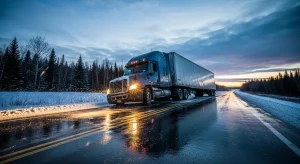
According to the Bureau of Transportation Statistics, cross-border freight transportation decreased by 9%.
Cross-border freight transportation is part of a complex ecosystem of customs regulations and security programs that enable the efficient flow of international trade. Recently, this sector has been significantly impacted by external factors, particularly tariffs. So much so, that year-to-date, cross-border truck freight has recorded its steepest decline since the pandemic, as a result of tariffs and the escalating trade war.
According to the Bureau of Transportation Statistics, in April, cross-border truck freight decreased by 9%. This drop not only marks the first year-over-year decline since June 2024, but also the largest contraction since June 2020, when activity fell by 14% due to the COVID-19 pandemic.

Cross-border freight transportation drops driven by tariffs
It is common to see declines in cross-border freight transportation in April; however, this year’s drop has set a new record not seen since 2020. The sharp decrease in freight movement between Mexico, Canada, and the United States coincides with the imposition of global tariffs and the intensifying U.S.–China trade war.
In January, cross-border truck freight saw a surge as many companies advanced purchases to get ahead of the tariffs. However, by April, activity had slowed significantly, resulting in a 12% decline, according to Land Line data.
That same month, the cross-border freight landscape changed dramatically. In April, President Donald Trump announced a 10% general tariff on all countries, along with higher reciprocal tariffs for certain nations. On April 3, a 25% tax on automobiles took effect, and on April 10, the trade war officially began, raising tariffs on Chinese products to as high as 145%.
The Trucking Conditions Index, developed by Freight Transportation Research Associates (FTR), returned to negative territory in April after a brief improvement in March. The index considers factors such as freight volumes, rates, fleet capacity, fuel prices, and financing conditions. A negative score indicates an unfavorable environment for the sector.
The vice president of trucking at FTR stated that conditions remained relatively neutral from February to April, despite the downturn. However, he warned that tariffs have completely altered the dynamics of the freight market.

Current state of cross-border freight transportation
The current economic context has strongly influenced the sector. According to ACT Research, Class 8 truck orders in April fell to levels not seen since the onset of the pandemic, reflecting uncertainty caused by U.S. economic policy.
Geographically, Canadian road freight declined by 16%, while Mexican road freight dropped by 3.5%, softened somewhat by an increase in tech-related imports. Overall, cross-border freight fell across all transportation modes except air freight, which rose by 4%. Maritime freight was hit hardest, plummeting by 25%.
On Friday, June 27, Trump announced that he does not plan to extend the pause on global and reciprocal tariffs.

Autonomous Trucks vs. Human Drivers: The Showdown Reshaping U.S. Trucking
The push to deploy driverless trucks without a human operator has reignited a national debate over safety, jobs, and regulation—drawing unions, tech companies, and federal lawmakers into a conflict that could redefine the future of U.S. freight transportation.

Trucking faces continued job losses as 2026 uncertainty looms
The U.S. trucking industry continues to lose jobs and reduce capacity, will this trend continue in 2026? The U.S. trucking industry continues to lose jobs

U.S. Allocates $1.5 Billion for Truck Road Infrastructure
The 2026 BUILD Grants program will invest $1.5 billion in truck road infrastructure across highways, ports, and truck parking facilities, with direct impact on logistics and freight transportation in the United States.

Wall Street Record: Transportation Stocks Boost Confidence in the Economy and Logistics
Transportation stocks in the United States have staged a strong rally so far in 2025, reflecting growing market confidence in the real economic activity behind logistics, freight movement, and mobility services more broadly.

The meaning of Hanukkah and how to celebrate it on the road
Hanukkah is a celebration of resilience and hope, and here are some ways you can take this on the road. December is one of the

Waymo under investigation for potential safety risk in school zones
A recent wave of videos has shown that some Waymo vehicles are not complying with safety regulations in school zones. The autonomous vehicle company Waymo,