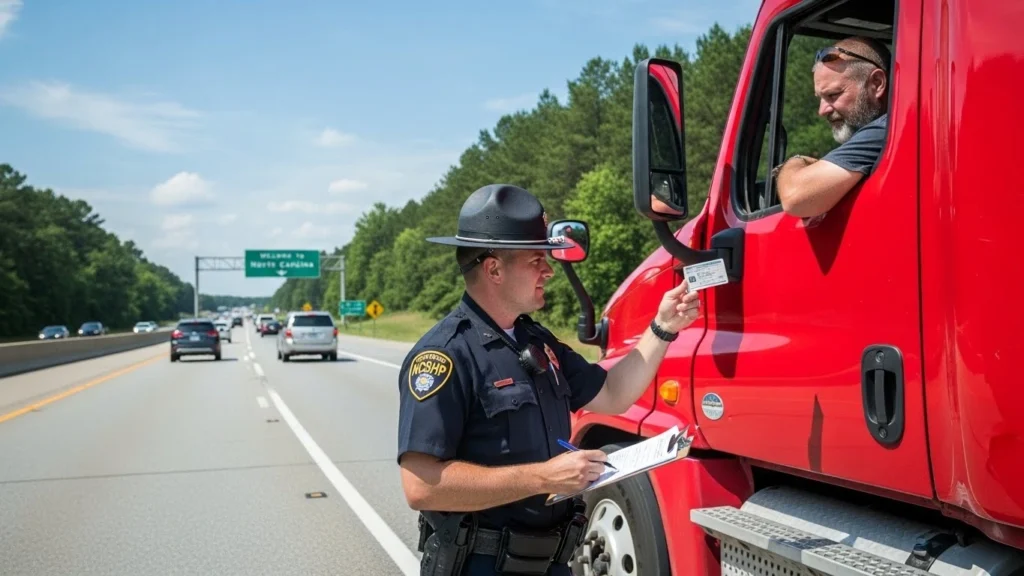
The U.S. Department of Transportation has found that nearly half of North Carolina’s commercial driver’s licenses were issued illegally, following a federal audit that uncovered major compliance failures. The findings directly affect truck drivers, fleets, and carriers—and raise urgent questions about road safety, enforcement, and the future of trucking operations.
The U.S. Department of Transportation (DOT) has released findings that are sending shockwaves across the trucking industry: nearly half of the non-domiciled Commercial Driver’s Licenses (CDLs) issued in North Carolina were granted illegally.
The conclusion comes from a federal audit conducted by the Federal Motor Carrier Safety Administration (FMCSA) as part of a nationwide review of how states manage commercial driver licensing systems.
According to the agency, 54 percent of the licenses reviewed failed to meet federal requirements. In many cases, licenses were issued to individuals whose lawful presence in the United States had already expired. In others, applicants were never eligible for a non-domiciled CDL in the first place. The audit also found that the state failed to properly verify immigration status before approving many of the licenses.
Federal officials made it clear that this is not a minor clerical problem. It is a systemic breakdown that directly affects road safety. If North Carolina does not revoke the improperly issued licenses and correct its processes, the state could lose nearly $50 million in federal transportation funding.
A national problem, not a one-state issue
While North Carolina is currently at the center of attention, it is not alone. The FMCSA audit is part of a broader federal initiative that has already uncovered similar failures in states such as California and Pennsylvania. This suggests the problem is structural, not isolated.
For the trucking industry, the implications are serious. CDL requirements exist for a reason: to ensure that drivers of heavy commercial vehicles meet minimum safety, training, and legal standards. When those rules are ignored, enforcement becomes inconsistent, competition becomes distorted, and safety risks increase.
When the system fails, everyone feels the impact.
What this means for fleets and carriers
For trucking companies, operating with drivers whose licenses could be revoked at any moment creates massive uncertainty. A federal compliance review can result in immediate operational disruptions, drivers being placed out of service, and trucks being sidelined.
Common consequences include:
Civil penalties and fines
Drivers removed from service without warning
Route cancellations and missed deliveries
Supply chain disruptions
Long-term damage to company reputation
If thousands of CDLs are revoked at once, carriers may suddenly find themselves short on qualified drivers, even if those drivers were working legally under state systems that failed to follow federal rules.
What this means for drivers
For truck drivers—especially those holding non-domiciled CDLs—this situation is deeply concerning. An invalid license is not just a paperwork issue. It can end a career overnight.
During roadside inspections, audits, or compliance checks, an invalid CDL may result in:
Immediate vehicle shutdown
Heavy fines
Being placed out of service
Job termination
Long-term disqualification from reapplying
That is why, today, simply “having a CDL” is no longer enough. That license must be legally valid, properly issued, and fully compliant with federal regulations.
What the DOT is demanding now
To avoid losing federal funding, North Carolina has been ordered to take immediate corrective action. According to the DOT, the state must:
Suspend the issuance of new non-domiciled CDLs
Identify every active license that does not meet federal standards
Revoke all improperly issued licenses
Reissue only those that can be brought into compliance
Conduct a full internal audit of its licensing system
These measures are meant to prevent future breakdowns—not just clean up past mistakes.

Language enforcement and new compliance priorities
At the same time, the federal government is tightening enforcement of English-language proficiency requirements for commercial drivers. Under new guidance, drivers who cannot demonstrate basic comprehension may be placed out of service.
This is not cosmetic. Understanding road signs, emergency instructions, inspection procedures, and official communications is essential for safety. The DOT says these rules will now be enforced more aggressively.
What fleets should do now
Given the direction of federal enforcement, fleets should not wait for problems to arise.
Key steps include:
Auditing all driver CDLs
Verifying federal compliance—not just state approval
Tracking expiration dates and documentation status
Keeping digital records accessible
Training HR and safety teams on compliance requirements
Monitoring federal and state regulatory updates
Proactive compliance is no longer optional—it is operationally critical.
What drivers should do now
Drivers should also take immediate steps to protect themselves:
Confirm that your CDL meets all federal requirements
Keep documentation up to date and accessible
Do not operate if your license status is uncertain
Stay informed about new federal rules
Ask questions before problems arise
A single compliance failure can sideline a driver indefinitely.
A turning point for the trucking industry
The DOT’s findings send a clear message: oversight is increasing, enforcement is tightening, and tolerance for noncompliance is shrinking.
For the trucking industry, this marks a shift. It is no longer enough to move freight efficiently. Carriers and drivers must now operate within a system that is more closely monitored, more strictly regulated, and far less forgiving.
Safety, legality, and transparency are no longer secondary concerns. They are becoming the foundation of how trucking will operate in the years ahead.

What Regulations Have Changed for Truck Drivers in the U.S. in 2026?
Learn about the new trucking regulations in the United States for 2026, upcoming FMCSA changes, and how they will affect drivers and trucking companies.

Apocalyptic-Looking Sky in Ontario Goes Viral Amid Wildfires
Wildfires swept across Ontario, Canada and smoke spread as far as the U.S. border.

The Biggest Match of the World Cup Was Played Off the Field
More than 453 metric tons of equipment, around 5,000 trucks and support vehicles, and simultaneous operations across 16 host cities kept the largest FIFA World Cup in history running.

DEF Act: 10 Years of Legal Protection for EPA Diesel Emissions Guidance
The Diesel Engine Flexibility (DEF) Act would protect agricultural and transportation businesses by building on the diesel emissions guidance by the EPA.

License Plate Readers Raise Privacy Concerns for Truck Drivers
Concerns are growing over the impact license plate readers could have on the privacy and security of truck drivers.

IMF Warns: The World Is Approaching an Energy Crisis
The IMF says the global oil market managed to absorb the initial shock of the Middle East conflict, but warns that the strategic reserves and commercial inventories used to prevent a supply crisis have been largely depleted.