rump assured reporters that not all the anticipated tariffs would be unveiled on April 2, adding that "many countries" could receive exemptions—though he did not elaborate.
U.S. President Donald Trump announced that tariffs targeting the auto industry are set to roll out soon, even as he suggested that not all of his proposed trade penalties will hit on April 2. He also indicated that certain countries might be granted exemptions—a signal of potential leniency that Wall Street interpreted as a calming sign after weeks of market turbulence.
In a simultaneous move escalating global trade tensions, Trump introduced a 25% secondary tariff on any nation purchasing oil or gas from Venezuela. This new directive immediately drove oil prices higher

“Many countries” could receive exemptions
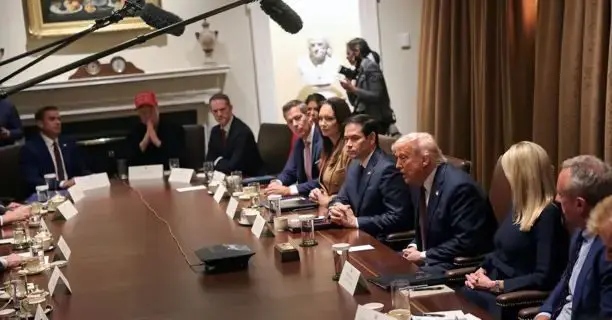
Speaking at the White House, Trump assured reporters that not all the anticipated tariffs would be unveiled on April 2, adding that “many countries” could receive exemptions—though he did not elaborate.
A White House official refused to confirm when specific tariffs on automobiles, pharmaceuticals, or semiconductor chips would take effect, stating those decisions remain “TBD (to be determined)” and at the president’s discretion. The official also warned against assuming too much leniency, emphasizing that Trump was committed to imposing tough reciprocal tariffs.
Earlier reports from Bloomberg and The Wall Street Journal indicated that the administration was reconsidering the breadth of the tariffs originally scheduled for April 2, possibly delaying certain sector-specific duties.
U.S. markets closed significantly higher , driven by hopes that the upcoming tariffs might not be as sweeping as initially feared.

Auto Tariffs Coming Soon, Followed by Other Sectors
Meanwhile, Trump confirmed that tariffs on automobiles, pharmaceuticals, and aluminum would be implemented “very soon,” justifying the move by claiming these industries are critical in times of war or crisis.
Auto tariffs are expected to be introduced within days, Trump added, with duties on lumber and semiconductor chips to follow in the near future.
“We’ve been taken advantage of by virtually every country,” Trump declared during a cabinet meeting, predicting that the expected tariffs would generate “rather astronomical” revenue for the U.S. government. He argued that this windfall could help maintain or reduce tax rates.
Reiterating his stance, Trump said nations could still avoid the new levies by either lowering their own tariffs or shifting manufacturing operations to the U.S. He also used the occasion to announce a major $21 billion investment in the U.S. by South Korea’s Hyundai Motor Group. This includes a $5.8 billion steel plant in Louisiana, unveiled during a White House event with Hyundai Chairman Euisun Chung and Louisiana Governor Jeff Landry.
‘Liberation Day’ for the U.S. Economy
Trump described the planned April 2 tariffs as a “Liberation Day” for the American economy, designed to help reduce the $1.2 trillion global goods trade deficit. The strategy is to match U.S. tariffs with those imposed by other countries while targeting non-tariff barriers.
In February, Trump signaled his intent to slap auto tariffs around 25%, alongside similar duties on semiconductor and pharmaceutical imports. However, following lobbying by the largest U.S. automakers, he agreed to postpone some of the auto-related penalties.
Since taking office, Trump’s aggressive tariff strategy has been marked by sudden announcements, changes, and delays. So far, his administration has enforced new 20% tariffs on Chinese goods, reinstated 25% duties on global steel and aluminum, and imposed 25% tariffs on Canadian and Mexican goods failing to meet U.S. trade agreement conditions related to the fentanyl crisis.
Targeting the ‘Dirty 15’ and Top Trade Surplus Nations
Two senior officials—Treasury Secretary Scott Bessent and White House Economic Adviser Kevin Hassett—recently confirmed that the focus for April 2 will likely be on countries with significant trade surpluses and tough trade barriers.
Bessent labeled the list the “Dirty 15,” while Hassett said they are concentrating on 10-15 countries.
Former senior Commerce Department official Ryan Majerus noted that whether sector-specific tariffs land on April 2 or later, the administration remains aggressive with trade investigations under Section 232, especially regarding lumber and copper.
“It’s clear that at least some countries will face new tariffs soon, although nations like the UK and India are lobbying hard for exceptions,” Majerus added.
Another White House source indicated that countries racing for early negotiations might struggle to secure exemptions, as non-tariff barriers are harder to dismantle quickly.
The U.S. Trade Representative’s office also issued a request for public feedback, focusing especially on the largest trading partners and those with the most substantial trade surpluses. Countries named include Argentina, Australia, Brazil, Canada, China, the European Union, India, Indonesia, Japan, South Korea, Malaysia, Mexico, Russia, Saudi Arabia, South Africa, Switzerland, Taiwan, Thailand, Turkey, the UK, and Vietnam—covering 88% of U.S. goods trade.
Venezuelan Oil Sanctions Add a New Layer
In a final blow, Trump announced a 25% secondary tariff on any country purchasing oil or gas from Venezuela, which will apply to any trade with the U.S. This measure also takes effect on April 2.
In a post on Truth Social, Trump accused Venezuela of sending “tens of thousands” of violent individuals to the U.S., justifying the new tariff as part of a broader national security effort.

Autonomous Trucks vs. Human Drivers: The Showdown Reshaping U.S. Trucking
The push to deploy driverless trucks without a human operator has reignited a national debate over safety, jobs, and regulation—drawing unions, tech companies, and federal lawmakers into a conflict that could redefine the future of U.S. freight transportation.

Trucking faces continued job losses as 2026 uncertainty looms
The U.S. trucking industry continues to lose jobs and reduce capacity, will this trend continue in 2026? The U.S. trucking industry continues to lose jobs

U.S. Allocates $1.5 Billion for Truck Road Infrastructure
The 2026 BUILD Grants program will invest $1.5 billion in truck road infrastructure across highways, ports, and truck parking facilities, with direct impact on logistics and freight transportation in the United States.

Wall Street Record: Transportation Stocks Boost Confidence in the Economy and Logistics
Transportation stocks in the United States have staged a strong rally so far in 2025, reflecting growing market confidence in the real economic activity behind logistics, freight movement, and mobility services more broadly.

The meaning of Hanukkah and how to celebrate it on the road
Hanukkah is a celebration of resilience and hope, and here are some ways you can take this on the road. December is one of the

Waymo under investigation for potential safety risk in school zones
A recent wave of videos has shown that some Waymo vehicles are not complying with safety regulations in school zones. The autonomous vehicle company Waymo,