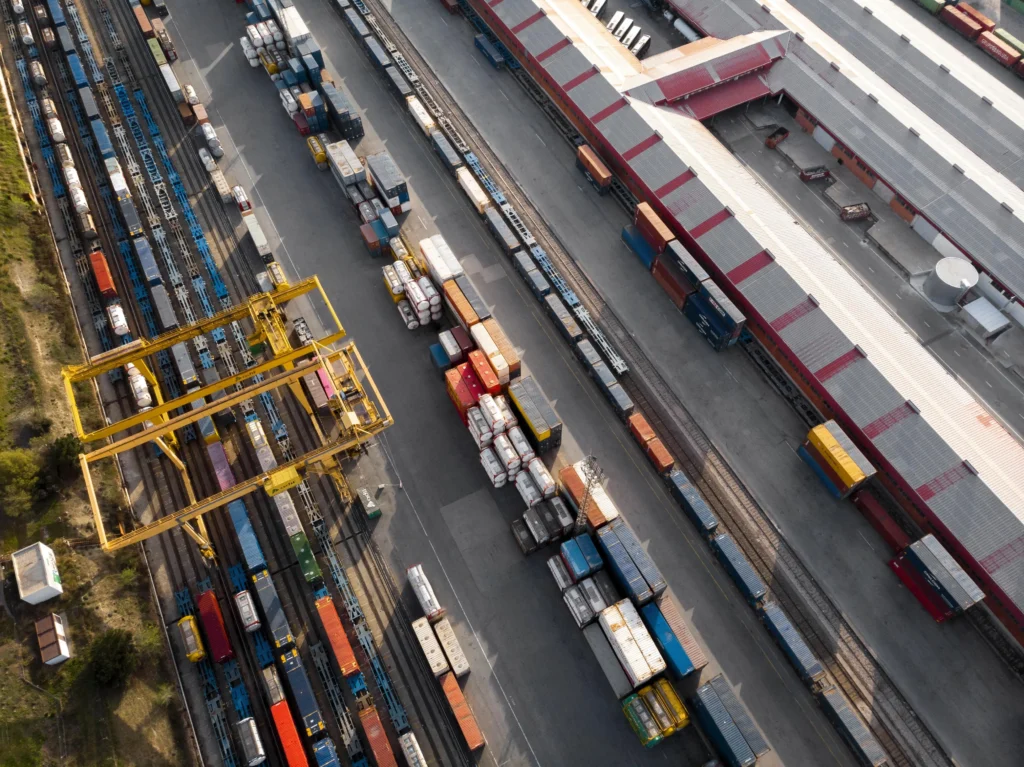
A report published by the Bureau of Transportation Statistics, reveals that North American cross-border freight transportation recorded an estimated decrease of 2.5%.
A report from the U.S. Department of Transportation, published by the Bureau of Transportation Statistics (BTS), reveals that North American cross-border freight transportation recorded an estimated decrease of 2.5% in August 2025 compared with the same month in 2024.
Through the TransBorder Freight program, the BTS provides detailed data on freight movement between the United States, Canada, and Mexico, which serve as the basis for research and studies in the field of transportation. The report, published on October 28, 2025, presents estimates for North American cross-border freight movement during August 2025.
Cross-border freight shows declines in august
In August 2025, the total estimated cross-border freight between the United States and its North American partners, Canada and Mexico, reached $133.4 billion, representing a 2.5% decrease compared with the same month in 2024.
Regarding trade between the United States and its partners, freight with Canada was estimated at $62.5 billion, reflecting a 0.7% decline from August of the previous year. Meanwhile, freight with Mexico totaled $70.9 billion, a 3.9% drop compared with the same period in 2024.
By mode of transportation, trucks moved approximately $86.4 billion in freight, showing a 4.7% year-over-year decrease. Railways carried about $16.4 billion, a 3.1% decline, while pipelines transported roughly $9.0 billion, a 0.9% decrease. Vessels moved around $9.4 billion, a 4.0% drop compared with August 2024.
The only mode of transport that recorded an increase was air freight, with a total of $4.9 billion in goods, representing a 4.9% rise from the same month last year.
Estimated total of cross-border freight by border and mode of transportation
The Bureau of Transportation Statistics (BTS) report on estimated cross-border freight by border and mode of transportation shows notable differences between the Canadian and Mexican borders. In Mexico, cross-border freight is primarily concentrated in trucking, with a total of $51.7 billion recorded in August, compared with $34.7 billion along the Canadian border.
Conversely, Canada shows greater strength in rail transportation, with an estimated $8.3 billion, compared with $8.1 billion recorded along the Mexican border. Similarly, air freight volumes are higher in Canada, totaling $2.9 billion, compared with $2.0 billion estimated for Mexico.
In terms of major crossing points, Detroit, Port Huron, and Buffalo stand out as the main truck ports for freight flows between the U.S. and Canada. In contrast, Laredo, El Paso, and Otay Mesa are the principal truck ports on the U.S.–Mexico border. For rail connections, the leading ports with Canada are Detroit, Port Huron, and International Falls, while with Mexico the main rail ports are Laredo, Eagle Pass, and El Paso.
The Bureau of Transportation Statistics clarifies that the figures presented in the report are estimates, as the primary data source for actual values is unavailable due to the expiration of budgetary allocations.

Human Trafficking: A Nationwide Call to Action on America’s Roads
Human trafficking is the focus of a nationwide awareness week aimed at educating truck drivers, motor carriers, law enforcement, and the public about human trafficking, how to spot the warning signs, and what to do if someone may be in danger.

TAA Compliance: When Safety Complaints Turn Into Six-Figure Losses
STAA compliance is no longer a technical detail for fleet owners—it is a financial, legal, and insurance exposure. A recent enforcement action in Texas shows how mishandling safety complaints can lead to termination claims, retaliation findings, and six-figure penalties, and what carriers must do to avoid becoming the next case

U.S. labor market raises red flags on Wall Street
The U.S. labor market closed 2025 with clear signs of weakening, as evidenced by the latest employment data released in December. In the latest episode

DOT finds half of North Carolina CDLs were issued illegally
The DOT warns that half of North Carolina’s CDL licenses are irregular after a federal audit uncovered serious compliance failures. The findings directly affect truckers, fleets, and transportation companies, raising urgent questions about road safety, legal operations, and the future of the trucking industry.

California’s Unhealthy Air: Impacts on Trucking and Freight
Unhealthy Air Quality in California: What Repeated Pollution Alerts Mean for Trucking and Freight Operations

Global Road Freight on Track to Hit USD 5 Trillion by 2033
Global Road Freight on Track to Hit USD 5 Trillion by 2033 as e-commerce growth, supply chain restructuring, and technology adoption accelerate demand for road-based cargo transport worldwide.
All content and original artwork, unless otherwise noted, is protected by copyright. Saint George uses certain images under license from various licensing vendors for this purpose. Any unauthorized commercial reproduction or distribution of copyrighted materials is prohibited.