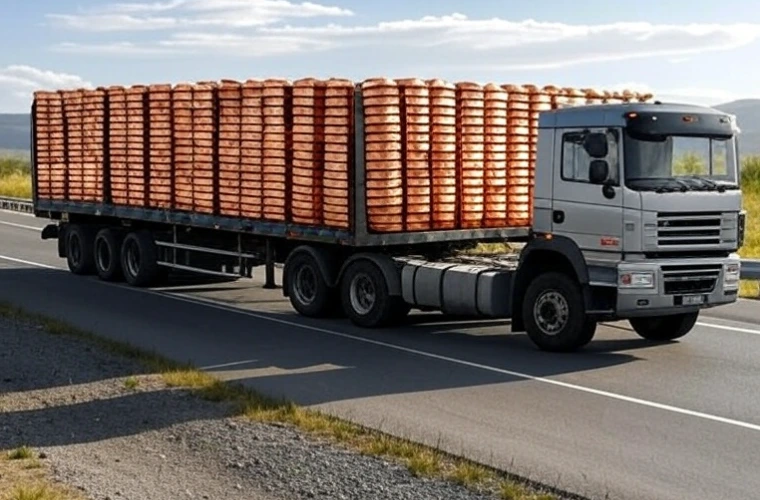
As copper prices soar and global demand increases, organized crime turns its eye to the supply chain.
Copper theft is surging across the United States, and it’s not just a matter of missing wires from construction sites. Today, the logistics industry is facing a sophisticated wave of cargo theft where copper—once a secondary concern—is now front and center. As the price of this industrial metal rises more than 35% in 2025 alone, copper has become a “hot metal” in more ways than one.
The Value of Copper: Why It’s a Prime Target
Copper is a foundational element across multiple industries, including:
Energy: It’s essential for electrical installations, solar panels, wind turbines, and lithium batteries.
Construction: Used in plumbing systems, roofing, and electrical wiring.
Technology and Transportation: A key component in electric vehicles, consumer electronics, and data centers.
With a single truckload of copper coils or cabling worth upwards of $100,000, the incentive for criminal groups is obvious. In fact, some carriers have reported losses of over $1 million in coordinated heists involving multiple shipments.
Modern Tactics: From Fake Drivers to Digital Hijacking
Copper theft has evolved far beyond cutting fences or smashing windows. According to The Wall Street Journal and industry watchdogs, new and more sophisticated schemes are emerging:
Carrier Impersonation: Criminals steal or buy real company credentials and present themselves as legitimate freight carriers.
Digital Manipulation: Using load boards like DAT and TruckStop, fraudsters intercept or reroute legitimate shipments with forged documents.
Ghost Pickups: Once assigned a load, these “phantom drivers” arrive with cloned IDs and DOT numbers to pick up the shipment—then vanish without a trace.
A notable case involved $135,000 in copper cable stolen from a manufacturing facility in Ohio. The perpetrators posed as a trusted carrier using a nearly identical DOT number and company name, bypassing routine checks and vanishing within hours.

How Logistics Companies Can Prevent Copper Theft
Strict Identity Verification
Before loading any valuable cargo, companies should:
Cross-check DOT and MC numbers using the FMCSA’s official portal.
Implement two-step or multi-factor validation for all load assignments.
Never rely solely on documents sent via email—call and confirm credentials through multiple channels.
GPS Tracking and Load Traceability
Hide GPS tracking devices within the cargo itself.
Monitor shipments in real-time from dispatch to final delivery.
Employ 24/7 security operations centers that can alert law enforcement the moment a route is compromised.
Staff Training and Protocols
Train dispatchers, warehouse workers, and drivers to identify red flags—such as mismatched email domains or sudden carrier changes.
Regularly review and update internal procedures for load assignment and verification.
Physical Security Along the Route
Strengthen on-site security at warehouses and loading points.
Use predetermined, secure rest stops and avoid high-theft areas.
Schedule deliveries during business hours—weekend or nighttime runs are more vulnerable.
Cargo Insurance: A New Baseline for Risk Mitigation
As copper theft becomes more prevalent, traditional cargo insurance policies may no longer provide adequate coverage. Logistics firms and shippers must ensure they:
Purchase policies that specifically cover non-ferrous metals such as copper or aluminum.
Include protection against fraud, digital deception, and indirect theft.
Confirm that the insurance extends throughout the entire transport chain, including any intermodal transfers.
Put simply, the right policy can be the difference between catastrophic loss and full recovery.
An Emerging Crisis for U.S. Road Logistics
The rise of copper as a strategic commodity has created a new risk frontier for the U.S. trucking and logistics sector. With record-high prices and a global appetite driven by renewable energy and electric mobility, copper is no longer just another cargo—it’s a magnet for organized crime.
In this context, proactive prevention, rigorous verification, real-time monitoring, and robust insurance are not optional—they’re operational imperatives. Because in today’s digital transport era, the job isn’t just getting the load to its destination… it’s making sure it arrives intact.

Teton Pass bridge will be closed to traffic for 10 days
Teton Pass is one of the most heavily traveled routes for truck drivers in Wyoming, serving as a vital corridor for the trucking industry. The

Terrifying Experiences of Truck Drivers Sleeping on the Road at Night

Cargo theft numbers drop for the third quarter of 2025
The cargo theft tracking company Verisk CargoNet released its report for the third quarter of 2025. The cargo theft tracking company Verisk CargoNet released its

40 major U.S. airports to see flight reductions due to government shutdown
40 U.S. airports, including those in New York, Los Angeles, and Chicago, will see flight reductions starting November 7 due to the government shutdown. 40

DOT Medical Card: Keeping Medical Certification Up to Date
Keeping your DOT Medical Card current is essential for both drivers and fleet operations.
Brake Safety Week 2025 results: almost 85% of commercial vehicles had no violations
Results of Brake Safety Week, organized jointly by the Commercial Vehicle Safety Alliance (CVSA) and the Department of Transportation, have been published. Results of Brake