 Hable con un agente al (888) 572-7520
  Enviar mensaje a un agente

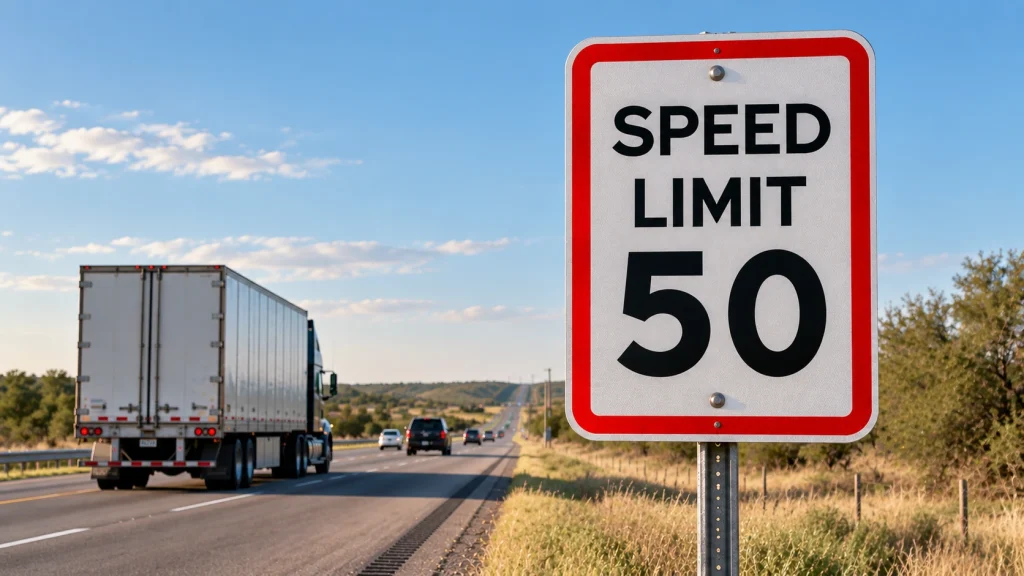

For truckers traveling across Texas, a new type of road sign deserves special attention. Traditional white speed limit signs are appearing in certain locations with a reflective red border, a tool used to make speed reductions much more visible.
The measure is particularly important for drivers with a Commercial Driver’s License (CDL). A speeding violation can have consequences that go far beyond the initial cost of the ticket: it can affect your driving record, increase insurance-related costs and, in more serious or repeated cases, put your commercial driver’s license at risk.
What Does the Red Border Mean?
It is not simply decoration. The red border serves as a visual enhancement designed to get the driver’s attention at locations where a lower speed limit begins, especially in areas with speeding problems.
The difference from other signs is important.
Yellow reduced speed limit ahead signs warn drivers that they will need to slow down farther ahead. By contrast, when you reach the white speed limit sign with the red border, the new speed limit begins at that point.
For a heavy truck, anticipating that reduction is even more important because of the distance required to slow down. The goal is for the vehicle to already be traveling within the posted limit by the time it reaches the sign.
Although these signs are attracting particular attention in 2026, the concept is more than two decades old. In 2003, TxDOT requested authorization from the Federal Highway Administration (FHWA) to experiment with a three-inch reflective border around speed limit signs and study whether greater visibility improved compliance with posted limits.
But this year, the state began new installations along its roads. One example was U.S. Highway 87, near Wall, Texas, where the signs were installed in May along a section where the speed limit is reduced.
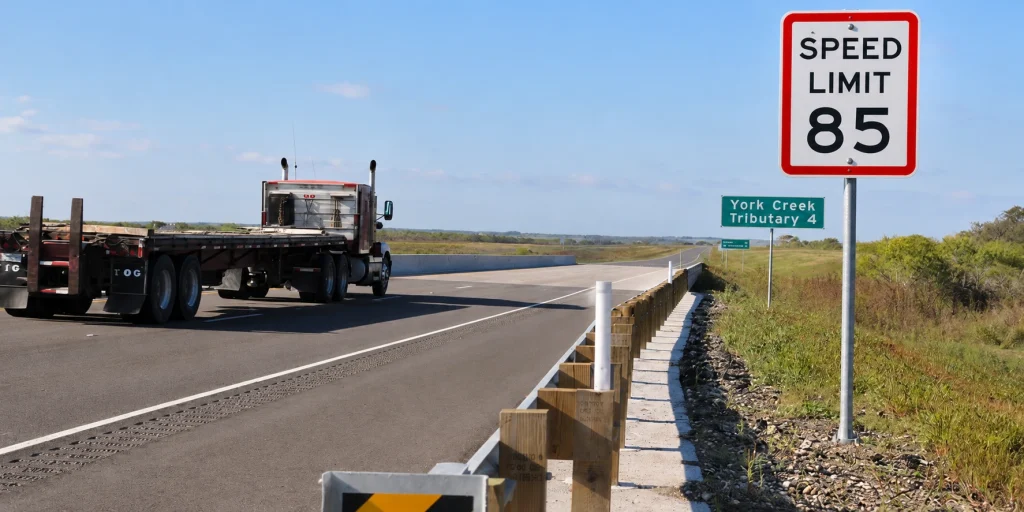
Texas speed limit
Why It Is Especially Important for Your CDL
For a commercial driver, getting a speeding ticket can have serious professional consequences.
One of the most important points is the so-called 15 mph rule. According to the Federal Motor Carrier Safety Administration (FMCSA), driving 15 mph or more above the speed limit constitutes a serious traffic violation for CDL purposes.
Accumulating these violations can result in disqualification: two serious violations within three years can mean a 60-day CDL disqualification; three within that period can increase the disqualification to 120 days.
There is another detail every commercial driver should know: certain serious violations can also count when they occur while the CDL holder is driving a personal vehicle, not only when behind the wheel of a truck.
For someone whose income depends directly on being able to drive commercially, losing a CDL for two or four months can have a financial impact far greater than the original ticket.
The Real Cost Can Far Exceed the Fine
The cost of a speeding ticket in Texas depends on factors such as the jurisdiction and how many miles per hour the driver was traveling above the limit. Available estimates place many fines at approximately $180 to $350, although the final amount can vary considerably.
But for a trucker, looking only at the price of the ticket can hide the real cost.
A violation becomes part of the driving record and can influence decisions made by employers and insurers. For an owner-operator, an increase in the cost of commercial insurance can last for years. For a company driver, a record with speeding violations can make it harder to stay with a fleet or find future job opportunities.
That is why a speed reduction sign that another driver might overlook represents a much greater professional risk for someone who depends on a CDL.
The Worst-Case Scenario: Work Zones
Work zones require even greater caution.
When workers are present, Texas provides for increased financial penalties for certain violations committed in construction zones. In these cases, fines can be doubled, making a speeding violation considerably more expensive.
For a trucker, a work zone also brings several risk factors together at the same time: reduced speed limits, lane shifts, narrower spaces, workers near the roadway and a much longer stopping distance than a passenger vehicle.
That is why any sign warning of an upcoming speed reduction deserves special attention.
What to Do When You See the Red Border
The best defense starts before you reach the sign. When a REDUCED SPEED LIMIT AHEAD sign appears, truckers should prepare for the reduction and gradually slow down. Waiting until you are directly in front of the red-bordered sign may be too late, especially with a loaded truck.
Drivers should also be especially alert when leaving high-speed corridors and entering towns, developed areas, work zones or other locations where the speed limit can drop quickly.
And if you receive a citation, the potential consequences for your CDL make it worth carefully evaluating your options before simply paying it. Paying a ticket can amount to accepting the violation, so a commercial driver may consider seeking legal advice from an attorney experienced in CDL matters, depending on the circumstances of the case.
The new signs are specifically intended to make speed reductions impossible to ignore. For truckers, paying attention to them has an added value: slowing down in time can do more than prevent a ticket. It can protect your CDL, your driving record and, ultimately, the tool that allows you to keep working.
 Business hours: Monday to Friday from 8:00 AM to 5:00 PM. California time