 Hable con un agente al (888) 572-7520
  Enviar mensaje a un agente

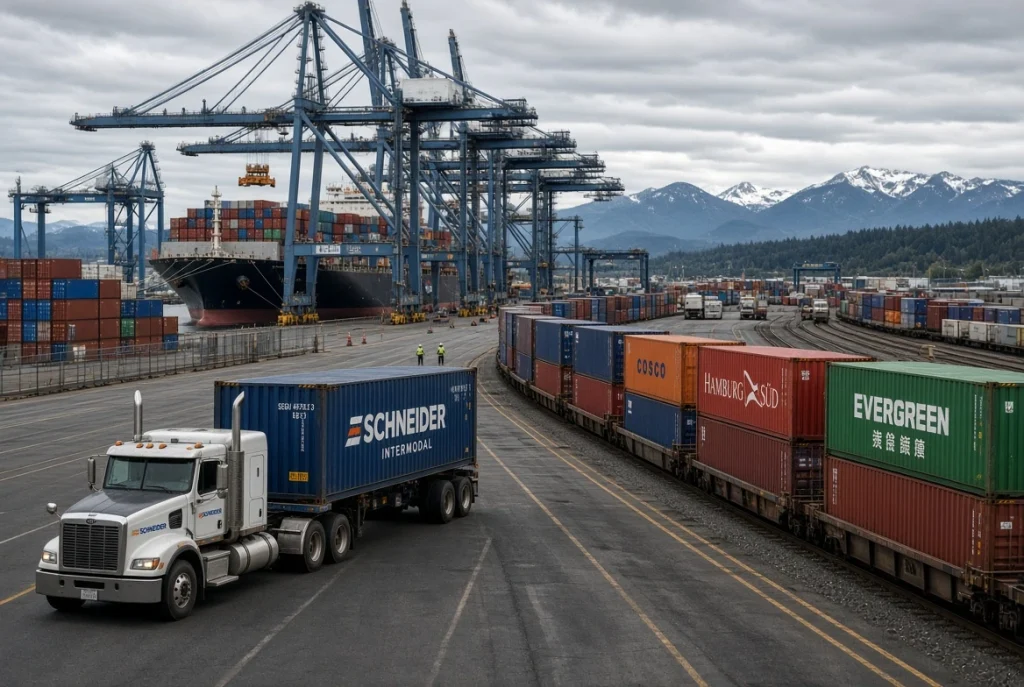

Intermodal transport in Washington is advancing in 2026 with two concrete developments that reduce reliance on trucks for long hauls: the Tri-Cities Inland Logistics Hub, formalized on February 5, 2026 through an interlocal agreement between the Northwest Seaport Alliance (NWSA) and the ports of Benton, Pasco, and Walla Walla, and the Tri-Cities Intermodal facility in Wallula, which by mid-2026 was already processing about 100 container lifts a week, with capacity for 60,000 a year.
Both projects share the same goal: moving agricultural and export cargo from eastern Washington to the ports of Seattle and Tacoma by rail instead of truck, reducing the heavy traffic that currently crosses Snoqualmie Pass.
What Intermodal Transport Is, and Why Washington Is Expanding It Inland
Intermodal transport combines ship, rail, and truck to move a single shipment without handling it at each stage. For years, this system in Washington was concentrated almost entirely in the Seattle-Tacoma port area. What changed in 2026 is the extension of that network into the state’s interior, with new rail terminals in eastern Washington that let agricultural producers and businesses in the eastern part of the state load their cargo onto a train without a truck having to haul it hundreds of miles to the coast.
According to the Northwest Seaport Alliance (NWSA) — the partnership that jointly operates marine cargo for the ports of Seattle and Tacoma — this expansion is part of its Inland Rail Hub Strategic Initiative, which already has precedent in other states, such as a terminal in Minot, North Dakota, that in its first three years of operation moved 74 full unit trains and, according to the NWSA itself, saved more than 10 million truck miles.
The Tri-Cities Inland Logistics Hub: The Newest Push
The most significant 2026 development is the interlocal agreement signed on February 5 between the NWSA and the ports of Benton, Pasco, and Walla Walla to develop an Inland Logistics Hub in the Tri-Cities region of southeastern Washington. According to the Port of Pasco’s own announcement, the project will leverage already-available industrial-zoned land and direct access to Class I railroad lines — BNSF and Union Pacific — with direct connections to the coastal ports.
Beyond intermodal transfer itself, the hub includes plans for warehousing and distribution facilities, plus barge access via the Columbia-Snake River system. According to data from the U.S. Trade Representative (USTR) cited by FreightWaves, the Tri-Cities region generated more than $796 million in goods exports in 2023, mainly processed foods, fruits, and vegetables, along with contributions from the technology and manufacturing sectors — the economic base this new hub aims to connect more efficiently to international markets.
Tri-Cities Intermodal in Wallula: From Pilot Project to Running Operation
Before this interlocal agreement, a concrete precedent already existed: Tri-Cities Intermodal, a private terminal located at the Dodd Road Industrial Park in Wallula, near Pasco, which launched operations with a first shipment of roughly 300 tons of hay in 2024. According to the Tri-Cities Area Journal of Business, by mid-2026 the terminal was already processing about 100 container lifts a week, with installed capacity for 60,000 lifts a year and room to keep growing. The facility has rail connections west to the NWSA’s Seattle and Tacoma ports, and east to Chicago.
The first loaded train to leave this terminal arrived at the Pierce County Terminal in Tacoma on February 8 of that year, carrying baled hay bound for China, which set sail days later aboard the vessel Ever Lucid — the first documented case of an eastern Washington agricultural export leaving via intermodal rail toward an Asian market through the Seattle-Tacoma gateway.
A Second Rail Link in Pasco: The Savage/Cando Connection
Alongside the Inland Logistics Hub, the Port of Pasco moved forward in 2026 with a separate agreement with rail company Savage/Cando, which will invest $175,000 to rehabilitate part of the rail line it plans to use. As Port Commissioner Matt Watkins explained to the Tri-Cities Area Journal of Business, this new connection represents “a significant increase” in the port’s operating capacity, and serves the same strategic goal as the region’s other initiatives: helping agricultural producers and other Mid-Columbia businesses reach international markets without relying exclusively on trucks, while also reducing dependence on the heavy traffic that currently crosses Snoqualmie Pass.
The Port Infrastructure Underpinning the Whole System
On the coastal side, the NWSA continues investing in the infrastructure that receives all this additional cargo coming from the interior. According to the alliance’s official figures, in 2025 the NWSA moved a total of 3,156,598 TEUs (twenty-foot equivalent units), of which 2,418,534 were international traffic and 738,064 were domestic traffic, mostly bound for Alaska, in addition to 327,574 metric tons of general (breakbulk) cargo and 470,906 vehicles handled during the year. The alliance is also continuing upgrades at Terminal 5 and expanding its refrigerated cargo capacity, according to the trade publication AJOT.
Why This Matters for Washington Beyond Logistics
Beyond the direct commercial benefit, the project’s own backers point to an environmental and traffic-congestion benefit: every ton of cargo shifted from truck to rail on its way from the state’s interior to the port is one less ton traveling by truck through mountain corridors like I-90 at Snoqualmie Pass — one of the highest-risk, most congested routes for freight transport in Washington. The NWSA itself notes that expanding its inland rail partners aims to “reduce truck traffic and the environmental impact of diesel particulate matter” near its ports.
Frequently Asked Questions
What is the Tri-Cities Inland Logistics Hub? It’s an inland logistics center agreed to on February 5, 2026 between the Northwest Seaport Alliance and the ports of Benton, Pasco, and Walla Walla, which will combine intermodal transfer, warehousing, distribution, and barge access via the Columbia-Snake River system.
What is Tri-Cities Intermodal? It’s a private rail terminal in Wallula, near Pasco, that connects eastern Washington by rail to the ports of Seattle and Tacoma to the west and to Chicago to the east. By mid-2026 it was processing about 100 container lifts a week.
How does intermodal transport benefit truck routes in Washington? By moving agricultural and export cargo by rail instead of truck, it reduces heavy traffic on mountain corridors like I-90 at Snoqualmie Pass, one of the state’s highest-risk and most congested stretches.
How much cargo did the Northwest Seaport Alliance move in 2025? 3,156,598 TEUs in total, combining international and domestic traffic, plus more than 327,000 tons of general cargo and nearly 471,000 vehicles.
 Business hours: Monday to Friday from 8:00 AM to 5:00 PM. California time