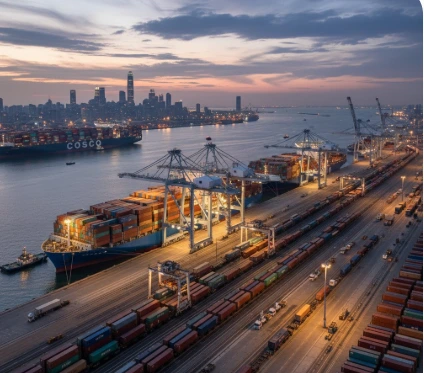
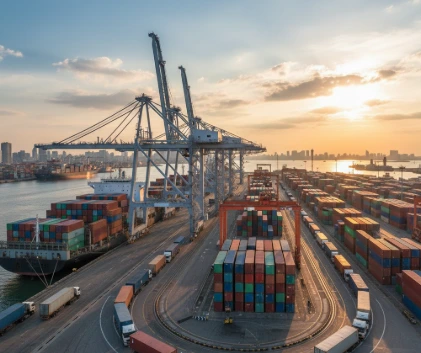
Intermodal transportation is entering a decade of rapid worldwide expansion, driven by growing demand for logistics efficiency, mounting cost pressures, and the global shift toward more sustainable freight systems.
Intermodal transportation is entering a decade of rapid worldwide expansion, driven by growing demand for logistics efficiency, mounting cost pressures, and the global shift toward more sustainable freight systems. According to the report Intermodal Freight Transportation Market Forecast and Outlook 2025–2035, published by the international market intelligence firm Fact.MR, the sector is expected to reach USD 166.2 billion by 2035, nearly 3.1 times the estimated USD 54 billion in 2025. The projected 11.9% CAGR is unusually high for a traditionally conservative and asset-intensive industry such as freight logistics.
While the report highlights strong growth across emerging markets in Asia and Latin America, the United States stands out as one of the most influential engines behind global expansion. With a projected 12.2% CAGR through 2035, the U.S. is solidifying its position as one of the industry’s strategic hubs—supported by advanced rail infrastructure, high-volume cross-border trade corridors, and the rapid digitalization of its supply chain.

A Global Market in Transformation
Fact.MR’s analysis shows that intermodal transportation is undergoing a structural shift. Supply chains are moving away from single-mode transport models and migrating toward integrated multimodal networks that combine trucking, rail, inland waterways, and maritime transport. This transition is fueled by three core pressures:
• Lowering logistics costs in an inflationary environment.
• Improving reliability and achieving more predictable transit times, particularly for e-commerce, automotive supply chains, and agricultural products.
• Meeting environmental targets by increasing reliance on lower-emission modes such as rail.
The report notes that Asia-Pacific will lead global growth. India tops the projections with a 14.3% annual expansion, supported by industrial corridors and major rail modernization projects. China follows closely, with 13.1% growth driven by the Belt and Road Initiative, port automation, and booming e-commerce activity.
Europe also maintains a strong position. Germany is expected to lead the region by 2035 thanks to its highly integrated rail network, modern intermodal terminals, and consistently high operational efficiency—reaching a projected 12% CAGR.
United States: A Pillar of Global Intermodal Growth
While Asia is setting the pace for infrastructure investment, Fact.MR identifies the United States as a central pillar of the global intermodal market. The country’s market value is projected to grow from USD 13.8 billion in 2025 to USD 42.8 billion by 2035, propelled by four key drivers:
1. Surging Cross-Border Trade With Mexico and Canada
Under the USMCA framework, industrial flows among the three countries are reaching historic levels. Mexico’s nearshoring boom—combined with a resurgence in U.S. manufacturing—is fueling sustained demand for intermodal transportation, particularly along corridors such as Texas–Midwest, California–Mexico, and Great Lakes–Ontario.
2. Highly Competitive Rail Infrastructure
The United States operates one of the most extensive and efficient freight rail systems in the world, featuring:
widespread double-stack rail capability,
digitized and automated intermodal terminals,
and major operators like J.B. Hunt, FedEx Logistics, XPO Logistics, and C.H. Robinson, all cited by Fact.MR as dominant global players.
The road–rail segment, which will account for 45.8% of the global market in 2025, finds one of its strongest bases in the U.S., thanks to the long-distance efficiency of freight rail.
3. Rapid Digitalization Across the Supply Chain
Real-time visibility platforms, IoT devices, integrated tracking, and predictive analytics are transforming operations. According to Fact.MR, the U.S. leads the global adoption of automated systems in intermodal terminals—reducing dwell times, improving dispatch accuracy, and cutting operational costs.
4. Increasing Strain on the Trucking Sector
Driver shortages, rising fuel costs, and congestion along major highways such as I-5, I-10, and I-95 are pushing shippers toward rail-based intermodal alternatives. As a result, U.S. intermodal container volumes are growing at an annual rate of nearly 18%, particularly in retail, food distribution, and automotive supply chains.
Global Competition and an Industry in Reconfiguration
Fact.MR’s report shows a market composed of 30 to 50 significant players, where the top three—Oracle, C.H. Robinson, and DB Schenker—control between 25% and 30% of global share. Competition no longer revolves solely around pricing; reliability, network coverage, and technological capability are now decisive.
Another clear trend is the rise of the transportation & warehousing segment, projected to represent 35.6% of the market in 2025. Growth in this segment is driven by logistics outsourcing, warehouse automation, and the increasingly seamless integration between storage and multimodal transportation.
The U.S. Reinforces Its Strategic Weight in a Market Set to Triple
As global logistics face mounting pressures related to cost, speed, and sustainability, intermodal transportation is becoming essential for economic competitiveness. The Fact.MR report underscores that while Asia will drive much of the global expansion, the United States will remain one of the core pillars of worldwide intermodal growth—thanks to its infrastructure, commercial volume, and rapid technological adoption.
By 2035, the U.S. will not only maintain its leadership but will play a decisive role in shaping the evolution of the global intermodal market—an industry set to triple in size and fundamentally transform how freight moves across the world.
Truck driver: stop choosing the worst route

Amulets, faith, and fortune: how truck drivers seek protection around the world
From saints to herbs, truck drivers carry amulets on every trip that, according to their beliefs, protect them in the harsh life of road transport.

Is It Worth Being a Truck Driver in the U.S. in 2026?
Becoming a truck driver in the United States means access to competitive pay and strong labor demand, but it also requires accepting time away from family, physical strain, and a lifestyle that isn’t for everyone.

Operation SafeDrive: Nearly 2,000 Truckers and Vehicles Taken Out of Service in Three Days
Operation SafeDRIVE triggered thousands of inspections across 26 states and Washington, D.C., leading to disqualified drivers, sidelined equipment, and arrests while reinforcing a stricter enforcement environment for the trucking industry.

Super Bowl LX: The Logistics Behind the Patriots–Seahawks Showdown
Super Bowl LX, featuring the New England Patriots and the Seattle Seahawks, is far more than the NFL’s championship game. It involves one of the most complex logistics operations in the world, with hundreds of trucks, ultra-precise technical production, layered security controls, and an industrial-scale deployment that turns Levi’s Stadium into a temporary city for 72 hours.

Job cuts surge in January, weighing on transportation
January saw one of the largest waves of job cuts since 2009 across multiple sectors in the United States. January saw one of the largest

Federal Reserve: rates remain unchanged with caution amid a solid economy
The United States Federal Reserve decided to keep interest rates unchanged, in line with market expectations. In the latest episode of the Mercado Sobre Ruedas