The transportation industry prepares for a new presidency that promises to radically transform some U.S. policies.
The new era of Donald Trump began on January 20, when he took office as the 47th President of the United States. After signing multiple executive orders, changes in the country have begun to take shape. This presidency promises to radically transform the nation’s energy and environmental policies, with profound implications for oil production, the expansion of offshore wind energy, and electric vehicle policies—topics that will have a significant impact on the transportation industry.
The first change in the transportation industry took place on November 18, 2024, when Trump appointed former Republican representative from Wisconsin, Sean Duffy, as Secretary of Transportation, responsible for leading the U.S. Department of Transportation (DOT). Duffy, who served nearly nine years in the House of Representatives, was a member of the Financial Services Committee and chairman of the Subcommittee on Insurance and Housing. He is also a former reality TV star and Fox News personality and was one of Trump’s most visible supporters on cable news.
In his appointment, Trump stated that Duffy would leverage his experience and the relationships he has built in Congress over the years to maintain and rebuild U.S. infrastructure, initiating what he called the “Golden Age” of travel. The goals focus on improving safety, efficiency, and innovation, enhancing the travel experience for all citizens of the country.

A New Era in the U.S. Automotive Industry
In his inaugural speech, President Donald Trump made clear his commitment to roll back federal regulations related to vehicle emissions. He emphasized that he would end the Green New Deal and undo electric vehicle mandates in order to preserve the U.S. automotive industry. He also stated that car production in the U.S. would return at an exceptional pace.
Trump’s executive order promises to eliminate the electric vehicle (EV) mandate and promote true consumer choice by removing regulatory barriers to motor vehicle access. He also committed to ending state emission exemptions that limit gasoline car sales and considering the removal of subsidies and market distortions that favor EVs, arguing that these policies force the purchase of electric vehicles.
Additionally, the order suggests that Trump will attempt to repeal the $7,500 tax credit for electric vehicles, which was approved by Congress as part of Biden’s 2022 climate law, and reverse EPA regulations on emissions. He also promised to eliminate a federal exemption that allows California and other states to phase out gasoline car sales by 2035, prompting changes in several states that follow California’s vehicle emission standards.

Back to natural gas
Another change is that the hydrogen economy in the U.S. will likely rely more on natural gas and carbon capture technologies than on green energy.
Blue hydrogen is expected to grow significantly, with a capacity of 377,000 tons in operation by the end of 2025, compared to 78,000 tons in 2024. Although it is unlikely that tax credits for green hydrogen will be eliminated, analysts suggest that projects will not receive immediate responses. Additionally, the global hydrogen sector could face difficulties this year, with the possibility of project cancellations and weak demand, leading to consolidation in the industry.

Tariffs to Mexico and Canada: a potential supply chain change
In his statements, President Donald Trump announced plans to impose a 25% tariff on Canada and Mexico starting on February 1. Although he had threatened tariffs of up to 60% on China during his campaign, he moderated his plans following a call with President Xi Jinping, stating that nothing was yet finalized and that discussions between the two leaders would continue.
Trump hopes that his executive measures will reduce energy prices and control inflation, believing that tariffs will strengthen the economy rather than raise prices for consumers. In his inaugural speech, he promised to impose tariffs and claimed that foreign countries would bear the trade penalties, even though these costs are usually absorbed by domestic importers and passed on to consumers. This is undoubtedly a decision that leaves the transportation industry uncertain.

While Trump’s previous policies in the road transportation sector were considered beneficial, the new changes bring uncertainty to the industry. This is primarily due to the fact that many regulations adopted by various companies will no longer be in effect. However, only time will tell what the future holds for the sector under Trump’s new term.

What Truck Drivers Love Most About Their Job
Truck driving isn’t just a job; for many, it’s a calling that offers a unique blend of freedom, adventure, and independence. By Bob Dilliplaine, Industry
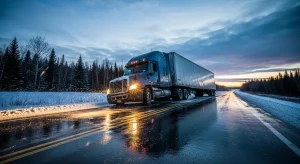
Frozen Roads After Bomb Cyclone: Black Ice, Record Snow and High Risk for Trucks
Frozen roads continue to disrupt freight transportation following the impact of a powerful bomb cyclone, leaving behind black ice, highway shutdowns, power outages, and dangerous winter driving conditions stretching from the Gulf Coast to New England.

Lunar New Year 2026: Ancient Traditions, Renewed Energy, and Massive Celebrations
Lunar New Year 2026 begins on February 17 under the sign of the Fire Horse and is marked by spiritual rituals, family reunions, and large-scale celebrations in both China and the United States, especially in California.

Freedom 250 Grand Prix: How Logistics and Transportation Will Power the Race in Washington
The first-ever IndyCar street race in Washington, D.C., scheduled for August 21–23, will headline the United States’ 250th anniversary celebrations — and it will trigger a massive transportation, freight, and urban logistics operation behind the scenes.

Groundhog Day: What It Means for Trucking When “Phil Sees His Shadow”
The forecast from America’s most famous groundhog is calling for more winter — and that’s an important signal for the trucking industry and cold-season route planning

Love on the open road: the best dating apps for truckers
If you’re looking for someone to go the long haul with, here are the best dating apps for truck drivers. They say love is everywhere…