Llame al (888) 572-7520 para hablar con un agente

With over 13.5 million heavy trucks and a logistics culture built on speed and flexibility, the U.S. is unmatched in the volume and scale of road freight transport.

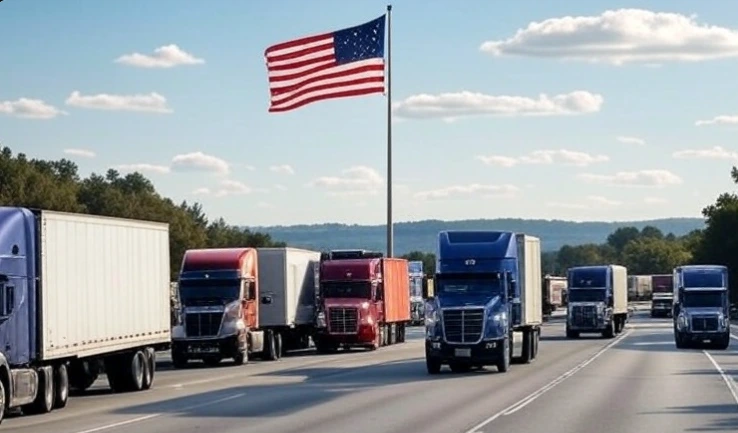
In the global logistics arena, trucks are the unsung heroes of ground commerce. They carry everything from food, medicine, and construction materials to cars, furniture, and even aircraft components. They are the engines behind modern economies. And if one country embodies this reality to its fullest, it’s the United States.

With a road network exceeding 4.2 million miles, a fleet of over 13.5 million commercial trucks, and a staggering annual freight volume of around 5.2 trillion ton-miles, the U.S. is, without question, the global leader in truck traffic.

A Fleet That Powers an Economy

The scale of American road freight transport is unmatched. According to the U.S. Department of Transportation (DOT) and the American Trucking Associations (ATA), nearly 72% of all domestic freight is moved by truck. That adds up to more than 10 billion tons of cargo annually. In fact, it’s estimated that 9 out of every 10 products on store shelves have, at some point, been delivered by a truck.

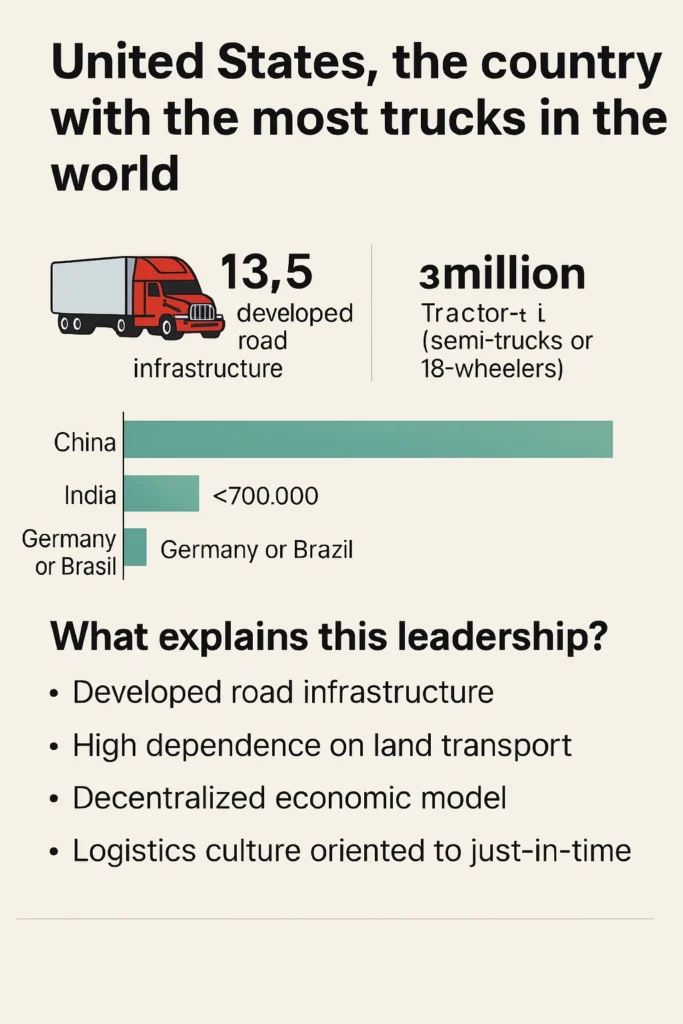
The country maintains an active fleet of 13.5 million heavy vehicles, including approximately 3 million tractor-trailers (semi-trucks or 18-wheelers). That figure vastly outpaces China (around 4.8 million), India (fewer than 700,000), and logistics powerhouses like Germany or Brazil.

What Drives U.S. Trucking Dominance?

Several core factors help explain why the United States leads the world in road freight:

  • Highly Developed Road Infrastructure
    The U.S. boasts one of the most expansive and well-maintained highway systems on Earth, including the Interstate Highway System, a cornerstone of long-distance freight movement.

  • Heavy Reliance on Road Transport
    Unlike regions such as Europe, where rail and river networks play a major logistics role, the U.S. overwhelmingly depends on trucks—even for long-haul freight.

  • Decentralized Economic Geography
    With industrial hubs, ports, logistics centers, and consumer markets spread across a vast geography, the U.S. sees constant inter-regional truck movement.

  • Just-in-Time Logistics Culture
    Many American industries operate with minimal on-site inventory, relying on fast, flexible truck deliveries to keep shelves stocked and production lines running.

Beyond Volume: Economic and Social Impact

The U.S. trucking sector doesn’t just dominate in scale—it’s a critical employer and economic driver. There are over 3.5 million professional truck drivers on the road, and the industry generates more than $800 billion annually.

Moreover, trucking is often viewed as a barometer of economic health: a drop in trucking activity can signal a broader economic slowdown. In recent years, the industry has faced serious challenges, including driver shortages, volatile fuel prices, and the rise of automation in fleet operations.

Global Comparisons

European countries like Germany and France report impressive freight volumes—Germany alone moves over 3 billion metric tons annually by road—but these operate over shorter distances and benefit from integrated rail and inland shipping alternatives.

China has seen explosive growth in truck usage, but its national fleet and logistics infrastructure still lag behind the U.S. in overall efficiency, road quality, and long-haul coordination. Meanwhile, Latin American countries such as Brazil and Mexico have vibrant road freight systems but are often constrained by poor road conditions, safety issues, and high operational costs.

Looking Ahead: Sustainability and Smart Logistics

Despite its dominance, U.S. trucking faces mounting pressure to evolve. Environmental concerns are driving innovation in electric and hydrogen trucks, while new emissions regulations aim to reduce the sector’s carbon footprint.

At the same time, automation and AI-based fleet management systems are poised to revolutionize the industry. Self-driving trucks, platooning technologies, and real-time logistics analytics could dramatically reshape how goods are moved across America.


The United States isn’t just the country with the most trucks—it has built an entire economic and logistical model around the power of road freight. While other nations explore multimodal strategies, America continues to double down on its road infrastructure, upgrading and adapting it for the future.

And though the challenges are many—environmental, technological, and workforce-related—the data is clear: the U.S. will remain, for the foreseeable future, the global giant of over-the-road transportation.

Facebook
Twitter
LinkedIn

ATRI Warns: Litigation Is Rising Across the U.S. Trucking Industry

A new report from the American Transportation Research Institute (ATRI) reveals how escalating litigation, higher legal costs, and mounting insurance pressures are reshaping the U.S. trucking industry. The findings mark a critical moment for motor carriers, insurers, and logistics stakeholders who must understand the changing legal environment — and the increasingly strategic role of strong insurance partnerships.

Read More »

Leave a Reply

Your email address will not be published. Required fields are marked *

Business hours: Monday to Friday from 8:00 AM to 5:00 PM. California time
Leave your number and a member of our company will contact you
Horario de atención: Lunes a viernes de 8.00 AM a 5.00 PM. Hora california

Deje su número y un miembro de nuestra empresa se pondrá en contacto con usted

Privacy summary

This website uses cookies so that we can offer you the best possible user experience. Cookie information is stored in your browser and performs functions such as recognizing you when you return to our website or helping our team understand which sections of the website you find most interesting and useful.

More information about the privacy policy: Privacy Policy

More information about the terms of use: Terms of use 

More information about the disclaimer: Disclaimer 

More information on acceptable use policies: Acceptable Use Policies