Convoys of advanced HEMTT and PLS military trucks carried armored vehicles, prefabricated base structures, mobile workshops and heavy equipment during the U.S. withdrawal from northeastern Syria — demonstrating the unmatched capabilities of modern military transport.
The withdrawal of U.S. forces from northeastern Syria after more than a decade of operations was not only a geopolitical event — it was also one of the most impressive heavy-transport logistics operations seen in recent years. The evacuation relied heavily on large ground convoys made up of some of the most capable military trucks in the world, vehicles designed to move entire bases across hostile terrain.
The trucks involved in the operation were far from ordinary transport vehicles. They were high-capacity military platforms built to move extreme loads under extreme conditions, from desert terrain and damaged roads to long-distance supply routes across conflict zones.
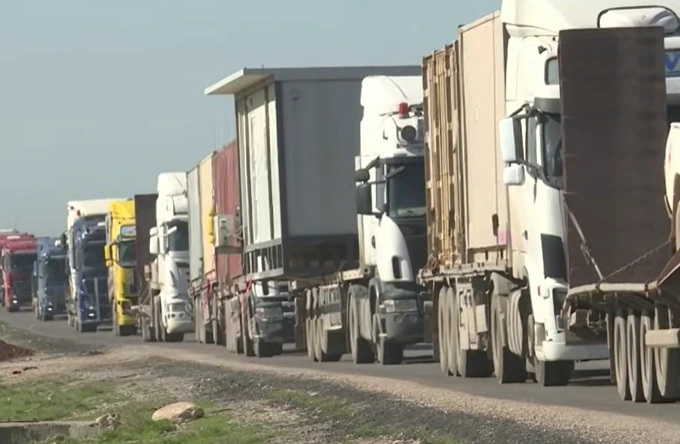
Witnesses described long convoys of heavy trucks stretching across rural highways, escorted by armored vehicles and security units. Additional vehicles reportedly entered Syria from Iraq in the days before the withdrawal, suggesting a logistics operation that involved well over one hundred heavy transport units.
These convoys allowed U.S. forces to dismantle and relocate nearly all of the base infrastructure by land — an effort comparable to taking apart and moving a small military city.

Trucks Built for Any Mission
The cargo transported during the withdrawal illustrates the scale and complexity of the operation. The convoys carried virtually everything required to sustain a military installation for years in a remote region.
Among the equipment transported were:
Armored vehicles and tactical units
Logistics containers
Heavy military equipment
Power generators
Communications systems
Mobile workshops
Fuel tanks
Prefabricated base structures
Sleeping modules used as troop housing
Field kitchens
Medical equipment
Storage units and dismantled structures
The diversity of cargo shows that the operation went far beyond relocating vehicles or weapons. The convoys were responsible for removing the full operational infrastructure that supported hundreds of troops for more than a decade.
From housing units to repair facilities and fuel storage systems, the trucks carried the components of an entire military installation across desert supply routes.
The Most Advanced Military Transport Trucks
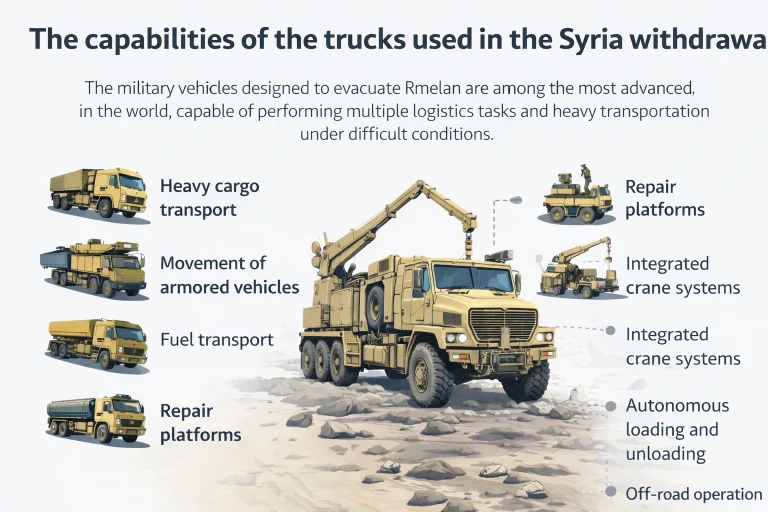
Many of the vehicles used during the withdrawal belong to the Heavy Expanded Mobility Tactical Truck (HEMTT) and Palletized Load System (PLS) families — widely regarded as some of the most advanced heavy military transport trucks in the world.
These vehicles are designed to perform virtually any logistics task required in a combat zone or remote environment.
Their capabilities include:
Heavy cargo transport
Movement of armored vehicles
Fuel transport operations
Mobile repair platforms
Integrated crane systems
Autonomous loading and unloading
Off-road operation
These trucks are capable of transporting tens of tons of cargo while operating for extended periods without fixed infrastructure. They are engineered to travel long distances in harsh environments and continue functioning in extreme heat, dust, mud, and rough terrain.
Their design typically includes all-wheel drive, multiple axles, reinforced suspension systems and high-torque engines, allowing them to operate in places where conventional trucks simply cannot travel.
Many units are equipped with self-loading hydraulic systems, enabling crews to load and unload heavy containers without the need for external cranes or lifting equipment — a critical advantage in remote or hostile environments.

A Withdrawal Carried Out on Wheels
While modern military operations often rely on airlift, the Syria withdrawal depended primarily on ground-based heavy transport convoys, which explains the large number of trucks observed in the region.
The columns traveled for hours across desert roads under armed escort, transporting equipment toward Iraq and other military positions. The movement required careful coordination of fuel supply, security, maintenance and route planning.
For observers on the ground, the most striking image was not aircraft or troop movements, but endless lines of heavy military trucks moving steadily across the desert landscape.
The withdrawal demonstrated a reality well known in the transportation industry: large-scale operations ultimately depend on trucks.
In Syria, those trucks proved capable of doing something extraordinary — moving an entire military base by road.
The operation stands as a powerful reminder that even in the most technologically advanced military forces, heavy transport trucks remain the backbone of strategic mobility.

The History of Soccer: From an Ancient Game to the World’s Most Popular Sport
Soccer is much more than a sport, it’s a passion that brings together cultures, generations, and entire nations.

Truck Accident Compensation: Economic, Non-Economic, and Punitive Damages
In addition to physical injuries, victims of truck accidents often face emotional trauma and financial hardships that affect their quality of life.

U.S. Dismantles Chinese Espionage Network: Transportation Is at Risk
The seizure of 13 internet domains allegedly used for espionage linked to China has once again highlighted growing cybersecurity concerns. Experts warn that transportation and logistics companies are becoming increasingly attractive targets because of the critical information they manage regarding cargo, routes, and supply chains.

New York Trucking Association Prepares for the 2026 FIFA World Cup
Carriers gear up for the impact of the 2026 FIFA World Cup in New York and New Jersey.

PepsiCo Goes Driverless to Boost Supply Chain Capacity
PepsiCo and Gatik partner to scale autonomous freight operations across North America.

World Cup 2026: Three Opening Ceremonies and a Logistics Challenge
The 2026 World Cup will kick off with an unprecedented format: three opening ceremonies in Mexico, Canada, and the United States. Beyond the sporting and musical spectacle, the tournament will test urban mobility, transportation infrastructure, and logistics planning in some of North America’s busiest cities.