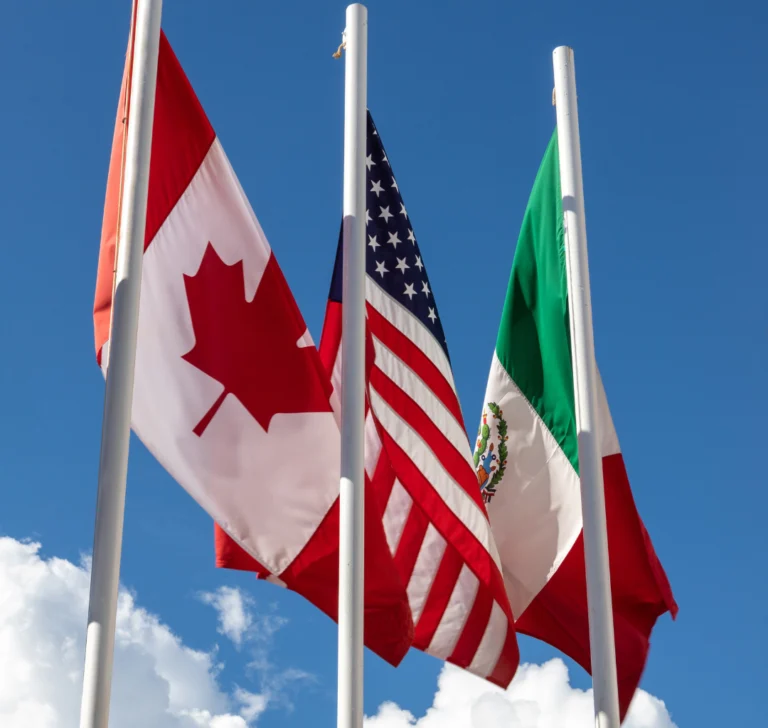
The United States-Mexico-Canada Agreement (USMCA) protects the vast majority of goods from Canada and Mexico from tariffs.
The tariffs established last week by President Donald Trump, set to take effect on August 7, have raised concerns in international markets, particularly in neighboring countries Mexico and Canada.
With tariffs of up to 35% on Canadian products and 25% on Mexican imports, the market is experiencing instability. However, a key clause in the United States-Mexico-Canada Agreement (USMCA) protects the vast majority of goods from Canada and Mexico from these tariffs.

The USMCA exempts most Canadian and Mexican products from tariffs
Products that meet the criteria of the USMCA, negotiated by Trump himself during his first term, are exempt from the new tariffs. This has significantly mitigated the impact of the trade measures.
In Canada, the Bank of Canada reports that 100% of energy exports and 95% of other exports comply with the USMCA. Additionally, the Royal Bank estimates that in April, nearly 90% of Canadian exports entered the U.S. market tariff-free.
Canadian Prime Minister Mark Carney stated that over 85% of bilateral trade with the United States remains free of tariffs and praised the agreement as an anchor of stability in a volatile trade environment.
Meanwhile, in Mexico, Trump has also imposed a 25% tariff on certain imports. However, this tariff only affects goods not covered by the USMCA. Mexican President Claudia Sheinbaum stated that Mexico remains the best-positioned country in the new global trade order thanks to the agreement. Economy Secretary Marcelo Ebrard confirmed that over 84% of trade with the United States is not subject to tariffs.
Some of the products covered under the USMCA include:
- Agricultural products
- Automobiles and auto parts
- Electronics
- Textiles
- Dairy products
- Energy products
- Wood and wood-derived products
- Metals
While the USMCA provides a critical shield, Trump has signaled his intention to renegotiate the agreement in 2026, when it is scheduled for review.

Impact on strategic sectors from tariffs
Despite the exemptions, Trump has imposed targeted tariffs on key sectors as part of Section 232 measures:
- 50% on steel and aluminum
- 25% on automobiles (except those manufactured in Canada and Mexico)
Prime Minister Carney noted that strategic industries such as automotive, steel, aluminum, copper, pharmaceuticals, semiconductors, and softwood lumber are being severely affected. On August 5, Carney announced a support package for the lumber sector.

The best roadside attractions for truckers in the U.S.
America’s highways hide unique places that break up the routine, don’t hesitate to check out these roadside attractions along the way. The road is much

The trucker style: comfort, function, and identity
Truckers’ style is much more than workwear; it’s an identity. These are the most commonly worn garments among truckers. Truckers’ style is much more than

Chaos on Highway 61: Viral Wrong-Way Truck Video Reignites the CDL Debate
An 80-ton tractor-trailer traveling miles in the wrong direction on Missouri’s Highway 61 has reignited a nationwide debate over Commercial Driver’s License (CDL) standards, training

How technology affects driver retention
Friend or foe? 52% of drivers say technology directly influences their decision to stay with or leave a fleet. Fleet telematics company Platform Science published

Dalilah Law seeks to remove non-english speaking commercial drivers
President Donald Trump proposed the “Dalilah Law,” an initiative aimed at prohibiting undocumented immigrants from obtaining commercial driver’s licenses. On February 24, President Donald Trump

FORMULA 1 and the AI That Could Transform Transportation in the U.S.
The artificial intelligence system that Formula 1 implemented to monitor every car on every turn is opening the door to new applications in trucking, logistics,