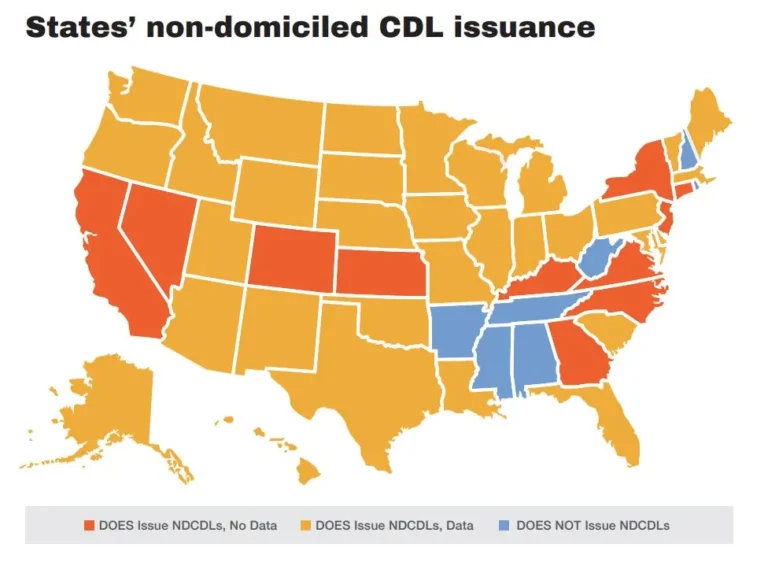
Overdrive exposes the reality behind the growing number of non-domiciled CDLs issued in the United States.
Overdrive has published an investigation that exposes the reality behind the growing number of non-domiciled commercial driver’s licenses (NDCDLs) issued in the United States. After several months of analysis across all 50 states, the well-known trucking news outlet has released its findings.
The report was based on three key questions:
- Does your state issue non-domiciled CDLs?
- If so, how many non-domiciled CDLs have been issued annually over the past 10 years?
- How many standard CDLs have been issued during that same period?
Although some states declined to provide information, data was gathered from the majority, revealing the seriousness of the current situation.

60,000 non-domiciled CDLs in the U.S.
Among the key findings of Overdrive’s investigation: only seven states do not issue CDLs to non-citizens with work authorization. Of the remaining 43 states, 11 do issue CDLs to non-domiciled drivers but lack easily accessible data on them, while 32 states provided concrete figures.
The data shows that over 60,000 non-domiciled CDLs have been issued. Over the past decade, the trend points to a steady increase in both the number of these licenses and their proportion relative to the total number of CDLs issued, according to the report.
CDLs issued to individuals with temporary work permits generally match the duration of the permit. Additionally, U.S. citizens residing in a state other than the one issuing the CDL can also receive a non-domiciled license. For these and other reasons, it is difficult to determine the exact number of non-domiciled CDLs issued or currently active in the U.S.—even with direct input from some states. Nonetheless, Overdrive’s investigation compiled sufficient data to offer a close estimate in the states that did share information.

States with the highest number of non-domiciled CDLs
Despite the lack of data from some large states and the fact that each state reports figures differently, a few key players in non-domiciled CDL issuance stand out. These were the states with the highest number of active non-domiciled CDLs, according to Overdrive:
- Pennsylvania: 11,572 active NDCDLs
- Illinois: 11,000+ NDCDLs issued in the past 18 months
- Florida: 10,000+ NDCDLs issued in the past 18 months
- Texas: 8,507 active NDCDLs
- Michigan: 6,809 active
- Arizona: 6,103 active
- Ohio: 5,136 active
In Illinois, 40% of all non-domiciled CDLs issued in recent years were concentrated in just one month—April 2025.
Though preliminary, these figures highlight a growing trend in the issuance of non-domiciled CDLs across the United States and simultaneously underscore the lack of precise data to fully grasp the scope of the phenomenon. The full Overdrive report is available on its website.

Freedom 250 Grand Prix Set to Make History in America’s Capital
Organized by INDYCAR in collaboration with the White House, the “Freedom 250 Grand Prix” will combine high-speed racing with a celebration of American patriotism.

Safe Driver Week 2026 Begins: Stay Prepared
The Safe Driver Week by the Commercial Vehicle Safety Alliance (CVSA), officially began on July 12.

ICE Expands Inspections for Truck Drivers: Required Documents
ICE agents have joined commercial vehicle inspections at selected U.S. weigh stations. Drivers should be prepared to present a valid CDL, vehicle documents, proof of legal work authorization, and meet the federal English proficiency requirement.

Common DOT Violations and How to Avoid Them
Common Department of Transportation (DOT) violations for truck drivers in Texas and California and how to avoid them.

New World Screwworm Cases Rise in Texas as Origin Remains Unknown
Uncertainty surrounds the spread of the New World screwworm in Texas; experts still don’t know how it entered the U.S.

Cyclospora Outbreak: How to Protect Your Health on the Road
The Cyclospora outbreak has already sickened more than 1,400 people in states including Michigan, Ohio, Illinois, Indiana, New York, North Carolina, and Texas. For truck drivers, recognizing the symptoms and preventing dehydration could make the difference between a safe trip and an unexpected stop.