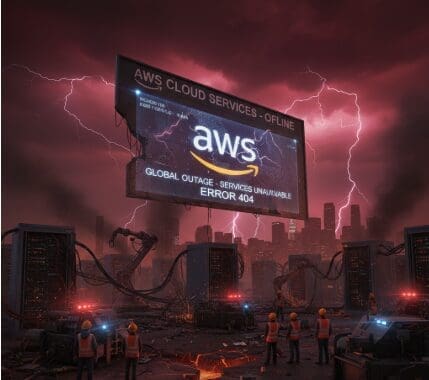
A major outage in Amazon Web Services (AWS) on Monday sparked widespread disruption across websites, apps, and back-office systems worldwide — with the logistics and trucking sectors among the industries most significantly affected.
A major outage in Amazon Web Services (AWS) on Monday sparked widespread disruption across websites, apps, and back-office systems worldwide — with the logistics and trucking sectors among the industries most significantly affected. While AWS stated that services were “recovering,” many U.S. users continued reporting issues, highlighting the fragility of a global logistics ecosystem that increasingly runs on cloud-based infrastructure.
The outage, which largely stemmed from issues in AWS’s US-EAST-1 region, affected services tied to DNS routing and database functionality. As a result, numerous transportation management systems (TMS), warehouse management platforms (WMS), telematics dashboards, fleet routing tools, and customer-facing shipment trackers either slowed to a crawl or went completely offline.

Trucks Delayed, Freight Re-Routed, and Fleets Left Blind
Modern trucking fleets rely heavily on cloud-based platforms for dispatching, electronic proof of delivery, route optimization, and real-time GPS tracking. When AWS faltered, so did critical logistics operations.
According to logistics managers interviewed shortly after the outage, some fleets experienced:
- Delays in dispatching trucks, as drivers were unable to receive updated route instructions.
- A temporary loss of visibility, with GPS tracking dashboards unable to retrieve location data from cloud-connected devices.
- Interrupted telematics feeds, affecting refrigerated loads that rely on continuous temperature monitoring.
- Manual fallback procedures, forcing dispatchers to rely on phone calls, emails, or even printed route manifests.
- Customer frustration, as shipment tracking portals became inaccessible or displayed outdated information.
In regions with high freight density such as Texas, Illinois, and California, carriers reported waiting times at distribution hubs while warehouses struggled to confirm orders or digitally release freight.
Digital Warehouses Felt the Shockwave
Warehouse operations were also hit, particularly in facilities that depend on AWS-backed systems for scanning inventory, slotting pallets, issuing pick lists, and generating bill-of-lading documents. A WMS failure can quickly lead to dock congestion and delayed truck turnarounds.
“Even a two-hour digital blackout can lead to a six-hour supply chain disturbance,” said a logistics analyst at a Chicago-based freight optimization firm. “Inbound trucks back up, outbound loads miss their delivery windows, and detention costs pile up.”
Carriers operating cross-border routes — particularly between the U.S., Mexico, and Canada — saw additional delays due to disruptions in digital customs documentation exchanges and milestone confirmations that rely on cloud automation.
Customers Left in the Dark
E-commerce platforms, 3PL providers, and freight marketplaces that depend on AWS-hosted interfaces experienced website and mobile app failures, leaving shippers unable to check load status or place new requests. Customer service hotlines experienced higher call volumes, increasing operational strain and escalating costs for carriers already grappling with slim profit margins.
“Visibility is everything in logistics,” said Maria Delgado, operations director at a mid-sized U.S.-Mexico freight carrier. “When customers can’t see where their freight is, even if the truck is on the road and on time, it becomes a crisis of confidence.”
A Warning for Fleet Operators: Redundancy Is No Longer Optional
The AWS outage underscores a major vulnerability: logistics is no longer just about wheels on the road — it’s about data continuity.
Experts say fleets should now:
✅ Implement multicloud strategies to avoid reliance on a single provider
✅ Maintain offline backup processes for dispatching and proof of delivery
✅ Ensure critical telematics data can failover to local storage or alternate servers
✅ Conduct digital outage drills, similar to cybersecurity breach simulations
✅ Reassess SLAs with cloud providers to ensure compensation for operational loss
Logistics 4.0 Meets Its First Big Stress Test
The logistics and trucking sectors have heavily invested in digital transformation, from AI-powered load matching to autonomous routing engines. Monday’s outage served as a crucial stress test: without cloud access, fleets equipped with cutting-edge digital platforms functioned no better than those running pen-and-paper systems — and sometimes worse.
While AWS began restoring services by Monday afternoon, analysts predict the real-world consequences will be felt for days as routing inefficiencies play out, freight is rebooked, and detention costs are reviewed.
The Bottom Line
As global supply chains continue to digitize, reliance on hyperscale cloud services like AWS, Microsoft Azure, and Google Cloud will deepen. But without adequate redundancy and emergency protocols, logistics operators risk significant financial exposure every time a cloud provider’s server blinks.
For trucking fleets already navigating regulatory shifts, volatile fuel costs, and persistent driver shortages, this outage is more than a disruption — it’s a warning shot.

World Laughter Day: Can laughter really make you healthier?
World Laughter Day is celebrated to promote joy, mental well-being, and connection among people through something as simple as laughing. Are the effects real?

Operation Safe Driver Week 2026 targets risky driving behaviors
Operation Safe Driver Week, organized by the CVSA, is a safe driving awareness and outreach initiative focused on drivers in the United States, Canada, and Mexico.

How Weather Is Reshaping Risk on U.S. Trucking Routes
Extreme events, emerging risk zones, and a growing impact on operations, costs, and insurance across the freight industry.

U.S. 250th anniversary celebrations take to the rails
Commemorative locomotives take the rails for United States’ 250th anniversary

In brief: rail crossing safety, California autonomous trucks, and CDL laws
From rail crossing safety to autonomous trucks and CDL laws, these are the key U.S. updates in transportation.

USDOT drives logistics hubs through the Regional Infrastructure Accelerators (RIA) program
USDOT strengthens its logistics hubs strategy through the Regional Infrastructure Accelerators (RIA) program, designed to unlock projects, enhance intermodal connectivity, and accelerate critical infrastructure for freight transportation across the United States.