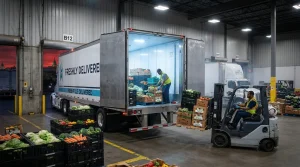
Drivers spend an average of 119 minutes waiting at each pickup or delivery.
The phenomenon of detention time, a peculiar reality for truck drivers, has come to light with data provided by FreightWaves SONAR. According to this data, drivers spend an average of 119 minutes waiting to be loaded or unloaded at each pickup or delivery. Although the first two hours of waiting are usually unpaid, drivers receive compensation for each additional hour, revealing a notably inefficient practice.
A 2018 study by the Office of the Inspector General of the U.S. Department of Transportation highlights the serious economic consequences of this phenomenon, estimating income losses between 1.1 and 1.3 billion dollars for truck drivers. Furthermore, each 15-minute increase in detention time increases the accident rate by 6.2%, emphasizing the associated risks.

What causes detention times?
Recently, FreightWaves explored the reasons behind these prolonged detention times from the perspective of truckers. One of the main identified causes is the lack of sufficient warehouse workers, despite wage increases in the sector, where employees earn an average of almost $24 per hour.
Outdated logistical practices also contribute to the problem, especially in live loading, where drivers wait during loading or unloading, leading to extended times of up to three hours. The proliferation of SKUs (stock-keeping unit) and the diversity of product sizes add complexity to the loading process.
This prolonged detention time seems to be the result of corporate cultures that do not prioritize logistics, affecting both drivers and overall efficiency. The solution would involve greater attention to logistics planning and the implementation of practices that reduce dwell times.
As the problem persists, some transportation companies choose to avoid known facilities to prolong detention time, which could lead to higher costs to attract drivers. The situation has led many retailers to pay for detention time or invest in improving facilities to expedite the loading process.
Despite these efforts, with hundreds of thousands of small trucking companies, a complete resolution of the detention time problem appears challenging, and drivers may continue to face this reality in the near future.

Trucking in Alaska and Hawaii: How America’s Non‑Contiguous States Break the Mold
When you step outside the contiguous U.S. and look at Alaska and Hawaii, the trucking industry becomes a very different story

FMCSA updates its coercion rule for drivers facing HOS and ELD pressure
The FMCSA’s updated guidance explains that the “coercion rule” is intended to protect commercial motor vehicle drivers.

New York Can Suspend Driver’s Licenses Over Tax Debt
New York has once again put the spotlight on driver’s license suspensions tied to unpaid state taxes, a situation that could affect thousands of transportation, delivery, and logistics workers who depend on driving to earn a living. For commercial drivers and CDL operators, the consequences can go far beyond a simple fine.

What you need to know about CVSA’s International Roadcheck 2026
The first annual inspection, as every year, kicks off with the International Roadcheck, also known as DOT Blitz Week. Here’s what you need to know.

Tariff Shock: Why U.S. Freight Demand Is Suddenly Surging
Companies are cutting inventories to avoid rising tariff-related and storage costs, forcing goods to move faster and in smaller batches. The unexpected result: stronger trucking demand

Bot Auto completes its first driverless commercial highway shipment
Bot Auto has completed its first long-distance commercial shipment without a driver in the cab or a remote operator.