Congressional report on China warns that Beijing’s global strategy poses direct risks to U.S. transportation, logistics and trucking. The document urges immediate action to protect supply chains, critical minerals and manufacturing.
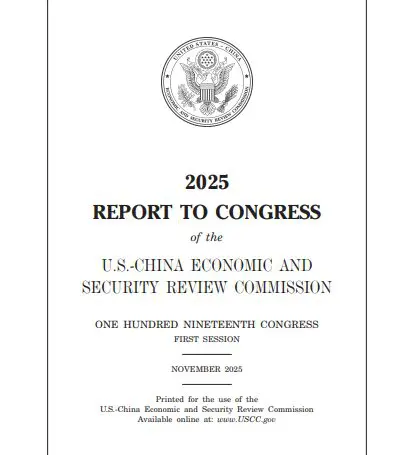
A sweeping 745-page Congressional report has sent shockwaves through the U.S. transportation, trucking, and logistics industries. The bipartisan document—produced by the U.S.-China Economic and Security Review Commission after a year of investigation—details how China is pursuing global economic dominance through control of manufacturing, minerals, technology, and critical supply chains.
More importantly, the report makes one point abundantly clear and you can read it here.
The United States must prepare for a future in which Beijing leverages its manufacturing power, mineral dominance, and technology control as instruments of economic pressure.
For the transportation sector, the report reads almost like a risk map—highlighting vulnerabilities that could hit U.S. trucking fleets, freight corridors, logistics operations and supply-chain infrastructure directly.

China’s Manufacturing Overreach: A Direct Threat to U.S. Industry
The report underscores that China has built a state-subsidized system of extreme overproduction, flooding global markets with artificially cheap goods. Beijing produces more than its domestic market can absorb, using exports as a strategic tool.
For U.S. transportation, the consequences are clear:
Critical Components for Trucks and Fleet Operations
China controls half of the world’s production of printed circuit boards (PCBs)—the backbone of:
engine control modules
brake and safety electronics
ADAS sensors
GPS and telematics hardware
charging systems for electric trucks
The report warns that if Beijing chooses to restrict exports—as it already did with gallium and germanium—thousands of U.S. fleets could face:
urgent maintenance delays
shortages of essential parts
longer equipment downtime
higher costs across the board
This is a choke point that touches every truck, every fleet and every mile on American highways.
Electric Vehicle Overproduction
Chinese manufacturers are aggressively expanding into heavy-duty EVs, buses and commercial vans, undercutting global prices with massive subsidies.
Congress warns this strategy aims to swallow market share rapidly—even if it puts competitors out of business and destabilizes international manufacturing.

Critical Minerals: The Bottleneck That Could Cripple Logistics
The report highlights a strategic reality that the American trucking and logistics industry cannot ignore:
China dominates the global supply of critical minerals from the mine to the refinery.
This includes:
lithium
nickel
cobalt
rare-earth elements for high-strength magnets
graphite for battery anodes
Any disruption would immediately impact:
EV fleet batteries
charging infrastructure
production of motors and transmissions
manufacturing of drones, rail systems, and advanced logistics equipment
In an industry where every minute of downtime costs money, the vulnerability is enormous.
Supply Chains Under Pressure: Logistics as a Geoeconomic Battlefield
The report details how China has expanded influence across global trade infrastructure, creating new strategic risks for U.S. logistics.
Ports, Trade Routes and Global Hubs
China has invested heavily in:
overseas ports
maritime routes
rail corridors
large-scale logistics facilities in Asia, Africa, and the Pacific
For the United States, this means:
Beijing gains leverage over critical shipping corridors
the ability to redirect global cargo flows
growing influence over port systems used by U.S. carriers and freight forwarders
Digital Infrastructure and Communications
Chinese tech firms are competing for contracts involving:
5G logistics networks
undersea data cables
port-management software
surveillance and communication systems
Congress warns that this presents significant cybersecurity and data-integrity risks, particularly for supply chains handling sensitive cargo or military-related shipments.
Energy and Electrification: Where China Already Leads the Game
According to the Congressional report, China is already the dominant force in:
solar panels
inverters
battery storage
wind turbines
grid equipment essential for electrified transportation
For U.S. fleets transitioning to renewable energy or electric trucks, this dependence creates strategic exposure. Beijing has already demonstrated its willingness to use export controls as an economic weapon.
Space, Cybersecurity and Critical Navigation Systems
One of the most alarming sections of the report focuses on China’s capabilities in space and cyber interference.
This matters enormously for trucking, freight and logistics because the industry relies on:
GPS accuracy
satellite-based communications
fleet monitoring tools
autonomous navigation
geolocation for temperature-controlled or high-value cargo
Congress warns that China has developed technologies capable of disrupting or degrading U.S. satellite systems, posing direct risks to highway safety, navigation reliability, and freight security.
Transportation Is on the Front Lines of This Global Competition
The Congressional report is not just a geopolitical analysis. It is a direct warning to the industries that keep America’s economy moving.
For trucking, intermodal transport, warehousing, last-mile delivery and logistics, the implications are immediate:
parts and components could become scarce
operational costs could rise sharply
Chinese manufacturing competition will intensify
geopolitical risks could disrupt shipping routes and freight flows
technology and communications systems may face vulnerabilities
resilience—not just efficiency—must become a priority
As the report makes clear, the question is no longer whether China influences global logistics.
The real question is how the United States will respond to protect the strength of its transportation system, its supply chains, and the uninterrupted flow of goods that keeps the national economy alive.
Truck driver: stop choosing the worst route

U.S. labor market raises red flags on Wall Street
The U.S. labor market closed 2025 with clear signs of weakening, as evidenced by the latest employment data released in December. In the latest episode

DOT finds half of North Carolina CDLs were issued illegally
The DOT warns that half of North Carolina’s CDL licenses are irregular after a federal audit uncovered serious compliance failures. The findings directly affect truckers, fleets, and transportation companies, raising urgent questions about road safety, legal operations, and the future of the trucking industry.

California’s Unhealthy Air: Impacts on Trucking and Freight
Unhealthy Air Quality in California: What Repeated Pollution Alerts Mean for Trucking and Freight Operations

Global Road Freight on Track to Hit USD 5 Trillion by 2033
Global Road Freight on Track to Hit USD 5 Trillion by 2033 as e-commerce growth, supply chain restructuring, and technology adoption accelerate demand for road-based cargo transport worldwide.

California misses DOT deadline risking $160 million in federal funding
The state of California has reached the deadline set by the DOT to take action regarding the situation involving the number of non-domiciled CDLs issued

Health on Wheels: How to Prevent the Most Common Conditions on the Road
Health on wheels matters for anyone who spends long hours on the road. How to prevent the most common physical and mental conditions and maintain healthier routines while working behind the wheel.