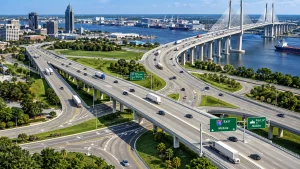
ConsumerAffairs revealed both the cities with the worst congestion and those with the lightest traffic.
Traffic is one of the most serious problems in the United States. Daily commutes between home and work have become so tedious that, in recent years, they’ve led to a significant increase in road rage incidents. While this situation affects many cities across the country, some stand out as especially problematic.
ConsumerAffairs analyzed various data points, such as average commute times, daily hours spent in traffic, and fatal traffic accident rates, across the 50 most populated metropolitan areas in the U.S., in order to determine which cities suffer from the worst traffic.
The study revealed that cities with the worst congestion often align with those that have intense economic activity. According to the findings, the cities with the worst traffic in the United States are:

Cities with the worst traffic in the U.S.
1. Washington, D.C.
This year, Washington, D.C., overtook Los Angeles as the city with the worst traffic in the country. The ConsumerAffairs analysis shows the following average traffic times in the nation’s capital:
- Average daily commute time: 33.4 minutes
- Average weekday congestion duration: 6 hours, 35 minutes
- Annual rate of fatal traffic accidents: 5.95 per 100,000 residents
The total average weekday congestion time is equivalent to spending 71 full days per year in traffic, the second-highest total among the cities studied.
2. Los Angeles, California
Los Angeles ranks second overall, yet it remains the city with the highest number of weekday traffic jams, equating to 85 full days per year stuck in traffic, according to ConsumerAffairs.
- Average daily commute time: 30.5 minutes
- Average weekday congestion duration: 7 hours, 51 minutes
- Annual rate of fatal traffic accidents: 7.33 per 100,000 residents
3. Miami, Florida
In 2024, Miami ranked 12th on the list, but this year it jumped to third place, with an estimated 70 full days per year lost to traffic congestion. The metrics show:
- Average daily commute time: 29.2 minutes
- Average weekday congestion duration: 6 hours, 31 minutes
- Annual rate of fatal traffic accidents: 11.40 per 100,000 residents

4. San Francisco, California
Another California city makes the top five. For the second year in a row, San Francisco has the second-longest average daily commute among all cities analyzed. Its metrics include:
- Average daily commute time: 32.1 minutes
- Average weekday congestion duration: 5 hours, 31 minutes
- Annual rate of fatal traffic accidents: 5.24 per 100,000 residents
5. Atlanta, Georgia
Atlanta also ranks among the top five cities with the worst traffic, with an average daily commute of over 31 minutes.
- Average daily commute time: 31.3 minutes
- Average weekday congestion duration: 4 hours, 57 minutes
- Annual rate of fatal traffic accidents: 10.75 per 100,000 residents
The rest of the cities rounding out the top 10 worst for traffic and congestion in the United States, according to ConsumerAffairs, are:
6. New York, New York
7. Houston, Texas
8. Seattle, Washington
9. Baltimore, Maryland
10. San Jose, California

Cities with the least traffic in the United States
Not everything is negative across this vast country. Just as there are cities with high congestion levels, there are others where traffic is lower, or at least more manageable. The ConsumerAffairs analysis also highlights the cities with the lightest traffic in the U.S., with Rochester, New York, taking the top spot. With an average commute time of just over 21 minutes, the shortest among all cities analyzed.
The 10 cities with the lowest traffic levels are:
- Rochester, New York
- Salt Lake City, Utah
- Cleveland, Ohio
- Hartford, Connecticut
- St. Louis, Missouri
- Milwaukee, Wisconsin
- Columbus, Ohio
- Fresno, California
- Kansas City, Missouri
- Buffalo, New York
Geographically, the cities ranked worst for traffic are clustered in two main regions: three are located in the South, and the remaining two are in California. In contrast, cities with lower traffic congestion are mostly found in the northern part of the country. The full report on traffic and congestion is available on the ConsumerAffairs website.

U.S. 250th anniversary celebrations take to the rails
Commemorative locomotives take the rails for United States’ 250th anniversary

In brief: rail crossing safety, California autonomous trucks, and CDL laws
From rail crossing safety to autonomous trucks and CDL laws, these are the key U.S. updates in transportation.

USDOT drives logistics hubs through the Regional Infrastructure Accelerators (RIA) program
USDOT strengthens its logistics hubs strategy through the Regional Infrastructure Accelerators (RIA) program, designed to unlock projects, enhance intermodal connectivity, and accelerate critical infrastructure for freight transportation across the United States.

Controlling road rage: a guide for truck drivers
The three key steps to help truck drivers control road rage.

New identification process for the Drug and Alcohol Clearinghouse
The FMCSA has begun implementing new identity verification requirements for the Drug and Alcohol Clearinghouse.

OPEC: What the United Arab Emirates Exit Means for U.S. Fuel Costs and Logistics
The departure of the United Arab Emirates from the Organization of the Petroleum Exporting Countries is reshaping the global oil market, introducing price volatility and creating new challenges for diesel costs, freight operations, and fleet planning across the United States.