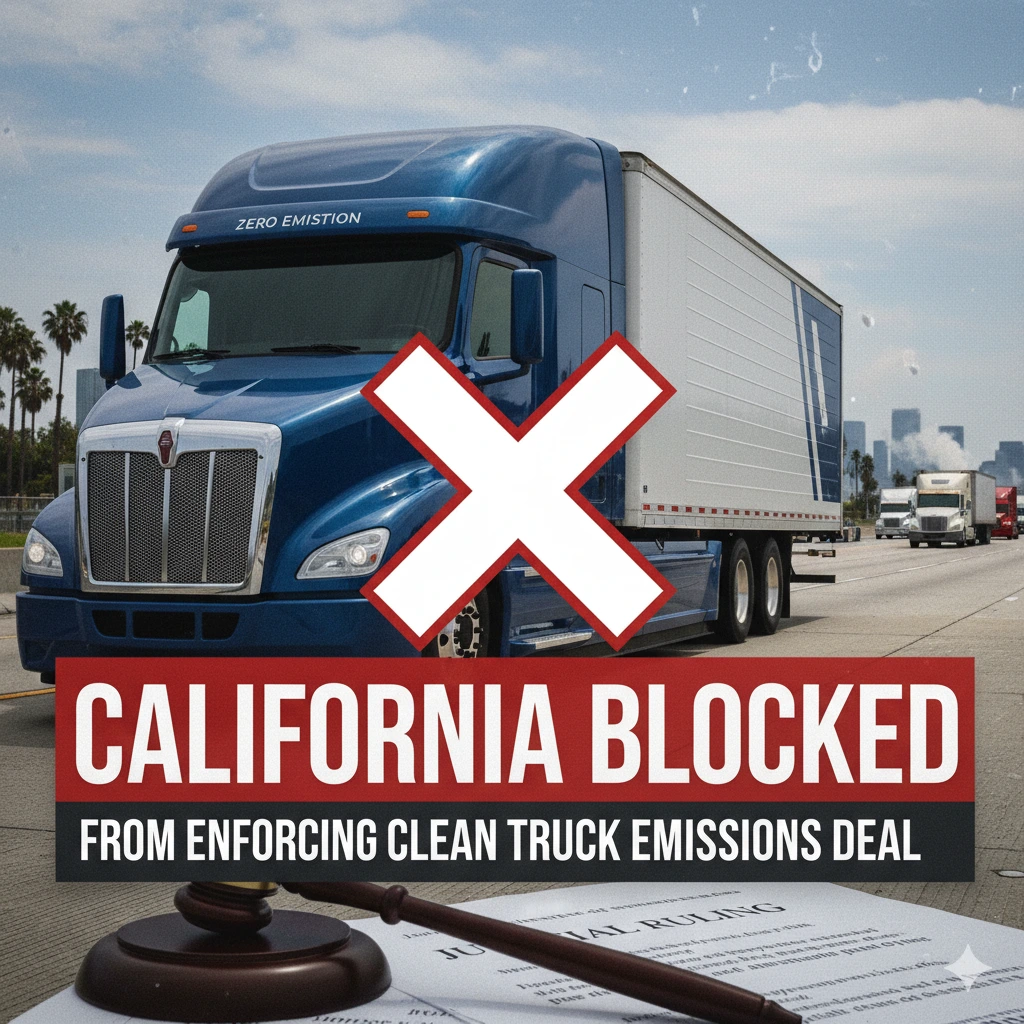
Clean truck deal and California emissions return to the center of the national debate after a federal court blocks enforcement of the Clean Truck Partnership, pausing requirements tied to zero-emission truck adoption while litigation continues.
The clean truck deal is now at a turning point. A recent ruling by a federal judge temporarily halted the implementation of the Clean Truck Partnership (CTP)—an agreement between the California Air Resources Board (CARB) and major truck manufacturers (OEMs). The decision does not overturn the agreement, but it does suspend CARB’s ability to enforce its terms while legal challenges move forward. The ruling marks a critical moment in the ongoing national debate over California’s emissions authority, industry obligations, and the pace of the transition toward zero-emission heavy-duty vehicles.
What Was at Stake in the Clean Truck Deal
Signed in 2023, the Clean Truck Partnership aimed to balance environmental ambition with regulatory predictability. It was built on mutual concessions:
CARB agreed to temporarily ease certain NOx emissions rules, which are more stringent than federal standards.
In return, manufacturers agreed not to legally oppose several California regulations, including the Advanced Clean Trucks (ACT) rule, which requires a growing percentage of new truck sales to be zero-emission over the next two decades.
However, the situation changed dramatically in 2025 when the federal waivers that allow California to impose stricter emissions standards than national regulations were suspended. Without those waivers, manufacturers argued that they were being forced to prepare for a market where the regulatory future was unclear—and where customers might not be required to purchase zero-emission vehicles at all.
The Lawsuit That Triggered the Court’s Intervention
Initially, the judge found that the manufacturers’ concerns did not justify blocking the agreement. But the calculus shifted when California itself filed a lawsuit in state court to force OEMs to comply with the deal.
This escalated the dispute from a theoretical regulatory disagreement to an immediate enforceable threat. The judge ruled that:
If OEMs were compelled to invest heavily in zero-emission production now,
And later the regulations were overturned,
They would suffer “irreparable harm” in unrecoverable financial losses.
On that basis, the court issued a temporary injunction halting enforcement of the CTP.
What the Ruling Does — and Does Not — Change
Paused for now:
CARB cannot force or pressure manufacturers to meet commitments under the Clean Truck Partnership.
No penalties or compliance demands tied to the CTP can be imposed during litigation.
Still in effect:
Standard certification and emissions compliance processes continue.
California retains its general authority to regulate air quality.
The injunction is temporary, not a final ruling.

Impact Across the Trucking and Logistics Sector
The effects of the temporary halt vary depending on the actor involved. For truck manufacturers, the ruling reduces immediate regulatory and financial pressure. Without the obligation to comply with uncertain standards, OEMs gain room to adjust production plans and evaluate investment strategies more cautiously while the legal framework evolves.
For carrier fleets and logistics companies, the decision offers a brief pause in the push toward rapid zero-emission fleet renewal. While the broader trend toward electrification and reduced emissions continues, this temporary suspension means fleets are less likely to face near-term deadlines for acquiring new zero-emission trucks—particularly in a market where purchase costs remain high and charging infrastructure is unevenly developed.
For the zero-emission truck market overall, the ruling introduces a period of slower short-term momentum. Investment decisions, procurement cycles, financing arrangements, and infrastructure buildouts often depend on regulatory clarity. Uncertainty tends to favor delays, and both manufacturers and fleet operators may take a more cautious approach until the legal questions surrounding California’s standards are resolved.
On the public policy side, the ruling opens a new chapter in the debate over state versus federal authority in environmental regulation. California’s ability to set emissions standards more ambitious than national requirements has historically shaped the direction of U.S. climate and clean transportation policy. The pause on the Clean Truck Partnership forces a reconsideration of how far that authority extends when federal waivers are challenged or suspended.
Despite these shifts, the ruling does not stop the transition to zero-emission heavy-duty vehicles—it simply affects the pace. The industry continues to move toward electrification and alternative drivetrains, but investment and deployment strategies are likely to become more cautious in the near term.
What Comes Next
The legal dispute is expected to continue through further hearings and potentially higher courts. The central issue will be whether California is permitted to enforce emissions standards that differ from or exceed federal requirements without an explicit waiver in place.
The outcome of the case will influence:
The degree to which California can continue to lead national climate and air quality policy.
Investment and procurement decisions within truck manufacturing and fleet operations.
The broader competitive timeline for the zero-emission heavy-duty vehicle market in the United States.
Much will depend on how courts interpret the scope and durability of California’s regulatory authority.
The pause on the clean truck deal does not represent a reversal of decarbonization goals—it reflects a recalibration of how and when the transition will unfold. The conflict surrounding California’s emissions standards is not solely about environmental policy; it also involves industrial planning, cost structures in logistics, technological development pathways, and the balance of power between state and federal regulators.
The eventual resolution of the case will shape the future of heavy-duty transportation in the United States, influencing not only market dynamics but also the strategic direction of climate and industrial policy over the next decade.

Teton Pass bridge will be closed to traffic for 10 days
Teton Pass is one of the most heavily traveled routes for truck drivers in Wyoming, serving as a vital corridor for the trucking industry. The

Terrifying Experiences of Truck Drivers Sleeping on the Road at Night

Cargo theft numbers drop for the third quarter of 2025
The cargo theft tracking company Verisk CargoNet released its report for the third quarter of 2025. The cargo theft tracking company Verisk CargoNet released its

40 major U.S. airports to see flight reductions due to government shutdown
40 U.S. airports, including those in New York, Los Angeles, and Chicago, will see flight reductions starting November 7 due to the government shutdown. 40

DOT Medical Card: Keeping Medical Certification Up to Date
Keeping your DOT Medical Card current is essential for both drivers and fleet operations.
Brake Safety Week 2025 results: almost 85% of commercial vehicles had no violations
Results of Brake Safety Week, organized jointly by the Commercial Vehicle Safety Alliance (CVSA) and the Department of Transportation, have been published. Results of Brake