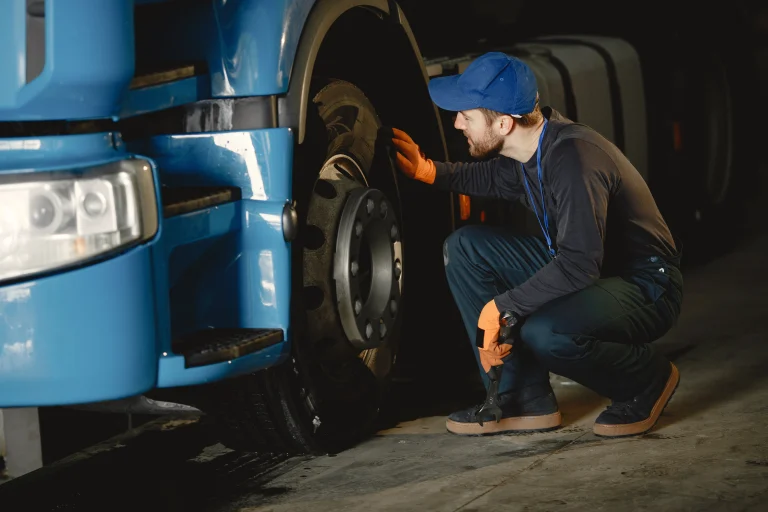
The 2026 inspection will focus on drivers who falsify or manipulate their electronic logging devices (ELDs) to alter their hours of service.
Each year, the Commercial Vehicle Safety Alliance (CVSA) conducts an international inspection across the United States, Mexico, and Canada to assess the condition of commercial vehicles and ensure compliance by motor carriers and truck drivers.
Scheduled for May, it has been announced that the 2026 inspection will focus on drivers who falsify or manipulate their electronic logging devices (ELDs) to alter their hours of service.
The CVSA reported that this focus stems from last year’s results, in which falsification of record of duty status was the second most cited violation among drivers, totaling 58,382 violations. Additionally, five of the ten most common driver violations were related to hours of service or ELDs.
ELDs as the focal point of CVSA’s annual inspection
From May 12 to 14, 2026, during a 72-hour period, CVSA will deploy inspectors at weigh and inspection stations, as well as at random roadside checkpoints. The primary objective will be to conduct a North American Standard Level I 37-step inspection on commercial vehicles. Inspectors will examine driver operating requirements and evaluate the vehicle’s mechanical condition, with a specific area of emphasis.
Each year, a specific focus area is selected for inspectors to concentrate on during reviews. With ELD manipulation, falsification, and alteration designated as this year’s focus, roadside inspectors will closely review drivers’ records of duty status to determine whether any ELD tampering has occurred, according to CVSA.
“Inaccurate ELD entries may result from drivers’ lack of understanding of federal regulations and exemptions,” CVSA stated. “However, in some cases, inaccurate entries are deliberately used to conceal hours-of-service violations, and some records are manipulated to hide driving time (without indicating that the record has been edited, as required by federal regulations).”
ELD manipulation is among the top seven issues exploited by bad actors in the industry, as identified by the Trucking Association Executive Council (TAEC), which seeks to end electronic logging device manipulation and hours-of-service fraud in order to prevent violations of transportation safety regulations.
Other components to be evaluated
In addition to reviewing ELD devices, CVSA inspectors will also verify driver qualifications, commercial driver’s license, record of duty status, medical certificate, seat belt use, skill performance evaluation certificate, and status in the Drug and Alcohol Clearinghouse, as in previous years.
This year’s vehicle inspections will also focus on:
- Cargo securement
- Brake systems
- Coupling devices
- Driveline components
- Driveshaft
- Driver’s seat
- Fuel and exhaust systems
- Frames
- Lighting devices
- Steering mechanisms
- Suspensions
- Tires
- Wheels
- Rims
- Hubs
- Windshield wipers
If a vehicle successfully passes a Level I or Level V inspection without critical violations, it receives a CVSA decal valid for three months. This allows enforcement personnel to recognize that the vehicle has been recently inspected and found free of violations. Those who fail to meet inspection standards risk being placed out of service.

What are Grabovoi numbers and what can be manifested with them
Grabovoi numbers: a list of numerical sequences intended to activate certain areas of daily life in order to enhance, improve, and develop them. Manifestation and

CVSA’s 2026 international inspection to target ELD manipulation
The 2026 inspection will focus on drivers who falsify or manipulate their electronic logging devices (ELDs) to alter their hours of service. Each year, the
Illinois CDL Audit: 20% Under Federal Review
A federal audit found that nearly 20% of Illinois’ non-domiciled CDLs may not comply with federal standards. The state has 30 days to correct the issues or risk losing $128 million in highway funding.

Wall Street under the microscope: solid employment, contained inflation, and rising volatility
Employment, inflation, and retail sales set the tone for a week marked by volatility and sector rotation on Wall Street. In the latest episode of

Predictive Logistics 2026: AI Stops Bottlenecks Before They Start
Predictive AI in transportation is no longer experimental — it is operational. In 2026, intelligent logistics systems anticipate demand spikes, optimize inventory levels, and redesign routes in real time, eliminating supply chain disruptions before they occur.

Best and Worst States to Be a Truck Driver in the United States in 2026
A new national ranking reveals the best and worst states to be a truck driver in the United States in 2026, measuring truck driver salaries, fatal crashes, congestion and road conditions.