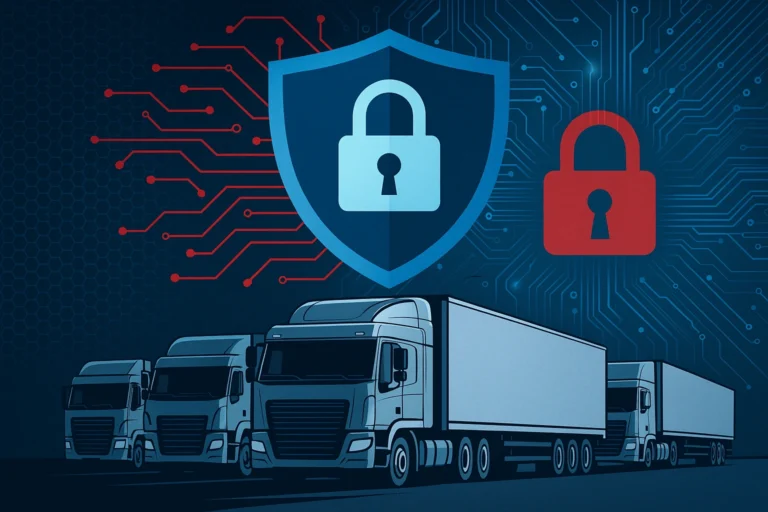
The extended factory closure of Jaguar Land Rover after a cyberattack underscores how vulnerable transportation and logistics companies are when operations hinge on digital systems. For trucking fleets, the warning is clear: cybersecurity is now as critical as fuel and tires.
Jaguar Land Rover: A Costly Wake-Up Call
Britain’s largest automaker, Jaguar Land Rover (JLR), has been forced to extend the shutdown of its factories until October 1 after a cyberattack paralyzed operations earlier this month. The incident, which has sent shockwaves through the global auto industry, has revealed the staggering costs of digital vulnerability.
According to the BBC, the luxury carmaker — owned by India’s Tata Motors — is losing an estimated £50 million ($68 million) per week, with production of roughly 1,000 vehicles per day on hold. Most of its 33,000 employees have been sent home while systems remain offline.
For the trucking and freight sector, the parallels are alarming. If a cyberattack can cripple one of the world’s top automakers, fleets that increasingly depend on digital platforms are just as exposed.

Why Trucking Fleets Should Pay Attention
While JLR builds cars, the operational backbone of today’s trucking industry relies on the same kind of digital integration. Virtually every aspect of modern freight transport is now connected:
Telematics systems track vehicle performance, fuel efficiency, and driver behavior.
Electronic Logging Devices (ELDs) are mandatory in the U.S. to monitor hours of service.
Cloud-based Transportation Management Systems (TMS) assign loads, optimize routes, and sync with shippers.
IoT sensors in trailers and cabs measure everything from cargo temperature to tire pressure.
If any of these layers is breached, the disruption can rival the impact of a large-scale labor strike or a multi-vehicle crash on an interstate.
Concrete Risks for the Trucking Sector
The Jaguar Land Rover shutdown offers a blueprint of what could happen to fleets if cyber defenses fail. Key risks include:
Operational paralysis: Without access to TMS or load-assignment platforms, hundreds of trucks could sit idle at depots.
Data manipulation: Altered records on weight, delivery times, or routing could trigger contract breaches and penalties.
On-road threats: Cyber intrusions into electronic braking or engine control systems could directly endanger highway safety.
Financial fallout: As with JLR, standard insurance often excludes cyberattacks, leaving companies exposed to multimillion-dollar losses.
Not Just Theory: Real-World Incidents
The JLR case is only the latest headline in a growing list of cyber disruptions affecting transport. In 2023, a European logistics firm had its port operations paralyzed for weeks after a ransomware attack.
In the U.S., the American Trucking Associations (ATA) has warned that targeted cyberattacks on the freight sector represent one of the fastest-rising threats of 2025. Industry analysts note that such incidents don’t just threaten individual carriers — they can destabilize entire supply chains.
The Takeaway for Fleets
For trucking companies, the lesson is unmistakable: cybersecurity is no longer an IT issue, it is a core operational risk. As fleets modernize with smart trucks, connected trailers, and AI-driven platforms, their exposure grows.
Just as preventive maintenance keeps trucks safe on the road, proactive investment in cybersecurity — from firewalls and monitoring to staff training and incident response plans — is essential to keep fleets moving.
The Jaguar Land Rover shutdown is a high-profile reminder that in today’s transport world, a digital breakdown can be just as costly as a mechanical one.

North Dakota among states regaining non-domiciled CDL authority
North Dakota will reissue approximately 150 of the 526 CDLs and CLPs for non-resident drivers that were active during the FMCSA audit.

The Growing Threat of Chameleon Fleets
A CBS ‘60 Minutes’ investigation exposes the rise of ‘Chameleon Fleets’ in the U.S. trucking industry.

US transportation begins to show signs of recovery
With tonnage at record levels and rates on the rise, carriers are leading the expansion of the logistics market. If the forecasts hold true, years of uncertainty could be over.

Trump Administration Restarts California Pipeline to Lower Gasoline Prices
Under Trump, the restart of the Santa Ynez Pipeline aims to boost local crude supply and impact gasoline prices amid persistently high energy costs in California.

Lawmakers push to raise minimum truck insurance compensation to $5 million
The “Fair Compensation for Truck Crash Victims Act” seeks to increase insurance requirements for interstate motor carriers.

The Invisible Ecosystem Behind Autonomous Trucks
While everyone focuses on driverless trucks, the real business lies in the infrastructure that makes them possible. That’s where smart money is flowing.