On November 10, the United States Marine Corps marks 250 years of history. This anniversary highlights not only courage and discipline in service, but also the essential role of logistics and transportation — a mission sustained by the same principles that guide the trucking and freight industry every day.
On November 10, the United States Marine Corps marks its 250th anniversary — a milestone that represents not only a legacy of courage and defense, but also a quarter of a millennium of operational endurance built on logistics, transportation, and the people who keep the mission moving. While public narratives often highlight heroic combat achievements, amphibious assaults, and strategic deployments, the real continuity of the Marines over 250 years has always depended on something more constant and less visible: the road.
Behind every historic battle and humanitarian response lies a system of supply convoys, fuel transport trucks, maintenance crews, mechanics, and route planners who ensure that Marines are able to act, survive, and return. In this sense, the Marines share a fundamental, almost brotherly connection with the trucking and transportation industry, whose drivers quite literally keep nations functioning.

The Road as Battlefield and Lifeline
In Marine operations, the “road” is often not a paved highway. It may be a desert plain where sand threatens engines, a mountain corridor carved by weather, a humid jungle track swallowing equipment, or a frozen route where visibility drops to meters. Regardless of context, one principle defines logistics: nothing happens until supplies arrive.
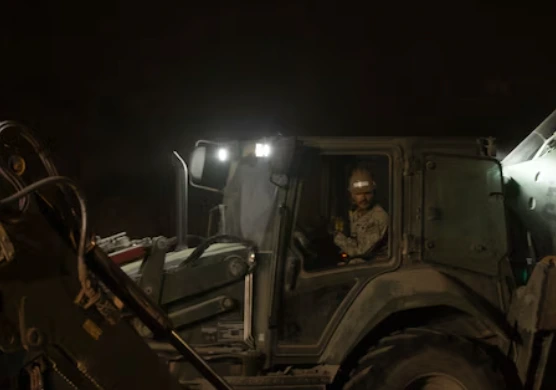
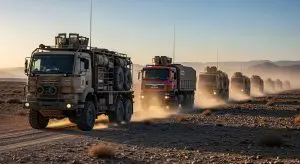
Marines drive heavy equipment transports, fuel tankers, cargo trucks, tactical troop carriers, and specialized vehicles designed for difficult and unpredictable terrain. They operate in convoys that require strict discipline, synchronized timing, steady communication, and a shared commitment to safety.
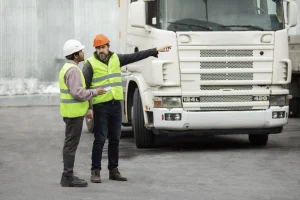
This environment mirrors the world of commercial trucking. Civilian drivers also face unpredictable weather, long distances, tight delivery windows, high-risk corridors, and the mental endurance required to take responsibility for cargo, equipment, and themselves.
Discipline and Professional Identity
Within the Marine Corps, logistics personnel are not simply drivers; they are trained decision-makers. They read terrain, resolve mechanical issues while on the move, manage timing, maintain equipment, and communicate under pressure. Their strength is not only physical — it is mental discipline.
Professional truck drivers understand this identity well. Their work depends on consistency, responsibility, attention to detail, and respect for risk. The shared lesson between Marines and truckers is clear: professionalism is built in the routine, not the spectacle.
Maintenance as Philosophy
In Marine logistics, preventative maintenance is a cornerstone of operational success. Every vehicle is inspected before departure and once again on return. No mission begins without certainty in equipment condition. This is not bureaucracy: it is survival.
The trucking industry lives by this same truth. A breakdown is never “just a breakdown.” It is lost time, safety risk, and operational cost. Both Marines and truck drivers know that preparation is invisible — until the moment it saves everything.
From Uniform to Highway
It is no coincidence that many Marines later become truck drivers. The skills transfer naturally: endurance, route planning, mechanical understanding, the ability to stay focused alone while still being part of a coordinated system. Several U.S. states formally recognize Marine vehicle operation when issuing CDL licenses, acknowledging its high standard.
For many former Marines, the mission does not end — it simply changes cargo.
A Shared Tribute
Saying Happy Birthday, Marines on this 250th anniversary means honoring not only the history of military service, but also those whose work keeps movement possible. The motto Semper Fidelis — Always Faithful — reflects a principle every long-haul driver knows: miles are earned, never given.
Whether crossing desert sands, mountain passes, interstate highways, or remote borders, one truth remains unchanged:
The world runs because someone drives.
Truck driver: stop choosing the worst route

Global Road Freight on Track to Hit USD 5 Trillion by 2033
Global Road Freight on Track to Hit USD 5 Trillion by 2033 as e-commerce growth, supply chain restructuring, and technology adoption accelerate demand for road-based cargo transport worldwide.

California misses DOT deadline risking $160 million in federal funding
The state of California has reached the deadline set by the DOT to take action regarding the situation involving the number of non-domiciled CDLs issued

Health on Wheels: How to Prevent the Most Common Conditions on the Road
Health on wheels matters for anyone who spends long hours on the road. How to prevent the most common physical and mental conditions and maintain healthier routines while working behind the wheel.

More Roadside Controls in 2026: What Truckers Need to Know
The U.S. trucking industry will face More Roadside Controls in 2026, with tighter inspections, data-driven enforcement, and stricter oversight of hours of service, licensing, and vehicle maintenance—what truckers need to know to stay compliant.

$118M in FMCSA Grants Boost Road Safety, Truck Enforcement, and Driver Training
More than $118 million in FMCSA grants will be distributed nationwide to improve road safety, commercial vehicle enforcement, CDL integrity, and truck driver training, with a strong focus on data-driven oversight and veterans entering the trucking workforce.

Essential documents every trucker needs to start 2026
In January, truck drivers should make sure they have the following key documents ready to meet legal requirements. A new year has arrived, and what