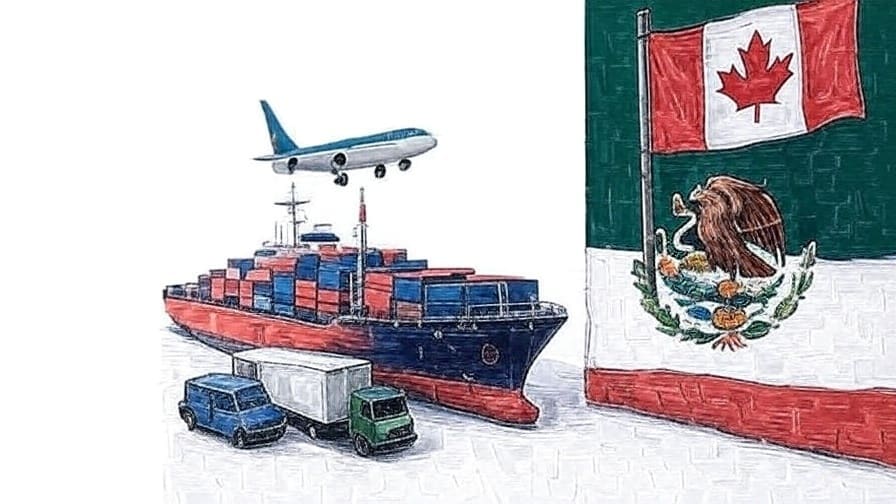
Cross-border freight among the United States, Canada, and Mexico reached $131 billion, a 2.4% year-over-year drop that underscores uneven performance across the continent’s main trade corridors.
In June 2025, cross-border freight between the United States, Canada, and Mexico totaled $131 billion, marking a decline of 2.4% compared to the previous year. The data highlights diverging trends across the continent’s major trade corridors.
Trade with Canada fell 9.7%, amounting to $58.1 billion, while trade with Mexico rose 4.4%, reaching $73 billion. This sharp contrast underscores Mexico’s growing role as the United States’ top land trade partner, powered by robust supply chains in the technology and automotive sectors. Canada, meanwhile, is seeing contractions across multiple industrial areas.

Freight by Mode: Air Cargo Surges, Rail and Pipelines Weaken
BTS data reveals significant variation across transportation modes in June 2025:
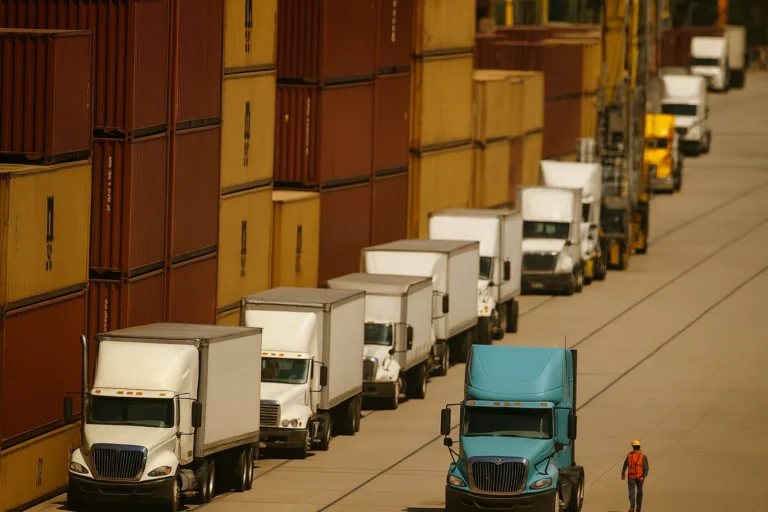
- Trucks: $84.9 billion (down 2.4%)
- Rail: $15.4 billion (down 11.9%, the steepest decline among land modes)
- Maritime: $10 billion (down 4.4%)
- Pipelines: $7.9 billion (down 11.6%)
- Air: $5 billion (up 8.5%)
Air cargo stood out as the only growing mode, boosted by shipments of high-value goods such as electronics, machinery, and pharmaceuticals. In contrast, land and energy transport struggled amid shifting market conditions.
Key Border Crossings: Laredo Leads North America
The BTS report also identifies the busiest freight gateways:
- S.–Canada: Detroit, Port Huron, and Buffalo lead in trucking; Detroit, Port Huron, and International Falls dominate rail; Chicago, Port Huron, and Minneapolis are central for pipelines; Boston, Arthur, and Portland stand out for maritime energy flows.
- S.–Mexico: Laredo, Texas, tops the list with $24.7 billion in truck trade, followed by El Paso–Ysleta ($9.5 billion) and Otay Mesa, California ($4.7 billion). On rail, Laredo ($4 billion), Eagle Pass ($2.9 billion), and Nogales ($700 million) are key. Houston, Arthur, and Texas City anchor energy trade by sea.
These figures confirm the strategic dominance of the southern border—especially Laredo—as the top trade gateway in North America.
Top Commodities: Electronics, Vehicles, and Energy
The most-traded goods in June 2025 included:
- S.–Canada: Computers and parts ($5.6 billion), vehicles and auto parts ($3.7 billion), electrical machinery ($2.3 billion).
- S.–Mexico: Computers and parts ($15.5 billion), electrical machinery ($11.2 billion), vehicles and auto parts ($6.9 billion).
Rail shipments remained dominated by vehicles, supplemented by mineral fuels and plastics with Canada, and computing machinery with Mexico.
Outlook: Opportunities and Challenges
The BTS emphasized that all figures are in current U.S. dollars, not adjusted for inflation or seasonality, and subject to revision. The next report, covering July 2025, will be released on September 24, 2025.
The current trade picture reveals:
- Mexico’s rising momentum in U.S. trade, fueled by tech and auto supply chains.
- Canada’s slowdown in critical industries.
- Air freight’s resilience, contrasting with rail, pipelines, and maritime declines.
The 2.4% drop in cross-border freight trade in June 2025 presents both challenges and opportunities for North America. While the downturn highlights vulnerabilities in energy and land transport, it also underscores the potential of air cargo and Mexico’s growing role as a logistics hub.
With computers, vehicles, and electrical machinery leading the flow of goods, the region’s competitiveness will depend on infrastructure investment, streamlined border operations, and adaptability to global trade shifts.
.

What Are the 5 Most Expensive Highways for Trucks in the U.S.?
These five U.S. highways have some of the highest toll costs for trucks, adding hundreds of dollars to a single trip.

Truckers in Washington: How to adapt to the new economy and come out ahead
The transportation market in Washington state is transforming. This article outlines the key factors and best strategies for optimizing routes, reducing costs, and capturing the most profitable loads.

Florida Raises Crash Reporting Threshold to $2,000
Starting October 1, Florida will quadruple the property-damage threshold that triggers the requirement to immediately report a crash. For truck drivers, however, the dollar value of the damage is not the only factor that matters.

Frequently Asked Questions About Trucking in Washington
100 questions and answers for truck drivers operating in the state of Washington.

Washington updates its freight corridors: how truck navigation will change on I-5, I-90, and other key routes.
The State of Washington is updating its planning for the state’s most important freight corridors with a clear goal: improving commercial truck traffic, strengthening supply

Washington speeds up new logistics hub development to strengthen freight transportation and trade with Canada
Washington is expanding its network of logistics hubs through investments in ports, highways, and distribution centers to streamline freight transportation.