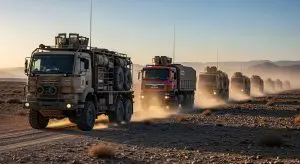
Understanding these terms will help you better grasp how the industry functions and its processes
The trucking industry has a specialized language understood only by those who are part of it. In such a dynamic field, it’s common to use multiple abbreviations that truckers learn to recognize quickly over time. Jenna Hume from FleetOwner has shared some of these secrets, which we have compiled into what we call “The Trucking ABCs.”
This glossary is designed for those who are just beginning to explore the industry or for those who want to speak the language of truckers. Below, you’ll find the main abbreviations that truckers use in their daily routines.

Talk like a trucker: specific terms in trucking operations
The terms listed below pertain to trucking operations. Understanding their meanings will help you better grasp how the industry functions and its processes.
CDL/CLP
CDL stands for Commercial Driver’s License in the U.S. This is a permit that every driver must have to legally operate a commercial vehicle. CDL is categorized into three different classes: A, B, and C.
On the other hand, CLP stands for Commercial Learner’s Permit. This permit allows drivers to operate a commercial vehicle for practice before obtaining a CDL.
CMV
This abbreviation stands for Commercial Motor Vehicle. A CMV is any motor vehicle used on highways for commercial purposes, whether for transporting goods or passengers. Additional requirements include the vehicle’s weight, design, and size.

FTL and LTL
A Full Truck Load (FTL), according to the National Motor Freight Traffic Association, refers to shipments where the truck is completely loaded with cargo that is transported directly from one point to another without making additional stops to pick up or deliver freight. On the other hand, Less Than Truckload (LTL) refers to shipments where the cargo is not enough to fill an entire truck, so the trailer is used to transport goods from multiple customers in a single trip.
HOS
HOS stands for Hours of Service. The FMCSA defines Hours of Service as the maximum number of hours commercial drivers are allowed to work while providing services for a company. Through HOS records, the number and duration of rest periods are monitored to ensure that drivers do not exceed the permitted driving limits.

OTR
You may have frequently seen these initials, as they refer to Over-the-Road Trucking. Also known as long-haul trucking, it involves commercial transport covering distances of 250 to 1,000 miles or more. Generally, it refers to long trips, as opposed to local or regional transportation.
P&D
P&D stands for Pick-Up and Delivery. This classification of freight transport refers to drivers who operate on sales routes or in pick-up and delivery operations, such as those for Amazon. P&D drivers usually have more customer interaction than OTR drivers and make more stops each day, as well as shorter trips.

These are just a few of the many terms that define the world of trucking; however, they are the most commonly used and provide an excellent introduction to the knowledge of this industry.

10 New Year’s Resolutions We Always Make and Never Actually Keep
There are 10 typical resolutions that repeat themselves all over the world. Yet many of the goals we set on December 31 are rarely fulfilled. Not because of a lack of willpower, but because we tend to demand immediate transformations instead of learning to enjoy life, practice gratitude, and live the present moment with greater awareness.

DOT announces grant program to strengthen CDL licensing standards
The DOT seeks to remove unqualified truck drivers from the roads and strengthen CDL licensing standards. Among the most recent efforts by the U.S. Department

9 Apocalyptic Predictions About the U.S. Economy That Didn’t Come True in 2025
From recession fears to collapse scenarios, these nine apocalyptic predictions about the U.S. economy didn’t come true in 2025 — and the data shows why.

California Restricts Truck Traffic on Residential Streets in the Inland Empire Starting in 2026
California’s new rule restricting truck traffic on residential streets in the Inland Empire starting in 2026 will force logistics operators to redesign routes, reshaping freight transportation, urban planning, and the regional supply chain.

$1 Billion U.S. Road Safety Plan Reshapes Key Freight Routes
A $1 billion U.S. road safety plan is reshaping key freight routes nationwide, directing federal investment into highways, intersections, and emergency-response systems to reduce accidents, improve freight efficiency, and deliver safer corridors for truck drivers and local traffic.

States with the most truck drivers in the U.S.
These are the states with the highest number of truck drivers in the United States. The trucking industry employs approximately 3.6 million truck drivers across