Transportation seeks proposals to rebuild the American Legion Memorial Bridge, repeating the call for proposals to address the most critical freight chokepoint on the East Coast. The initiative aims to attract ideas, financing models, and private-sector innovation to modernize a corridor that today imposes millions in delays on the trucking industry.
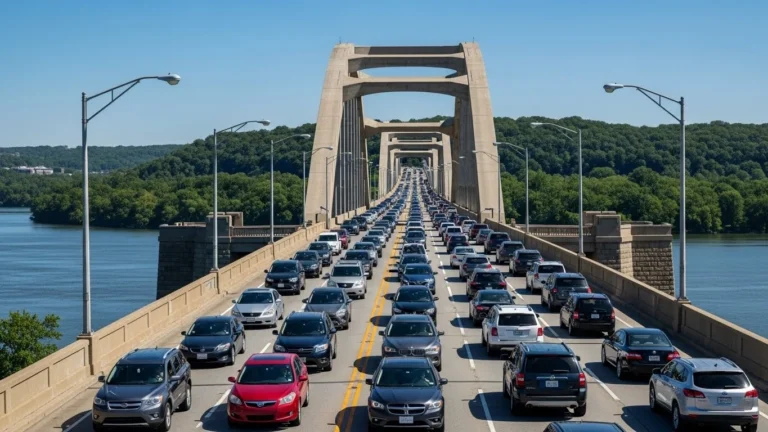
The American Legion Memorial Bridge sits at the center of a growing national concern: the urgent need to rebuild the most critical freight link on the East Coast before congestion and aging infrastructure inflict even greater costs on the trucking sector. As transportation authorities call for proposals from private investors, infrastructure developers, and freight stakeholders, the goal is clear—replace an outdated structure, relieve the most expensive chokepoint in the region, and restore predictability for long-haul carriers moving along the I-495 Capital Beltway.
For transportation leaders, this invitation marks a shift in strategy. With Maryland unable to fully finance the reconstruction on its own, the sector is actively seeking new ideas and partnerships to accelerate a project that has been stalled despite its overwhelming importance to national logistics.
A Bottleneck Costing the Freight Industry USD 43 Million a Year
The American Legion Memorial Bridge is far more than a regional commuter connection. For thousands of truckers navigating the Atlantic seaboard, it functions as the primary bypass to avoid urban congestion around Washington, D.C. It is one of the heaviest freight corridors in the eastern United States—and one of the most fragile.
Years of structural stress and daily saturation have turned the bridge into a persistent chokepoint. According to transportation data cited by FreightWaves and federal officials, congestion on this bridge generates over USD 43 million per year in delays for the freight industry alone. Longer travel times, wasted fuel, and lost hours of service (HOS) combine to erode efficiency across small, mid-size, and large fleets.
For carriers operating under tight contracts and shrinking margins, the cumulative effect of this bottleneck has become unsustainable.
Why Transportation Is Turning to Private-Sector Solutions
Maryland acknowledges the urgency of replacing the bridge—but the state simply does not have the financial capacity to undertake the full reconstruction. The cost of modernizing the American Legion Memorial Bridge, expanding lanes, improving approaches, and upgrading the surrounding Beltway corridor exceeds the available budget by a wide margin.
This financial reality is why transportation authorities are now issuing a public call for proposals, opening the door to private-sector financing and delivery models. The invitation seeks “innovative project solutions” capable of accelerating a project that is essential not only for the region, but for the entire national freight network.
The types of proposals transportation leaders are encouraging include:
Long-term concessions that allow private partners to finance, build, and operate the asset.
Dynamic tolling systems to sustain the project without imposing disproportionate costs on daily users.
Blended financing models involving infrastructure funds, federal grants, and private capital.
Accelerated construction methods to reduce downtime and maintain predictable freight flow.
Smart traffic-management technologies to optimize capacity and reduce congestion even before full reconstruction is completed.
The emphasis is not only on rebuilding the bridge—but on doing so with speed, efficiency, and minimal disruption to freight carriers.

Direct Impact on Truckers and Freight Operators
For truck drivers, the American Legion Memorial Bridge is more than an infrastructure problem—it is a daily operational burden. Congestion at this chokepoint contributes to:
Lost hours of service that cannot be recovered
Higher fatigue due to stop-and-go patterns
Delays in time-sensitive deliveries
Increased fuel consumption
Heightened exposure to rear-end collisions and congestion-related incidents
Rebuilding the bridge would dramatically reduce friction along one of the busiest freight corridors on the East Coast. For fleets, it would mean improved routing reliability, tighter scheduling, lower operational costs, and fewer service disruptions during peak seasons—including the critical holiday freight surge.
A Turning Point for U.S. Transportation Infrastructure
Beyond the importance of this specific bridge, the call for proposals carries a broader message: the nation’s transportation infrastructure is reaching the limits of its capacity, and solving critical freight chokepoints increasingly requires collaboration between the public and private sectors.
With more than 70% of U.S. goods moved by truck, the efficiency of corridors like the Capital Beltway directly shapes the competitiveness of the national economy. The reconstruction of the American Legion Memorial Bridge is not simply a regional upgrade—it is a strategic investment in the health of the entire supply chain.
As transportation leaders continue to seek proposals, the coming months will define what model is chosen, how quickly construction can begin, and what role private capital will play in alleviating one of the country’s most costly freight bottlenecks.

Seven charged in New York CDL fraud case involving DMV employees
A group of DMV employees in New York allegedly manipulated the process of obtaining commercial driver’s licenses by allowing applicants who never showed up to

Transportation Seeks Proposals to Rebuild the American Legion Memorial Bridge
Transportation seeks proposals to rebuild the American Legion Memorial Bridge, repeating the call for proposals to address the most critical freight chokepoint on the East Coast. The initiative aims to attract ideas, financing models, and private-sector innovation to modernize a corridor that today imposes millions in delays on the trucking industry.
New action plan targets fraud, safety, and regulatory gaps in U.S. trucking
A roadmap to reform: how TAEC plans to eliminate fraud in American trucking A broad group of state trucking associations has published an action plan

The top 5 big rigs ever manufactured
Big rigs are more than just machines—they are icons of the open road, symbols of power, endurance, and craftsmanship. Bob Dilliplaine Orange Commercial Credit Big

California DMV unveils revised rules for autonomous truck operations
The California DMV announced a series of proposed revisions aimed at facilitating the testing and eventual deployment of autonomous trucks on the state’s highways. The

Polar Vortex in the U.S.: Northeast Could Become the Coldest Place on Earth Before Christmas
A powerful polar vortex could make the Northeast the coldest place on Earth, bringing life-threatening cold just days before Christmas.