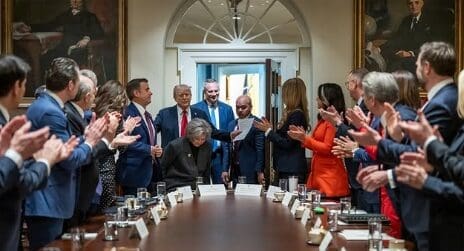
In his first Cabinet meeting since beginning his second term, U.S. President Donald Trump declared his intention to impose a 25% tariff on European Union (EU) imports, claiming the bloc was "created to take advantage of the United States."
In his first Cabinet meeting since beginning his second term, U.S. President Donald Trump declared his intention to impose a 25% tariff on European Union (EU) imports, claiming the bloc was “created to take advantage of the United States”
Trump reiterated his longstanding grievances against the EU, accusing it of maintaining unfair trade practices. “They don’t accept our cars, they reject our farm products under false pretenses, yet we take everything from them,” he said. “We run a $300 billion deficit with the EU.”
The European Commission quickly responded, warning that any unjustified trade restrictions would be met with firm countermeasures. A spokesperson for the Commission stated, “The EU will react swiftly and decisively to protect free and fair trade.”
Despite past EU resistance to similar tariff threats, Trump remained undeterred. When asked about potential retaliatory measures from European nations, he dismissed the possibility of effective pushback. “They can try,” he said, “but they won’t win. If necessary, we’ll just stop buying from them altogether. We hold the power.”

Ukraine’s NATO Bid Rejected
Turning to foreign policy, Trump ruled out Ukraine’s NATO membership aspirations, suggesting that the possibility of Kyiv joining the alliance was a primary cause of Russia’s full-scale invasion. “Ukraine can forget about NATO,” he stated bluntly. “That’s probably what started this whole thing in the first place.”
Later this week, Trump is set to host Ukrainian President Volodymyr Zelenskyy at the White House to sign a minerals agreement, which will grant the U.S. access to Ukraine’s mineral resources in exchange for continued American support.
Trump, who has frequently criticized U.S. financial aid to Ukraine, framed the deal as a way for Kyiv to “repay” America. “The previous administration put us in a terrible position, but we’re fixing that now. This deal ensures we get our money back—and then some.”
Vice President JD Vance also spoke on the issue, pushing back against claims that Trump had conceded to Russian interests. “Every time the president engages in diplomacy, he’s accused of making concessions,” Vance said. “That’s simply not true. He is acting as the chief diplomat of the United States.”

Elon Musk Warns of U.S. Bankruptcy Without DOGE
In an unexpected turn, Trump invited billionaire Elon Musk to speak at the meeting. Though not an official Cabinet member, Musk currently heads the Department of Government Efficiency (DOGE), an initiative aimed at reducing the national deficit.
“America cannot sustain a $2 trillion deficit,” Musk warned. “Without DOGE, the country will go bankrupt.”
However, Musk admitted that the agency had already made some errors in its cost-cutting efforts, such as mistakenly canceling USAID’s Ebola prevention programs. He insisted that “there was no disruption” in critical services before funding was restored.
Since resuming office on January 20, Trump has frozen all foreign aid spending, including funding for disease prevention initiatives. According to USAID officials, no new funds have been released for Ebola response efforts since the freeze began.
Musk also defended his controversial “pulse check” emails, which require government employees to justify their weekly work activities or risk termination. He dismissed criticisms of the policy, claiming it was a necessary measure to confirm whether government workers “are real, alive, and capable of writing an email.”
As Trump’s second term gains momentum, his aggressive trade stance, foreign policy shifts, and unorthodox government efficiency measures are set to remain focal points of his administration’s agenda.

Guide to Cab Card: What Is It, What It’s Used For, and Why You Should Carry It in Washington
The Cab Card is a registration card or document that identifies a commercial vehicle and provides information related to its authorization to operate.

Port of Tacoma: How to Pick Up Containers Faster in 2026
RFID mandatory also at domestic terminals, new shift dashboard, and updated eModal rules: the 2026 guide to picking up containers faster at the Port of Tacoma.

Bridges in Washington with Restrictions for Commercial Vehicles
The state of Washington has several bridge restrictions that every truck driver should know.

How the SR 167 is progressing and what will change for truckers
WSDOT began the final stage of SR 167 in July 2026, the highway that will directly connect the Port of Tacoma with I-5.

The Busiest Freight Corridors in Texas
Learn about the main freight corridors in Texas and the most important routes for truck drivers transporting goods.

When Is a Truck Too Old to Insure in the United States? Age Isn’t the Real Problem
An older truck is not necessarily an obsolete truck. In the United States, the real problem begins when age translates into mechanical deficiencies, inadequate maintenance, safety violations, or an inability to meet the requirements applicable to the carrier’s operation. Brakes, tires, lights, inspections, maintenance, cargo, and type of operation can matter far more than the year printed on the title.