According to the IRU’s global report, 3.6 million positions in the road transport sector remain unfilled across the 36 countries.
The latest report of the IRU, the global road transport organization, reveals alarming data about the global shortage of truck drivers. The study, which examines industry vacancies throughout 2024, highlights a growing generational gap: the average age of drivers continues to rise, while the entry of young people into the sector is increasingly limited.
According to the IRU’s global report, 3.6 million positions in the road transport sector remain unfilled across the 36 countries analyzed, which together represent 70% of global GDP. This confirms that the driver shortage is a structural problem affecting all regions. The survey, which included more than 5,000 transport companies in 2024, revealed that in some countries, up to 70% of companies are facing serious or very serious difficulties in hiring drivers.
China, the United States, and Mexico are among the countries experiencing the most severe shortages of truck drivers. In 2024, China reported 2.9 million vacancies in the sector, followed by Mexico with 99,000 and the United States with 67,000 unfilled positions. These figures represent between 15% and 16% of the industry’s total jobs. With this data, the IRU aims to highlight how age distribution directly impacts the severity of the shortage.

The age gap among drivers is widening
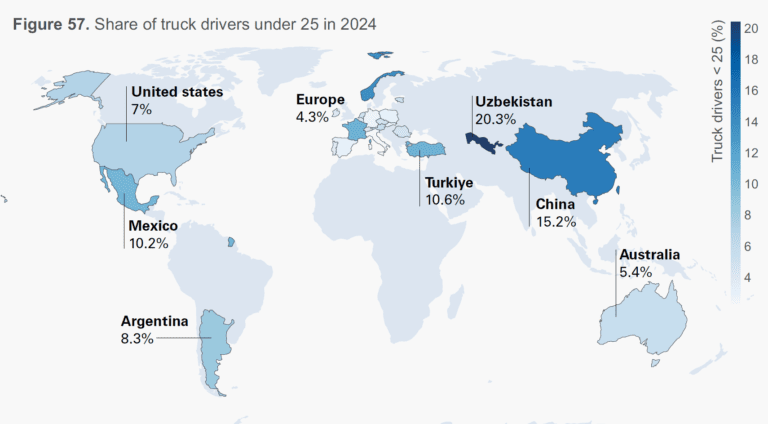
The IRU describes the lack of young drivers as a “growing generational gap” between younger and older drivers. This gap is clear when considering that drivers aged 25 or younger make up only 6.5% of the total workforce. In some countries, the numbers are even lower, revealing a worrying lack of generational renewal in the industry:
- Italy: 2.2%
- Germany: 2.6%
- Poland: 3%
- Spain: 3%
Additionally, the report shows that the percentage of young truck drivers fell by 5.8% from 2023 to 2024. In stark contrast, 31.6% of truck drivers are over 55 years old, with particularly high proportions in the following countries:
- Spain: 50%
- Australia: 47%
- Italy: 45%
The trend is indeed concerning. In line with global workforce participation rates for older age groups, the share of truck drivers over 55 increased by 1.6% in the last year. As a result, the global average age of truck drivers has risen to 44.5 years, according to the IRU report.
This aging workforce is especially worrying, as an estimated 3.4 million drivers in the studied countries are expected to retire within the next five years. In Australia, 21% of current drivers are projected to retire by 2029; in China, 18%; and in Europe, 17%. This suggests that labor shortages will continue to worsen, further deepening the generational divide.

Job satisfaction amid the age gap
Wages are often cited as a key reason behind the driver shortage, but the data contradicts this. Average truck driver salaries range from 30% to 135% above the basic cost of living across all regions. There is no clear correlation between driver wage levels and the severity of the shortage.
Regarding job satisfaction, the IRU found that 81% of truck drivers are satisfied with their work, with 57% reporting being very or extremely satisfied. Drivers under the age of 25 reported the highest levels of job satisfaction across all age groups. However, 91% of respondents cited the lack of well-equipped rest areas and poor treatment at delivery sites as their main concerns on the job.
In Australia and several European countries, the structural gap between younger and older drivers is especially pronounced. IRU Secretary General Umberto de Pretto stated that the crisis is worsening at an alarming rate and emphasized the urgent need for action to address the issue.


Truck drivers are at high risk of developing diabetes
About 11% of the adult population meets the criteria for prediabetes, and there is a particular group at high risk: truck drivers. Diabetes rates in

Starting in trucking: required permits, registrations, and compliance
Are you a new carrier? This is what you need to know about permits, registration, and compliance. The trucking industry can be quite challenging for

Alberta Clipper Brings an Early Polar Blast: A Critical Alert for Drivers
The Alberta Clipper is sweeping across the country with fast-moving Arctic air, sharp temperature drops, and dangerous road conditions that demand heightened attention from all professional drivers.

American manufacturers trigger truck “dumping” investigation
Foreign trailer manufacturers under investigation for alleged “dumping” in the U.S. The U.S. truck market is at the center of a trade dispute. After domestic

ATRI Warns: Litigation Is Rising Across the U.S. Trucking Industry
A new report from the American Transportation Research Institute (ATRI) reveals how escalating litigation, higher legal costs, and mounting insurance pressures are reshaping the U.S. trucking industry. The findings mark a critical moment for motor carriers, insurers, and logistics stakeholders who must understand the changing legal environment — and the increasingly strategic role of strong insurance partnerships.

FMCSA says no to hours-of-service exemptions
FMCSA rejects two requests for exemptions to hours-of-service rules for commercial drivers. The Federal Motor Carrier Safety Administration (FMCSA) has denied two exemption requests related