A new national ranking reveals the best and worst states to be a truck driver in the United States in 2026, measuring truck driver salaries, fatal crashes, congestion and road conditions.
Choosing where to work has become one of the most strategic decisions a professional truck driver can make. Pay still matters, but it is no longer the only factor defining whether a route is truly worth it. Traffic density, pavement quality, infrastructure reliability and the probability of being involved in a crash now play a central role in day-to-day life behind the wheel.
In 2026, with freight demand high and delivery schedules tighter than ever, understanding the operating environment in each state is critical. A few cents more per mile may not compensate for constant congestion, higher stress levels or increased exposure to serious accidents.
With that in mind, The Barber Law Firm produced a nationwide ranking comparing all 50 states using official data from the National Highway Traffic Safety Administration and the Federal Highway Administration. The goal is simple: transform complex statistics into practical guidance for drivers, carriers and recruiters.

How the ranking was built
The study integrates five variables that together describe what a truck driver can realistically expect when working in a specific state.
Researchers examined the average annual salary, large trucks involved in fatal crashes per 100,000 registrations, total fatalities under the same metric, interstate congestion per mile and the share of highways considered to be in good or fair condition.
By blending income potential with risk exposure and infrastructure quality, the report creates a final score that highlights which states demand extra caution and which provide a more predictable work setting.
The most challenging states for truck drivers
At the bottom of the ranking are places where safety concerns, operational strain and infrastructure issues combine to make daily work harder.
Louisiana frequently appears among the toughest environments. Analysts point to elevated crash statistics and road conditions that require sustained attention throughout long shifts.
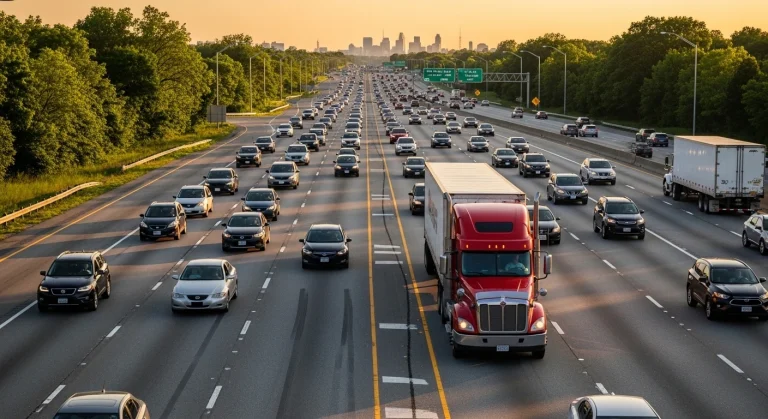
Texas represents a paradox. Freight activity is enormous and earning opportunities are strong, yet heavy traffic and urban congestion significantly raise the likelihood of incidents. Many drivers say the accumulated stress can offset part of the financial benefit.
New Mexico stands out for its fatality numbers relative to the volume of registered trucks. Long stretches between services and remote corridors may add extra pressure during extended hauls.
Mississippi presents demanding routes and safety indicators that often exceed the national average. Oklahoma also remains above benchmark risk levels, forcing companies and drivers to plan more carefully.
Other states frequently listed among the most difficult include Arizona, Delaware, North Carolina, South Carolina and West Virginia.
For many professionals, this does not necessarily mean refusing loads to those destinations. Instead, the information becomes leverage to negotiate higher rates, include additional rest time or secure broader insurance protection.
Where truck drivers find better conditions
On the positive side of the spectrum, several states offer lighter traffic volumes and infrastructure that helps reduce critical situations.
Wyoming is regularly mentioned thanks to open highways and comparatively low crash rates. North Dakota maintains solid safety metrics even on corridors with intense freight movement.
Georgia achieves an attractive balance between economic activity and road maintenance, making it appealing for fleets assigning regular routes. Montana benefits from low population density, which translates into fewer delays and smoother daily operations. Kansas also ranks well because its conditions favor planning and limit unexpected disruptions.
In these states, drivers typically encounter fewer traffic jams and face a lower statistical probability of being involved in fatal collisions.
Pay is no longer the only magnet
The trucking industry has evolved. Quality of life on the road, fatigue generated by constant stop-and-go traffic, availability of rest areas and personal security are increasingly decisive.
Many truck drivers are willing to accept slightly lower annual earnings in exchange for greater stability and reduced tension. Online communities and social networks accelerate the spread of both good and bad experiences, shaping employment decisions faster than ever.
Why recruiters and fleets should pay attention
For carriers, brokers and logistics operators, understanding this risk map is invaluable.
It supports smarter incentive structures by corridor, improves safety policy design, allows more accurate insurance projections and strengthens retention strategies. In a market where experienced drivers are hard to secure, offering routes in better-rated states can be as powerful as raising pay.
Reliable data enables both companies and truck drivers to make informed choices, minimize unpleasant surprises and build longer, more sustainable working relationships.
Comparison Chart – Best & Worst States for a Truck Driver (2026)
| Category | State | What it means for a truck driver | Main risk or advantage factors |
|---|---|---|---|
| Worst | Louisiana | Highly demanding daily operation | High crash rates, infrastructure challenges |
| Worst | Texas | Heavy operational pressure | Extreme traffic volume, major congestion, higher exposure to incidents |
| Worst | New Mexico | Elevated fatality concern | High deaths relative to number of truck registrations |
| Worst | Mississippi | Tough environment | Safety indicators above national averages |
| Worst | Oklahoma | Harder trip planning | Risk levels higher than comparable markets |
| Also challenging | Arizona | Physically demanding routes | Long corridors, heat, relevant crash exposure |
| Also challenging | Delaware | Dense traffic | Congestion in key freight corridors |
| Also challenging | North Carolina | Intense operation | Heavy traffic, logistics pressure |
| Also challenging | South Carolina | Greater exposure | Weaker safety performance than top states |
| Also challenging | West Virginia | Complex terrain | Mountain routes, variable infrastructure |
| Best | Wyoming | More predictable trips | Low congestion, fewer severe crashes |
| Best | North Dakota | Strong balance | Good safety outcomes in freight routes |
| Best | Georgia | Fleet-friendly | Economic activity with consistent road maintenance |
| Best | Montana | Lower daily stress | Very low traffic density |
| Best | Kansas | Easier scheduling | Stable and predictable road conditions |

What are Grabovoi numbers and what can be manifested with them
Grabovoi numbers: a list of numerical sequences intended to activate certain areas of daily life in order to enhance, improve, and develop them. Manifestation and

CVSA’s 2026 international inspection to target ELD manipulation
The 2026 inspection will focus on drivers who falsify or manipulate their electronic logging devices (ELDs) to alter their hours of service. Each year, the

Illinois CDL Audit: 20% Under Federal Review
A federal audit found that nearly 20% of Illinois’ non-domiciled CDLs may not comply with federal standards. The state has 30 days to correct the issues or risk losing $128 million in highway funding.

Wall Street under the microscope: solid employment, contained inflation, and rising volatility
Employment, inflation, and retail sales set the tone for a week marked by volatility and sector rotation on Wall Street. In the latest episode of

Predictive Logistics 2026: AI Stops Bottlenecks Before They Start
Predictive AI in transportation is no longer experimental — it is operational. In 2026, intelligent logistics systems anticipate demand spikes, optimize inventory levels, and redesign routes in real time, eliminating supply chain disruptions before they occur.

Best and Worst States to Be a Truck Driver in the United States in 2026
A new national ranking reveals the best and worst states to be a truck driver in the United States in 2026, measuring truck driver salaries, fatal crashes, congestion and road conditions.