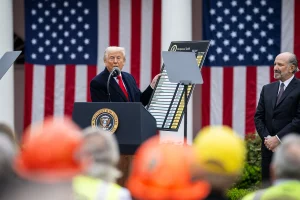
Companies have challenged the global tariffs imposed by President Donald Trump, asking federal courts to reactivate proceedings to begin the refund process.

The companies that challenged the global tariffs imposed by President Donald Trump have asked federal courts to reactivate proceedings to begin the refund process, after the Supreme Court of the United States struck down the levies.

On February 20, the Supreme Court confirmed that the so-called “reciprocal” tariffs were unlawfully imposed under the International Emergency Economic Powers Act of 1977. In doing so, it upheld a prior ruling by the United States Court of Appeals for the Federal Circuit. The plaintiffs are now asking that the decision be formalized so the case can return to the United States Court of International Trade, where the next steps, including the reimbursement of amounts paid, will be determined.

$170 billion at stake: 1,500 companies demand tariff refunds
Image: The White House, Public domain, via Wikimedia Commons

1,500 refund claims before the Supreme Court

To date, more than 1,500 refund claims have been filed, according to an analysis by Bloomberg News, with most submitted after the Supreme Court heard arguments in November and placed on hold pending the ruling. In the days following the decision, new cases have continued to be filed.

Among the most recent plaintiffs is FedEx Corp., which filed its claim on February 23, though it did not disclose the amount paid in tariffs. In a brief submitted to the Court of International Trade, the company stated that it has “suffered harm” as a result of paying the tariffs and is therefore seeking prompt compensation.

The remaining companies asked the trade court on February 25 to schedule a hearing as soon as possible to prevent further economic harm and legal complications. However, according to court filings, the government opposed setting an immediate hearing.

The companies involved in the case before the Supreme Court did not seek a nationwide injunction, considering that the ruling already prevents enforcement of the tariffs. Nevertheless, they suggested that the trade court could consolidate all claims to ensure a swift and fair resolution.

In earlier filings, the Department of Justice had indicated that if the original plaintiffs prevailed, they would receive refunds with interest. However, following the ruling, Trump suggested that paying refunds could lead to new litigation and drag on for years. So far, importers have paid approximately $170 billion in tariffs.

170 mil millones de dólares en juego: 1,500 empresas demandan obtener reembolsos arancelarios
Image: DanielMichaelPerry, CC0, via Wikimedia Commons

A complex legal landscape

International trade experts anticipate that the administration will face a complex legal landscape if it attempts to block the refunds, given that it had previously acknowledged the possibility of reimbursing the plaintiffs and conceded key points in order to continue collecting the duties while the judicial dispute progressed.

Shortly after the Supreme Court’s ruling, Trump signed a new proclamation imposing another round of global tariffs, this time under the authority of the Trade Act of 1974. Analysts expect that these new measures could also be challenged in court.

Facebook
Twitter
LinkedIn
WhatsApp

Leave a Reply

Your email address will not be published. Required fields are marked *

Business hours: Monday to Friday from 8:00 AM to 5:00 PM. California time
Leave your number and a member of our company will contact you
Horario de atención: Lunes a viernes de 8.00 AM a 5.00 PM. Hora california

Deje su número y un miembro de nuestra empresa se pondrá en contacto con usted

Privacy summary

This website uses cookies so that we can offer you the best possible user experience. Cookie information is stored in your browser and performs functions such as recognizing you when you return to our website or helping our team understand which sections of the website you find most interesting and useful.

More information about the privacy policy: Privacy Policy

More information about the terms of use: Terms of use 

More information about the disclaimer: Disclaimer 

More information on acceptable use policies: Acceptable Use Policies