Incidents between ships and bridges that have left their mark on maritime transport
On March 26th, the Francis Scott Key Bridge in Baltimore collapsed after colliding with a 948-foot-long container ship, which lost power during its journey. The incident led to the closure of one of the busiest ports in the United States, while rescue teams continue to search for possible survivors in the Patapsco River. In the days following the incident, authorities have focused on rescue efforts and assessing the total damages.
While this is the most recent incident caused by a ship colliding with a bridge, it is not the only one in the history of the United States. Over the years, similar accidents have been recorded on different scales, highlighting the risks associated with maritime transportation.
Bridge collisions in the United States
John P. Grace Memorial Bridge, 1946
On February 24, 1946, the SS Nicaragua Victory was anchored in the Cooper River in Charleston, South Carolina, when it veered off course during a storm and collided with the John P. Grace Memorial Bridge. This impact caused a section of the bridge to collapse into the river, resulting in the fall of a vehicle traveling on it, and causing five fatalities.
Sidney Lanier Bridge, 1972
On November 7, 1972, the African Neptune, just 15 minutes after departing from the docks of Brunswick, Georgia, collided with the Sidney Lanier Bridge, causing it to collapse. This tragedy resulted in the loss of 10 lives and left 11 people injured. This incident was not isolated, as 15 years later, the Polish freighter Ziemia Bialostocka collided with the same bridge, causing damages totaling $1.4 million.

Sunshine Skyway Bridge, 1980
On May 9, 1980, the Sunshine Skyway Bridge, spanning Lower Tampa Bay in Florida, collapsed after the cargo ship Summit Venture collided with one of its support columns during a sudden storm. Unfortunately, at the time of impact, several vehicles and a truck carrying 26 people plunged into the water. This tragedy resulted in the loss of 35 lives.
Big Bayou Canot, 1993
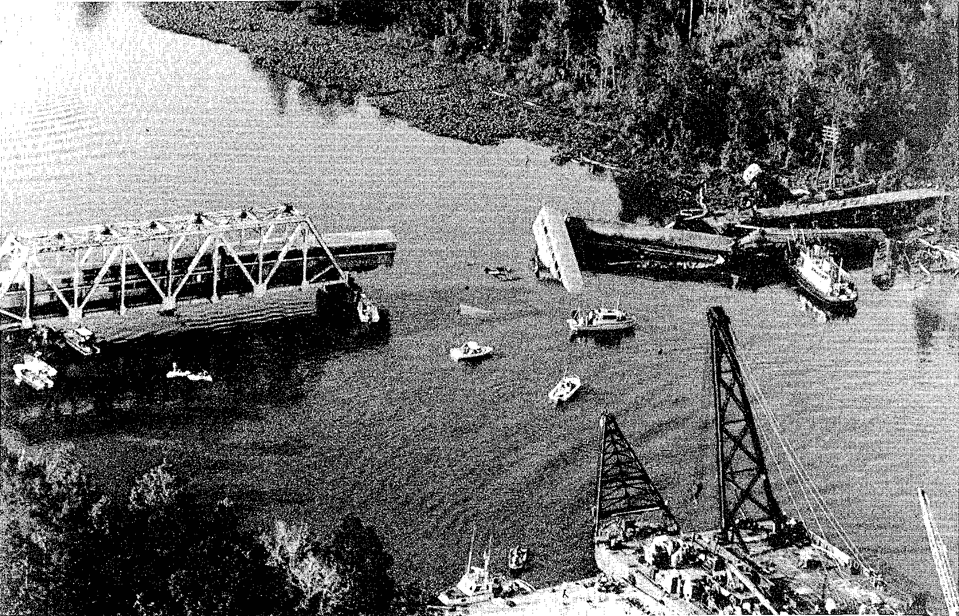
In dense fog on September 22, 1993, the towboat Mauvilla was pushing barges when, due to low visibility, it collided with the Big Bayou Canot railroad bridge near Mobile, Alabama. Shortly after the impact, an Amtrak train traveling from Los Angeles to Miami collided with the newly displaced bridge and derailed. Several cars fell into the water, resulting in the loss of 47 lives and leaving 103 people injured.

Queen Isabella Causeway, 2001
On September 15, 2001, a tugboat carrying four barges collided with the Texas bridge, connecting South Padre Island with Port Isabel. The collision caused ten vehicles to fall off the bridge, tragically resulting in the death of eight people.
Interstate 40 Bridge, 2002
On May 26, 2002, the towboat Robert Y. Love was navigating the Arkansas River in Oklahoma, transporting barges, when it lost control of the tow. This caused the barges to collide with the bridge pier, which in turn caused a section of the bridge over the river to collapse, throwing vehicles and tractor-trailers into the water. This accident resulted in the tragic loss of 14 lives and left another 11 injured.


Trucking in Alaska and Hawaii: How America’s Non‑Contiguous States Break the Mold
When you step outside the contiguous U.S. and look at Alaska and Hawaii, the trucking industry becomes a very different story

FMCSA updates its coercion rule for drivers facing HOS and ELD pressure
The FMCSA’s updated guidance explains that the “coercion rule” is intended to protect commercial motor vehicle drivers.

New York Can Suspend Driver’s Licenses Over Tax Debt
New York has once again put the spotlight on driver’s license suspensions tied to unpaid state taxes, a situation that could affect thousands of transportation, delivery, and logistics workers who depend on driving to earn a living. For commercial drivers and CDL operators, the consequences can go far beyond a simple fine.

What you need to know about CVSA’s International Roadcheck 2026
The first annual inspection, as every year, kicks off with the International Roadcheck, also known as DOT Blitz Week. Here’s what you need to know.

Tariff Shock: Why U.S. Freight Demand Is Suddenly Surging
Companies are cutting inventories to avoid rising tariff-related and storage costs, forcing goods to move faster and in smaller batches. The unexpected result: stronger trucking demand

Bot Auto completes its first driverless commercial highway shipment
Bot Auto has completed its first long-distance commercial shipment without a driver in the cab or a remote operator.