A federal audit found that nearly 20% of Illinois’ non-domiciled CDLs may not comply with federal standards. The state has 30 days to correct the issues or risk losing $128 million in highway funding.
A review conducted by the Federal Motor Carrier Safety Administration (FMCSA) placed Illinois’ commercial driver licensing program under scrutiny after identifying compliance failures in the issuance of non-domiciled Commercial Driver’s Licenses (CDLs).
The audit, part of a nationwide initiative led by the U.S. Department of Transportation (USDOT), found that approximately 20% of non-domiciled CDLs issued by Illinois may have been granted in violation of federal requirements.
Key compliance concerns
According to preliminary findings, investigators identified two main categories of irregularities:
- Licenses that remained valid after the driver’s lawful presence had expired.
- Cases where immigration status may not have been properly verified prior to issuance.
Non-domiciled CDLs are designed for drivers who do not hold permanent U.S. residency but are legally authorized to operate commercial vehicles under specific conditions. However, strict federal documentation and verification standards must be followed.

30-day deadline and funding risk
Following the audit, Illinois was formally notified that it has 30 days to bring its program into compliance. If corrective measures are not implemented, the state could lose up to $128 million in federal highway funding.
Required actions include:
- Temporary suspension of new non-domiciled CDL issuance.
- Identification of all active licenses that fail to meet federal standards.
- Revocation and potential reissuance of eligible licenses.
- A full internal audit to identify administrative errors, system flaws, training deficiencies, and oversight weaknesses.
The possible withholding of funds represents a serious financial concern, as these federal dollars are critical for road maintenance and infrastructure improvements.
.
Part of a broader national review
Illinois is not alone. Federal authorities have also identified compliance concerns in states including California, New York, and Pennsylvania as part of this broader enforcement effort.
The review aligns with federal directives focused on strengthening highway safety, tightening CDL issuance standards, and reinforcing eligibility verification procedures nationwide.
English Language Proficiency enforcement
In parallel, the USDOT announced updated guidance reinforcing the federal English Language Proficiency (ELP) requirement for commercial drivers.
Under the revised enforcement framework, drivers who do not meet minimum English competency standards may be placed out of service until compliance is demonstrated. The measure is aimed at improving safety during inspections and ensuring clear understanding of traffic signs and regulations.
Impact on freight and logistics
For the transportation industry, the potential revocation of a significant number of CDLs could affect short-term driver availability, especially amid sustained freight demand.
Motor carriers, logistics operators, and insurers should review driver documentation, monitor regulatory updates, and prepare for possible operational adjustments.
Beyond the political debate, the core issue centers on regulatory compliance and roadway safety. The outcome of Illinois’ response could set an important precedent for CDL oversight across the United States.

What are Grabovoi numbers and what can be manifested with them
Grabovoi numbers: a list of numerical sequences intended to activate certain areas of daily life in order to enhance, improve, and develop them. Manifestation and

CVSA’s 2026 international inspection to target ELD manipulation
The 2026 inspection will focus on drivers who falsify or manipulate their electronic logging devices (ELDs) to alter their hours of service. Each year, the
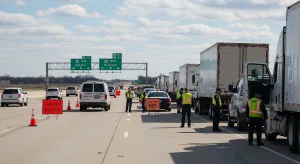
Illinois CDL Audit: 20% Under Federal Review
A federal audit found that nearly 20% of Illinois’ non-domiciled CDLs may not comply with federal standards. The state has 30 days to correct the issues or risk losing $128 million in highway funding.

Wall Street under the microscope: solid employment, contained inflation, and rising volatility
Employment, inflation, and retail sales set the tone for a week marked by volatility and sector rotation on Wall Street. In the latest episode of

Predictive Logistics 2026: AI Stops Bottlenecks Before They Start
Predictive AI in transportation is no longer experimental — it is operational. In 2026, intelligent logistics systems anticipate demand spikes, optimize inventory levels, and redesign routes in real time, eliminating supply chain disruptions before they occur.

Best and Worst States to Be a Truck Driver in the United States in 2026
A new national ranking reveals the best and worst states to be a truck driver in the United States in 2026, measuring truck driver salaries, fatal crashes, congestion and road conditions.