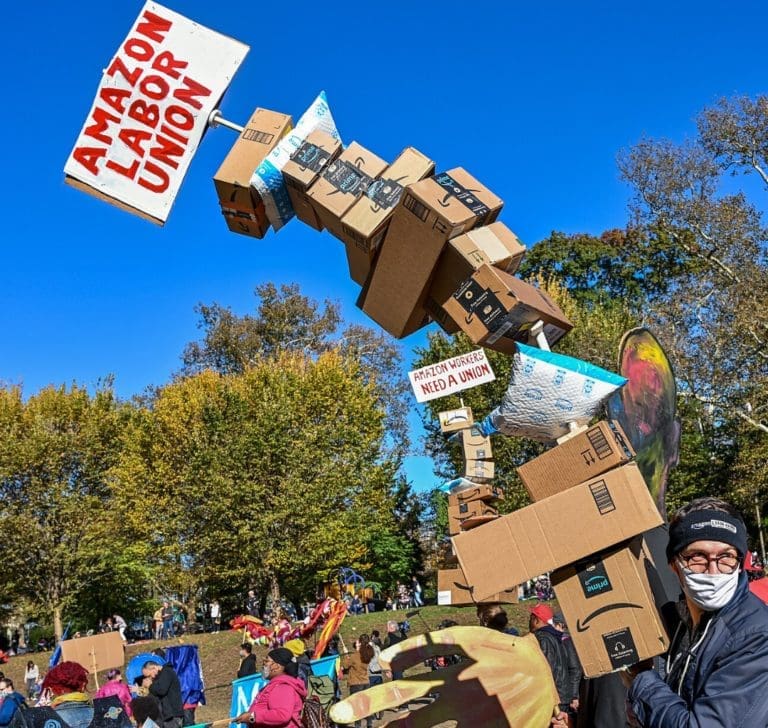
Workers from over 30 countries, including the United States, and more than 80 unions joined the strike for the fifth consecutive year.
Thousands of Amazon employees worldwide went on strike on Friday, November 29, demanding higher wages and improved working conditions during one of the company’s busiest weekends, from Black Friday through Cyber Monday. The strike, organized by UNI Global Union and Progressive International, has been named “Make Amazon Pay Day,” an annual workers’ protest against Jeff Bezos’ multibillion-dollar company.
Workers from over 30 countries, including the United States, and more than 80 unions joined the strike for the fifth consecutive year, holding Amazon accountable for labor abuses, environmental degradation, and threats to democracy. According to Christy Hoffman, General Secretary of UNI Global Union, Amazon’s relentless pursuit of profits comes at a high cost to workers, the environment, and democracy. The protests demand that Amazon fairly pay its employees, commit to sustainability, and respect workers’ right to unionize.

Make Amazon Pay Day: over 80 unions unite in protest
Although Amazon is headquartered in the United States, protests against its labor practices have spread across six continents. Over 80 unions, environmental groups, and civil society organizations are involved in this global effort. Additionally, workers from several countries, including the United States, the United Kingdom, France, Italy, and Nepal, participated in strikes at warehouses in Germany. The protests also extended to other countries like France, Bangladesh, Australia, and cities such as London, California, New York, Kentucky, Michigan, and Illinois, with significant actions organized by Amazon’s Teamsters.
This year’s “Make Amazon Pay Day” marks the fifth anniversary of the protests held during the holiday weekend. The protest began in 2020 during the COVID-19 pandemic, when Amazon reported record profits due to the surge in online shopping.
The movement also reflects the struggles against Amazon led by Senator Bernie Sanders, who has spearheaded several initiatives in Congress. In early 2024, Sanders released a report revealing that nearly half of Amazon’s workers were injured during Prime Day 2019, highlighting the poor working conditions at the company.

Amazon’s response
In response to the protests, Amazon rejected the accusations from the global union, calling them misleading and false. The company defended its practices, stating that it offers competitive wages, benefits, and opportunities from day one, claiming to have created more than 1.5 million jobs worldwide and continuing to expand with a modern, safe, and attractive work environment, both in offices and operational centers.
Furthermore, earlier this year, Amazon announced a $2.2 billion investment to raise the wages of its logistics and transportation employees in the U.S., increasing the base wage to over $22 per hour, with a total value of up to $29 per hour when including benefits like healthcare, dental and vision insurance, a 401(k) plan with a 50% company match, and up to 20 weeks of paid vacation.
Amazon’s financial results during Black Friday 2023 accounted for about 8% of global sales, exceeding $170 billion in sales. However, worker protests remain constant, focusing not only on labor conditions within the company but also on the negative environmental impact of its global business model. This reflects growing discontent and the need for change in the company’s labor and environmental practices.

Fuel tax cuts gain momentum across U.S. states
In response to recent increases in fuel prices, lawmakers in several states have been working to adopt measures that temporarily suspend fuel taxes.

Maintenance practices commonly overlooked in fleets
These overlooked maintenance tasks can cost a fleet an average of $12,000 to $18,000 per truck annually.

U.S. Economy 2026: Accelerating vs. Stalling Sectors
Technology, renewable energy and domestic tourism drove production during the first quarter of the year. The residential real estate, agriculture and textile sectors lagged behind. What happened to transportation? Special report.

10 Things Truck Drivers Are Not Allowed to Do (And Many Don’t Know It)
Fines up to $16,000, CDL suspension, and accident risk: these are the DOT and FMCSA rules every truck driver must know today.

Do you want to be a truck driver? Here’s what you need to know
Being a truck driver in the United States represents an attractive professional option due to the sustained demand in the logistics industry, but it comes with certain challenges.

$12.5 billion saved by the impact of weigh station bypass technology
The 2026 National Bypass Impact Index reveals significant operational benefits accumulated over nearly three decades.