These haulers are responsible for transporting NASCAR cars, serving as repair workshops, meeting rooms, observation decks, and more.
NASCAR races, established in 1948, have become one of the most popular sports in the United States and other parts of the world. With around 1,200 events in countries like the United States, Canada, Mexico, and Europe, NASCAR is an icon for fans of high-performance vehicles.
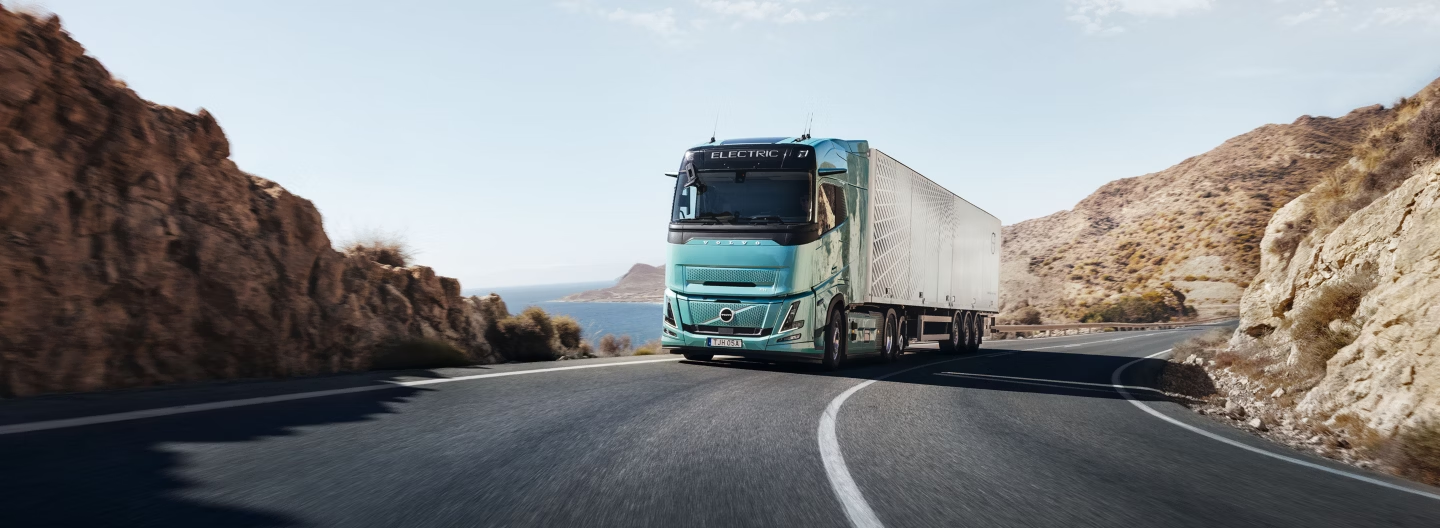
Over the years, in addition to race cars, another type of vehicle has gained prominence: the haulers responsible for transporting NASCAR cars. Since the races are not held on conventional roads and are spread across the U.S., these haulers play a crucial role in moving the cars from one track to another between events. However, their function is not limited to transportation; they also serve as repair workshops, restaurants, meeting rooms, observation decks, and storage spaces.

History of NASCAR haulers
Although today NASCAR cars are transported in this way, it wasn’t always the case. The idea of using haulers didn’t emerge until the 1990s, after several attempts and inventions to move the vehicles. In the beginning, NASCAR race cars were regular vehicles with numbers painted on the sides, and the drivers themselves would transport them from track to track.
As NASCAR races became more popular and spread across the country, transporting the cars from one circuit to another became a problem. On one hand, long trips added wear to the engines, and on the other, the long distances caused damage to the vehicles, affecting their performance. In response to this, a solution was needed, and that’s when haulers were introduced to transport the cars, though not in the way we know them today.
The initial idea for transporting NASCAR cars was to hook a flatbed trailer to a pickup truck. Later, the box truck with a trailer was introduced, used by teams like Petty Enterprises. These innovative trucks included fans, radios, and beds for the driver, which helped reduce lodging costs. Additionally, the truck’s box stored spare parts, tools, and supplies for the pits.
Richard Petty and his company were pioneers in these improvements, with the idea that reducing the use of cars on the road would extend their lifespan on the track. These innovations marked the beginning of the evolution of NASCAR haulers, which would continue to transform thanks to other major innovators like Bud Moore.

The rise of NASCAR haulers
Bud Moore, a member of the NASCAR Hall of Fame, was a pioneer in creating enclosed trailers for transporting NASCAR cars. In 1982, he debuted an enclosed trailer that protected the vehicles from damage and contained everything needed for a race weekend, including spare parts and a backup car. This innovation was quickly adopted by other teams, leading to the expansion and improvement of NASCAR haulers.
In 1991, Richard Childress, with his GM Goodwrench No. 3 team and Dale Earnhardt, took the idea even further by creating a “garage on wheels.” He collaborated with Featherlite Trailers to design a two-story trailer that not only transported cars but also carried parts, engines, and featured a command center, diagnostic area, and observation platform. This design set the standard for modern NASCAR haulers, which continues to be used today.

NASCAR haulers today: features and parades
Today, the foundations established by Childress and his team remain, with some modifications made by each team to meet their specific needs. A NASCAR hauler typically includes the following:
- Sleeping cabin: The front cabin is equipped with a space for drivers to rest during trips.
- Fully equipped office: At the front of the hauler is a communications office where strategies are analyzed and contact with drivers is maintained.
- Generator: Each truck has its own generator to provide enough power for all the technological equipment.
- Car bay: The hauler includes a space designed to house two cars: the primary car and the backup.
- Mechanical garage: An area of the hauler is designated to store tools and spare parts for repairing potential car damage.
- Upper platform: The haulers are equipped with a platform from which the race can be observed.
If you’re wondering how all of this fits, these haulers can measure up to 24 meters (80 feet) long and weigh up to 86 tons. Additionally, like the cars, they are decorated with logos, numbers, and bright colors, making the haulers parades a unique experience for NASCAR fans.

The tradition of haulers parades has become so popular that many tracks now broadcast them live, as well as the parking of haulers inside the track. The teams arrive at the track at the same time and drive through the streets toward the facilities, offering a one-of-a-kind show for the spectators.

Teton Pass bridge will be closed to traffic for 10 days
Teton Pass is one of the most heavily traveled routes for truck drivers in Wyoming, serving as a vital corridor for the trucking industry. The

Terrifying Experiences of Truck Drivers Sleeping on the Road at Night

Cargo theft numbers drop for the third quarter of 2025
The cargo theft tracking company Verisk CargoNet released its report for the third quarter of 2025. The cargo theft tracking company Verisk CargoNet released its

40 major U.S. airports to see flight reductions due to government shutdown
40 U.S. airports, including those in New York, Los Angeles, and Chicago, will see flight reductions starting November 7 due to the government shutdown. 40

DOT Medical Card: Keeping Medical Certification Up to Date
Keeping your DOT Medical Card current is essential for both drivers and fleet operations.
Brake Safety Week 2025 results: almost 85% of commercial vehicles had no violations
Results of Brake Safety Week, organized jointly by the Commercial Vehicle Safety Alliance (CVSA) and the Department of Transportation, have been published. Results of Brake