Texas continues to lead in the adoption of advanced transportation technologies
Texas could be one of the first states to witness the future of road transportation. Austin-based Kodiak Robotics is perfecting the deployment of fully autonomous trucks, operating without the supervision of a safety driver. The innovative company employs technology that promises to transform both the supply chain and the lives of truck drivers.
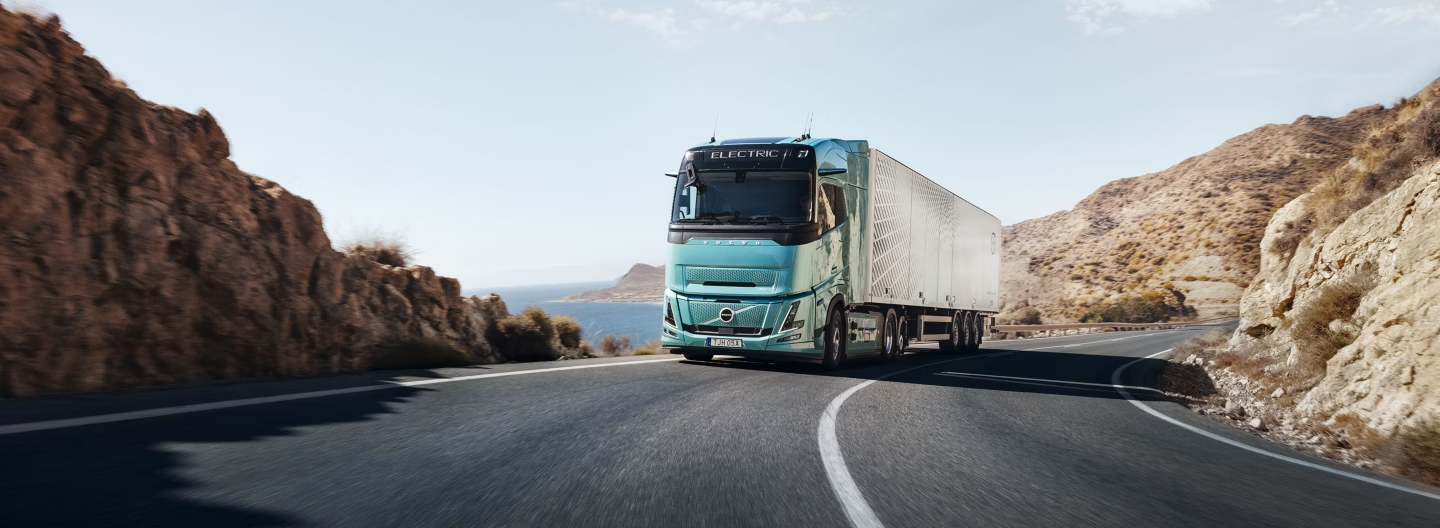
Autonomous trucks are not a novelty, as Kodiak Robotics is currently testing them, although it still employs safety drivers to oversee the vehicles during their journey. By the end of 2024, the company plans to start operating autonomous trucks without anyone at the wheel, marking a significant advancement in transportation automation. Given its headquarters is in Texas, this state might be the first to see the advent of completely autonomous trucks.
Dan Goff, Kodiak’s head of policy, believes that autonomous vehicles can address supply chain issues and improve the lives of truck drivers. However, John Esparza, president and CEO of the Texas Trucking Association, asserts that the industry has no intention of replacing human drivers but aims to enhance safety and efficiency on the roads, according to Community Impact.

Transition to autonomous vehicles: what changes are being made?
The growing demand and challenges in the transportation industry have led to increased insurance rates and operational costs. A report from the American Transportation Research Institute revealed a historic increase in the marginal cost per hour for carriers in 2023. However, autonomous transportation is expected to reduce total transportation costs by 30% by 2040, according to PwC.
To support this transition, the Texas Department of Transportation and Cavnue are upgrading a 21-mile stretch of SH 130 with new technology to assist autonomous trucks. This effort is part of a broader trend, as 25 states in the U.S. have enacted laws for autonomous vehicles, and another 12 allow testing, according to the Insurance Institute for Highway Safety.
Texas has been a fertile ground for autonomous vehicle innovation, with companies like Zoox and Mars Auto also conducting tests in the state. Autonomous trucking companies are required to report any accidents to the National Highway Traffic Safety Administration, with recent data showing that autonomous trucks exhibit more predictable driving patterns compared to cars.
State legislation, such as Senate Bill 2205, has facilitated the adoption of these technologies by prohibiting cities from regulating autonomous vehicles. Esparza emphasizes that this technology could increase freight transportation efficiency, although autonomous trucks are not subject to the same driving hour limitations as human drivers.
Thus, Texas continues to lead in the adoption of advanced transportation technologies, preparing for a new era where autonomous trucks could become a common sight on the state’s roads.

10 New Year’s Resolutions We Always Make and Never Actually Keep
There are 10 typical resolutions that repeat themselves all over the world. Yet many of the goals we set on December 31 are rarely fulfilled. Not because of a lack of willpower, but because we tend to demand immediate transformations instead of learning to enjoy life, practice gratitude, and live the present moment with greater awareness.

DOT announces grant program to strengthen CDL licensing standards
The DOT seeks to remove unqualified truck drivers from the roads and strengthen CDL licensing standards. Among the most recent efforts by the U.S. Department

9 Apocalyptic Predictions About the U.S. Economy That Didn’t Come True in 2025
From recession fears to collapse scenarios, these nine apocalyptic predictions about the U.S. economy didn’t come true in 2025 — and the data shows why.

California Restricts Truck Traffic on Residential Streets in the Inland Empire Starting in 2026
California’s new rule restricting truck traffic on residential streets in the Inland Empire starting in 2026 will force logistics operators to redesign routes, reshaping freight transportation, urban planning, and the regional supply chain.

$1 Billion U.S. Road Safety Plan Reshapes Key Freight Routes
A $1 billion U.S. road safety plan is reshaping key freight routes nationwide, directing federal investment into highways, intersections, and emergency-response systems to reduce accidents, improve freight efficiency, and deliver safer corridors for truck drivers and local traffic.

States with the most truck drivers in the U.S.
These are the states with the highest number of truck drivers in the United States. The trucking industry employs approximately 3.6 million truck drivers across