A powerful storm system is set to bring severe weather across the southern United States starting Monday night
A powerful storm system is set to bring severe weather across the southern United States starting Monday night and continuing into Tuesday, with impacts reaching the East Coast by Wednesday. This storm system has the potential to produce tornadoes, damaging winds, and large hail. Additionally, blizzard conditions are expected in the Plains and Midwest.

Severe Weather Timeline and Threats
Monday Night
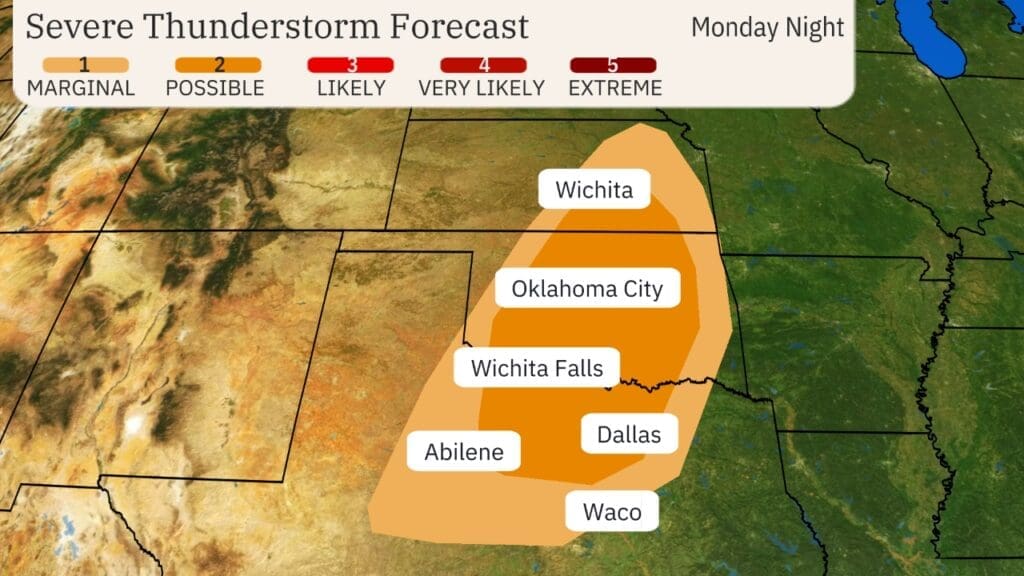
An intensifying low-pressure system combined with increasing Gulf moisture will trigger severe weather in the Southern Plains.
Areas at risk include central and eastern Oklahoma and north-central Texas, including Oklahoma City, Tulsa, and Dallas-Fort Worth.
Expected hazards include large hail, wind damage, and possible tornadoes.
Tuesday and Tuesday Night
NOAA’s Storm Prediction Center has identified a heightened threat for severe thunderstorms from eastern Texas and eastern Oklahoma to the lower Mississippi Valley, Alabama, and western Georgia.
The greatest risk includes Louisiana, Arkansas, and Mississippi, with key cities such as Jackson, MS, Little Rock, AR, and Shreveport, LA, under threat.
Severe storms could persist from morning through the evening, moving eastward throughout the day.
Damaging winds and several tornadoes are possible, with the highest risk of strong tornadoes (EF2 or greater) in southern Arkansas, northern Louisiana, and central Mississippi.
Wednesday
Severe weather will continue ahead of the cold front, affecting parts of the East Coast.
Areas at risk include Delaware, Maryland, northern Florida, Charleston (SC), Raleigh (NC), Richmond (VA), and Washington, D.C.
The primary threats are damaging winds and the possibility of tornadoes.

Flood Threat
Heavy rain is expected in parts of the Midwest and South, potentially leading to localized flash flooding.
Areas that experienced recent flooding, particularly in Kentucky and Tennessee, should remain alert.
Rainfall totals could reach at least 2 inches in some locations, but this event is not expected to be as prolonged as the mid-February storm.
Safety Recommendations for Truck Drivers
Monitor Weather Updates: Check forecasts regularly via weather apps or radio channels like NOAA Weather Radio.
Plan Your Route: Avoid areas with severe weather alerts and have an alternate route in case of road closures.
Drive with Caution: High winds can make truck driving hazardous, especially for high-profile vehicles. Reduce speed and maintain a firm grip on the steering wheel.
Avoid Flooded Roads: Do not attempt to drive through flooded areas. Water depth can be deceiving and may sweep away even large vehicles.
Find Safe Parking: If conditions become too dangerous, pull over at a safe location such as a truck stop or designated rest area.
Prepare an Emergency Kit: Keep essential supplies such as food, water, blankets, a flashlight, and a first aid kit in your truck.
Communicate with Dispatch: Stay in touch with your dispatch team to update them on your location and any detours needed.

Truck drivers are at high risk of developing diabetes
About 11% of the adult population meets the criteria for prediabetes, and there is a particular group at high risk: truck drivers. Diabetes rates in

Starting in trucking: required permits, registrations, and compliance
Are you a new carrier? This is what you need to know about permits, registration, and compliance. The trucking industry can be quite challenging for

Alberta Clipper Brings an Early Polar Blast: A Critical Alert for Drivers
The Alberta Clipper is sweeping across the country with fast-moving Arctic air, sharp temperature drops, and dangerous road conditions that demand heightened attention from all professional drivers.

American manufacturers trigger truck “dumping” investigation
Foreign trailer manufacturers under investigation for alleged “dumping” in the U.S. The U.S. truck market is at the center of a trade dispute. After domestic

ATRI Warns: Litigation Is Rising Across the U.S. Trucking Industry
A new report from the American Transportation Research Institute (ATRI) reveals how escalating litigation, higher legal costs, and mounting insurance pressures are reshaping the U.S. trucking industry. The findings mark a critical moment for motor carriers, insurers, and logistics stakeholders who must understand the changing legal environment — and the increasingly strategic role of strong insurance partnerships.

FMCSA says no to hours-of-service exemptions
FMCSA rejects two requests for exemptions to hours-of-service rules for commercial drivers. The Federal Motor Carrier Safety Administration (FMCSA) has denied two exemption requests related