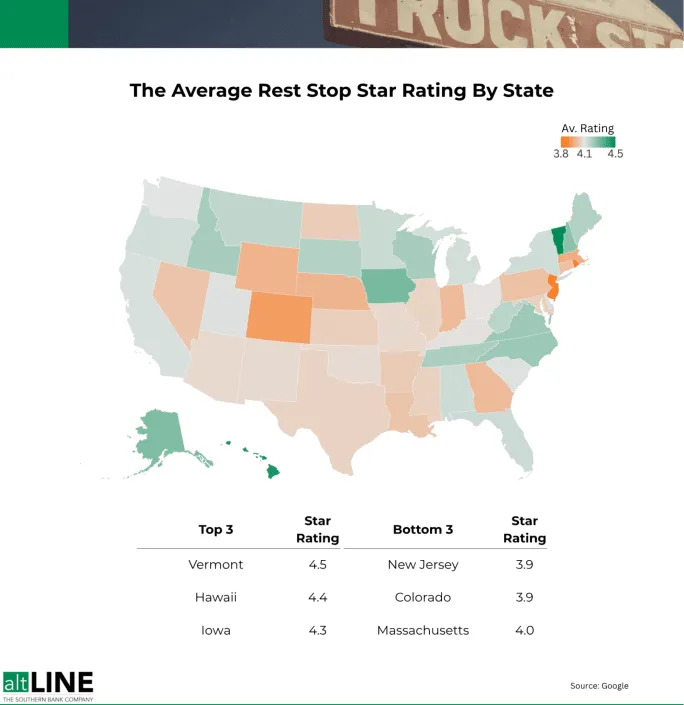
AltLINE released an analysis of the best rest areas and truck stops across the United States to highlight the locations best rated by drivers.
Last October, AltLINE, a financial solutions company for freight transportation businesses, released an analysis of rest areas and truck stops across the United States to highlight the locations best rated by drivers.
Using data and reviews collected from Google Maps, AltLINE published the results of the top-rated rest area and truck stop locations nationwide. By gathering data from nearly 100,000 stops, the company conducted this analysis to identify trends in quality and customer service provided at these facilities, classifying as “the best” those with the highest average scores according to Google user reviews.
Best rest areas and truck stops in the United States
In the results shared by AltLINE, Vermont stood out with the highest average rating for rest areas, scoring 4.5 stars. Hawaii, Iowa, Alaska, and New Hampshire ranked second with 4.0 stars, followed by New Jersey, Colorado, and Massachusetts with ratings below 4.0 stars.
Despite several states having relatively high ratings, customer service consistently received lower scores than overall ratings in all states. AltLINE reported that Delaware and Florida showed the greatest drop in service-related reviews, while Massachusetts, West Virginia, and South Dakota maintained service ratings that aligned with the overall quality of their rest areas.
To accurately pinpoint the best rest areas and truck stops, AltLINE divided the U.S. into a grid of 1,770 km² hexagons. This helped identify regions with a high concentration of these facilities and allowed the incorporation of user review ratings. The result was a map highlighting the most frequented rest spots along with the average score of each location.
In Waynesville, North Carolina, and its surrounding areas, the analysis revealed a cluster of rest areas with consistently high ratings. With an average score of 4.7 based on more than 7,000 reviews, Waynesville emerged as the nation’s capital for high-quality service areas.
The financial solutions company also identified the highest-rated service areas along the country’s busiest freight corridors:
- I-80 Salt Flats Rest Area, Utah – Average rating of 4.6 stars, praised for its scenery and facilities.
- Official Florida Welcome Center on I-10 – Rated 4.7 stars, known for its cleanliness and complimentary orange juice.
- Georgia Welcome Center on I-95 – Rated 4.6 stars, recognized for its safety and small museum-like interior.
AltLINE’s conclusions
In the U.S., rest areas have an average rating of 4.17, according to AltLINE’s analysis. The study highlights how drivers experience highways and rest points during long-haul trips. Although many of these areas are managed by large chains, the best-rated locations are often local, consistent in their service, and frequently independent.
Truck driver: stop choosing the worst route

Controlling road rage: a guide for truck drivers
The three key steps to help truck drivers control road rage.

New identification process for the Drug and Alcohol Clearinghouse
The FMCSA has begun implementing new identity verification requirements for the Drug and Alcohol Clearinghouse.

OPEC: What the United Arab Emirates Exit Means for U.S. Fuel Costs and Logistics
The departure of the United Arab Emirates from the Organization of the Petroleum Exporting Countries is reshaping the global oil market, introducing price volatility and creating new challenges for diesel costs, freight operations, and fleet planning across the United States.

Trucks only: Georgia plans dedicated commercial vehicle lanes on I-75
The Georgia Department of Transportation has begun developing a project that plans to add commercial vehicle lanes on I-75.

Tesla Semi moves toward scale
Tesla’s electric truck is already on the road—now the real challenge is scaling production for the freight industry

New US transportation map: adapt without wasting time
The U.S. government has implemented sweeping changes to regulations governing freight transportation, affecting everything from who can be behind the wheel to mandatory in-cab technology. This is an effort to strengthen safety and operational transparency.