The American Transportation Research Institute has released its annual report on freight bottlenecks in the United States.
The American Transportation Research Institute (ATRI) published its yearly analysis of the nation’s most congested freight corridors. Using GPS data from trucks, the report evaluates the highways with the highest levels of congestion across the country, ranking them from most to least congested.
This year’s report paints a concerning picture for the U.S. supply chain, revealing that traffic congestion at the country’s most critical freight hubs has intensified, threatening the efficiency of over-the-road goods movement.
According to the report, the average truck speed during peak hours at bottleneck locations dropped to 33.2 mph, representing a 2.8% year-over-year decrease. Among the top 10 locations, the average peak-hour truck speed was 29.6 mph, slightly below the 29.7 mph recorded for the top 10 sites last year.
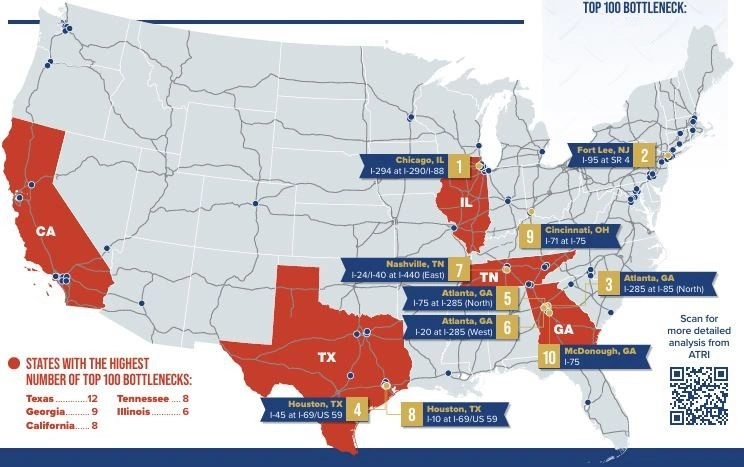
The top 10 bottlenecks in the United States
For nearly 25 years, ATRI has collected and processed truck GPS data in support of the Freight Mobility Initiative of the United States Department of Transportation to develop and monitor key performance measures of the nation’s freight transportation system. Using this GPS dataset, ATRI conducts ongoing truck bottleneck analyses to quantify the impact of traffic congestion on freight movement at more than 325 specific locations nationwide.
“While other external analyses may identify congested corridors, no dataset currently available specifically identifies granular congestion points within the nation’s truck freight transportation system,” ATRI explains in its report.
For seven consecutive years, the intersection of I-95 and State Route 4 in Fort Lee, New Jersey, ranked as the top congestion point, according to ATRI. However, this year a new location has claimed the number one spot as the worst freight bottleneck in the United States: I-294 at the junction with I-290 and I-88 in Chicago.
The top 10 bottlenecks according to ATRI:
- Chicago, Illinois – I-294 at I-290/I-88
- Fort Lee, New Jersey – I-95 at State Route 4
- Atlanta, Georgia – I-285 at I-85 (North)
- Houston, Texas – I-45 at I-69/US 59
- Atlanta, Georgia – I-75 at I-285 (North)
- Atlanta, Georgia – I-20 at I-285 (West)
- Nashville, Tennessee – I-24/I-40 at I-440 (East)
- Houston, Texas – I-10 at I-69/US 59
- Cincinnati, Ohio – I-71 at I-75
- McDonough – I-75
Other key metrics from the 2026 report
- 75% of the top 100 bottlenecks now report average truck speeds below 45 mph.
- Texas, Georgia, California, Tennessee, and Illinois remain the five states with the most bottlenecks.
- Atlanta continues to be a major freight frustration point, accounting for four of the top 10 locations.
- Twenty-eight states appear at least once in the top 100 bottlenecks list.
- California does not appear in the top 10 but has a total of eight locations in the full ranking.
Congestion: the supply chain’s main enemy
“Congestion-related delays experienced by truck drivers are equivalent to 436,000 drivers sitting idle for an entire year,” said Rebecca Brewster, President and COO of the American Transportation Research Institute (ATRI).
However, she noted that there are examples showing the situation can be reversed. Illinois, once the most congested state in the country, implemented sustained efforts to expand roadway capacity, resulting in its former worst bottleneck dropping out of the top 25 most congested locations.
According to Brewster, these results demonstrate that responsibility lies with policymakers and state governments to implement measures that reduce congestion and, in turn, foster economic growth.
Chris Spear, President and CEO of the American Trucking Associations (ATA), stated that highway congestion not only chokes supply chains, adding $109 billion annually to the cost of goods paid by consumers, but also impacts the quality of life for all motorists, underscoring the urgent need for action.

The top truck bottlenecks in the U.S. 2026
The American Transportation Research Institute has released its annual report on freight bottlenecks in the United States. The American Transportation Research Institute (ATRI) published its

US Climate Records 2026: Extreme Weather Is Already Reshaping Transportation Across the Country
US Climate Records 2026 are already redefining risk patterns for the transportation industry. Historic flooding and a deadly avalanche in California, unusual winter heat in Colorado, extreme snowfall in Alaska and rare January tornadoes in Oklahoma mark a start to the year of extraordinary intensity. In just two months, US Climate Records 2026 have broken long-standing benchmarks across multiple states.

What are Grabovoi numbers and what can be manifested with them
Grabovoi numbers: a list of numerical sequences intended to activate certain areas of daily life in order to enhance, improve, and develop them. Manifestation and

CVSA’s 2026 international inspection to target ELD manipulation
The 2026 inspection will focus on drivers who falsify or manipulate their electronic logging devices (ELDs) to alter their hours of service. Each year, the
Illinois CDL Audit: 20% Under Federal Review
A federal audit found that nearly 20% of Illinois’ non-domiciled CDLs may not comply with federal standards. The state has 30 days to correct the issues or risk losing $128 million in highway funding.

Wall Street under the microscope: solid employment, contained inflation, and rising volatility
Employment, inflation, and retail sales set the tone for a week marked by volatility and sector rotation on Wall Street. In the latest episode of