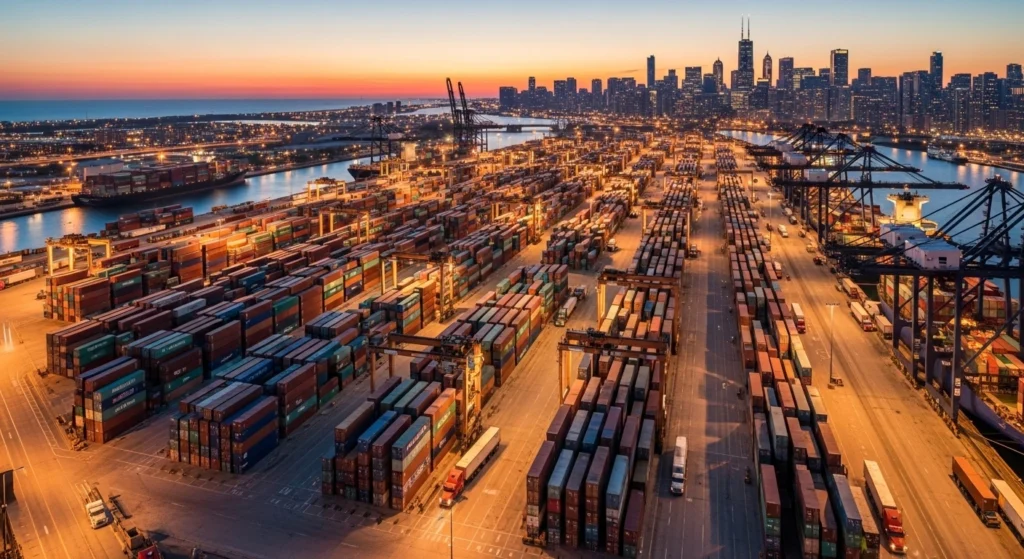
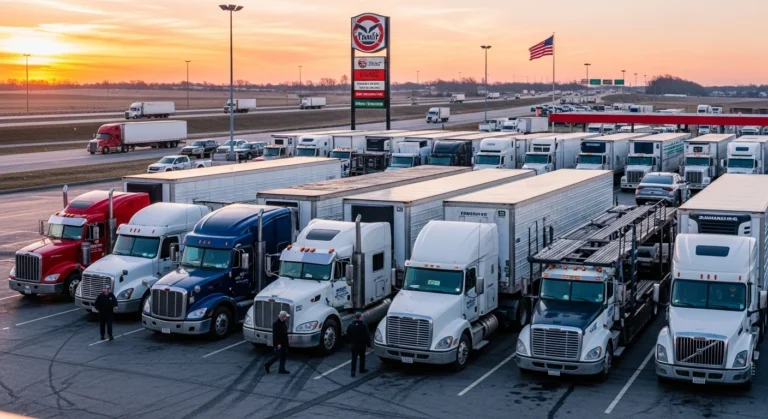
Contrary to seasonal patterns, the U.S. trucking market entered 2026 without the traditional January slowdown. Capacity, pricing, and demand indicators suggest the industry remains tighter than expected, driven by inventory shifts, resilient consumer spending, and a reconfiguration of supply chains.
Historically, January has been synonymous with a cooling-off period for the U.S. trucking industry. After the surge in activity seen in November and December—when retailers rush to replenish inventory ahead of the holidays—freight volumes typically soften. Excess capacity emerges, and downward pressure builds on rates. This seasonal pattern is commonly referred to as the January lull, a predictable post-holiday reset for the transportation market.
This year, however, that pattern is not playing out.
Instead of cooling, the U.S. truckload market has entered 2026 with more momentum than expected. Key indicators suggest that capacity remains relatively tight, spot rates are holding at elevated levels, and shippers are navigating a more competitive environment than is typical for this time of year.
Signs of a resilient market
One of the most widely used gauges of market balance is how often carriers accept or reject freight. When demand is soft, carriers tend to accept nearly every load they are offered. When the market tightens, they become more selective—choosing higher-paying freight or avoiding lanes that no longer make economic sense.
Early 2026 data shows that carriers are still exercising that selectivity.
Multiple private-sector indicators—including tender rejection indexes, load-to-truck ratios, and spot pricing benchmarks—point to a market that remains under pressure. This suggests that carriers continue to have meaningful negotiating power, while shippers must plan further ahead and rely less on last-minute capacity.
In practical terms, this means fewer easy wins for shippers and fewer signs of the slack conditions that normally define January.

Spot rates are not falling as expected
Another telling signal is the behavior of spot rates. After the holidays, prices typically retreat quickly as demand fades. That retreat has been far more muted this year.
Instead of a sharp correction, rates have remained above historical January averages, reinforcing the idea that capacity is not oversupplied. The market is not flooded with idle trucks—a hallmark of a weak cycle.
For shippers, this creates tighter budgeting conditions and fewer opportunities to capitalize on seasonal discounts. For carriers, it is a sign that the balance of power may be shifting back in their favor after several challenging years.
Regional complexity remains a defining feature
As always, the trucking market is not monolithic. Some regions are experiencing more friction in covering outbound loads, while others have relatively looser conditions. These differences are driven by a mix of structural and short-term factors, including:
• Shifts in consumer demand
• Import and export flows
• Weather-related disruptions
• Local infrastructure constraints
• Industry-specific seasonality
This regional fragmentation is one of the reasons national averages can be misleading. The true state of the market is often found in lane-level and metro-level data.
The intermodal factor
Intermodal rail continues to play a role in shaping truckload dynamics. Over the past few years, it has absorbed some long-haul freight, particularly for shipments that are less time-sensitive.
But when inventories tighten and replenishment becomes more urgent, truckload often regains share. It offers faster transit times, door-to-door service, and end-to-end visibility—advantages that become critical when timing matters.
If this shift accelerates in 2026, it could further strain truckload capacity and provide additional support for rates.
Inventories, consumption, and urgency
One of the main reasons the market has not cooled as expected lies in the inventory cycle. Business surveys and supply chain indicators suggest that many companies ended the year with leaner stock levels than anticipated.
At the same time, consumer spending has remained resilient. When these two forces combine—low inventories and strong demand—transportation networks become more time-sensitive. Replenishment must happen quickly, and flexibility becomes more valuable than cost alone.
This dynamic tends to favor truckload over slower or more rigid alternatives.
A less predictable logistics environment
What is unfolding now is part of a broader transformation. Supply chains are no longer governed by neat, predictable seasonal cycles. Nearshoring, shifting trade policies, extreme weather events, and geopolitical uncertainty are introducing more volatility into freight markets.
As a result, traditional patterns—like the reliable January slowdown—are becoming less dependable.
What lies ahead for 2026
If inventories remain tight and consumer demand continues to hold, truckload volumes may stay stronger than expected. In that scenario, shippers will likely need to:
• Secure capacity earlier
• Diversify carrier relationships
• Balance contract and spot exposure
• Invest in better planning and forecasting
For carriers, this could translate into more stable pricing, better asset utilization, and a more favorable negotiating position.
A clear takeaway
For now, one thing is evident: the U.S. trucking industry is defying the typical January slowdown.
The market remains firmer than expected. Rates have not collapsed. Capacity is not abundant. And shippers are facing a more competitive environment.
2026 did not begin quietly. It began with tension.
And in logistics, that changes everything.

Amulets, faith, and fortune: how truck drivers seek protection around the world
From saints to herbs, truck drivers carry amulets on every trip that, according to their beliefs, protect them in the harsh life of road transport.

Is It Worth Being a Truck Driver in the U.S. in 2026?
Becoming a truck driver in the United States means access to competitive pay and strong labor demand, but it also requires accepting time away from family, physical strain, and a lifestyle that isn’t for everyone.

Operation SafeDrive: Nearly 2,000 Truckers and Vehicles Taken Out of Service in Three Days
Operation SafeDRIVE triggered thousands of inspections across 26 states and Washington, D.C., leading to disqualified drivers, sidelined equipment, and arrests while reinforcing a stricter enforcement environment for the trucking industry.

Super Bowl LX: The Logistics Behind the Patriots–Seahawks Showdown
Super Bowl LX, featuring the New England Patriots and the Seattle Seahawks, is far more than the NFL’s championship game. It involves one of the most complex logistics operations in the world, with hundreds of trucks, ultra-precise technical production, layered security controls, and an industrial-scale deployment that turns Levi’s Stadium into a temporary city for 72 hours.

Job cuts surge in January, weighing on transportation
January saw one of the largest waves of job cuts since 2009 across multiple sectors in the United States. January saw one of the largest

Federal Reserve: rates remain unchanged with caution amid a solid economy
The United States Federal Reserve decided to keep interest rates unchanged, in line with market expectations. In the latest episode of the Mercado Sobre Ruedas