The multinational company Amazon Inc. continues to advance in the technology race, introducing new equipment aimed at improving its operations.
The multinational company Amazon Inc. continues to advance in the technology race, introducing new equipment aimed at improving its operations. Its most recent announcement: equipping delivery drivers with augmented reality glasses designed to help them find the right location for each package delivery.
On October 22, the company revealed that it is already testing the glasses among delivery drivers in North America to refine the technology before expanding its implementation internationally. According to Amazon, the system will act as a companion to the driver throughout the delivery route, allowing them to work hands-free while staying focused on safety and their surroundings.
Augmented reality glasses: Amazon Inc.’s latest innovation
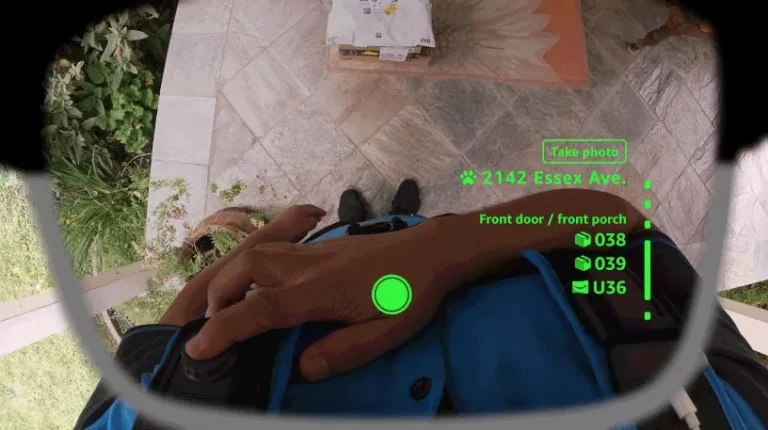
To address concerns about the safety of drivers and other motorists on the road, Amazon clarified that the new equipment will only activate once the vehicle is completely parked. The glasses are equipped with cameras that guide drivers step by step to the customer’s door safely.
“Finding a porch can be easy in suburban areas, but drivers often get lost in apartment complexes with multiple units or in businesses with confusing entrances,” the company explained.
Currently, drivers use a mobile app to assist them during deliveries. However, the goal of the new glasses is to provide a hands-free technology that offers more direct guidance. To achieve this, the smart glasses display essential information directly in the driver’s field of view, allowing them to scan packages, follow step-by-step directions, and capture proof of delivery without checking their phone. The device also features a controller designed to attach to drivers’ vests.
Developed in collaboration with hundreds of delivery drivers, the glasses also use artificial intelligence and computer vision to detect potential hazards, such as pets or uneven sidewalks, and share that information to improve future deliveries.
With this technology, Amazon hopes that future versions will be able to detect a dropped package, notice the presence of a dog in a yard, or flag when a house number doesn’t match the delivery address.
Amazon implements new technology as a tool for support, not replacement
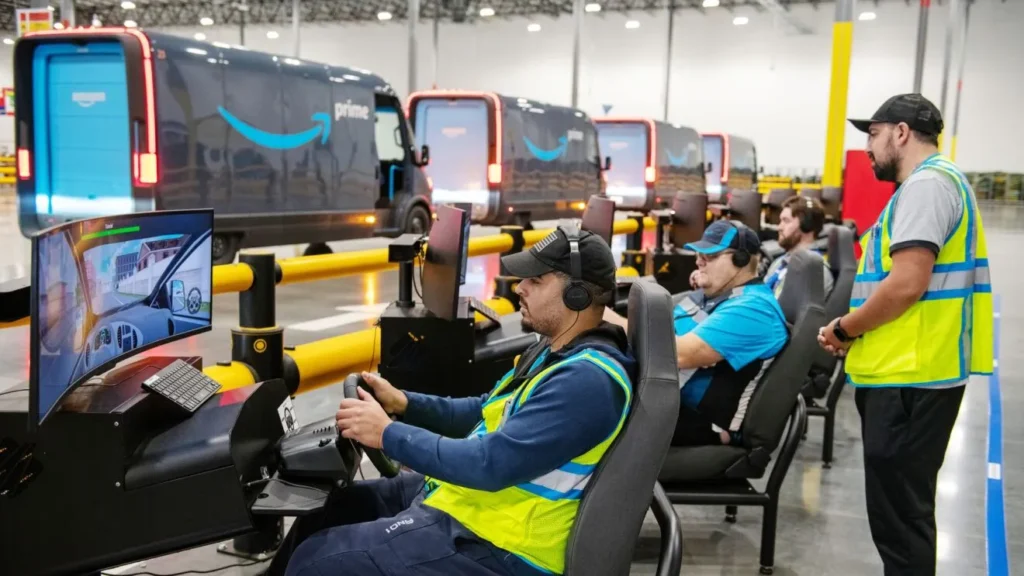
The company made the announcement during a press conference held at a warehouse south of San Francisco, where executives also introduced a new robotic arm system for package handling called Blue Jay, an AI-based tool named Eluna designed to help warehouse managers solve problems, and immersive virtual reality modules for driver training.
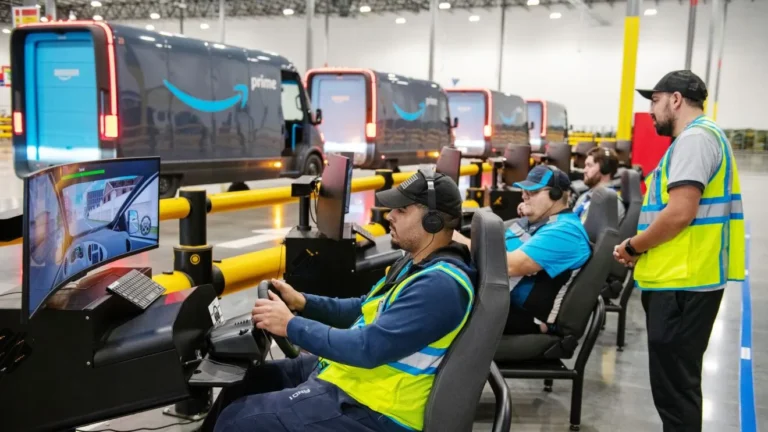
The latter consists of a virtual reality system that prepares delivery drivers for real-world challenges before they hit the road. The program, known as the Enhanced Virtual Learning Driving Experience (EVOLVE), is a driving simulator recently launched at Amazon’s facilities in Colorado, Maryland, and Florida. The simulator provides trainees with immediate feedback on their performance and encourages them to develop practical defensive driving skills in a safe, standardized virtual environment. Amazon expects 40 iLMDA (Integrated Last Mile Driver Academies) centers to offer the EVOLVE experience by the end of 2026.
The innovations implemented by Amazon Inc. undoubtedly keep the company at the forefront, as it has been for years. They not only reflect its ongoing commitment to improvement but also demonstrate how technology can serve as a tool to support workers, rather than replace them.

OPEC: What the United Arab Emirates Exit Means for U.S. Fuel Costs and Logistics
The departure of the United Arab Emirates from the Organization of the Petroleum Exporting Countries is reshaping the global oil market, introducing price volatility and creating new challenges for diesel costs, freight operations, and fleet planning across the United States.

Trucks only: Georgia plans dedicated commercial vehicle lanes on I-75
The Georgia Department of Transportation has begun developing a project that plans to add commercial vehicle lanes on I-75.

Tesla Semi moves toward scale
Tesla’s electric truck is already on the road—now the real challenge is scaling production for the freight industry

New US transportation map: adapt without wasting time
The U.S. government has implemented sweeping changes to regulations governing freight transportation, affecting everything from who can be behind the wheel to mandatory in-cab technology. This is an effort to strengthen safety and operational transparency.

The Longest Straight Road in the World: A Challenge for Drivers
Highway 10 in Saudi Arabia, the longest straight road in the world, stretches over 250 km without curves across the desert

Route 66 Turns 100: A Year of Celebrations Across America
The U.S. Route 66—widely known as The Main Street of America, The Mother Road, and Will Rogers Highway—is marking a full year of centennial celebrations throughout 2026
All content and original artwork, unless otherwise noted, is protected by copyright. Saint George uses certain images under license from various licensing vendors for this purpose. Any unauthorized commercial reproduction or distribution of copyrighted materials is prohibited.