The multinational company Amazon Inc. continues to advance in the technology race, introducing new equipment aimed at improving its operations.
The multinational company Amazon Inc. continues to advance in the technology race, introducing new equipment aimed at improving its operations. Its most recent announcement: equipping delivery drivers with augmented reality glasses designed to help them find the right location for each package delivery.
On October 22, the company revealed that it is already testing the glasses among delivery drivers in North America to refine the technology before expanding its implementation internationally. According to Amazon, the system will act as a companion to the driver throughout the delivery route, allowing them to work hands-free while staying focused on safety and their surroundings.
Augmented reality glasses: Amazon Inc.’s latest innovation
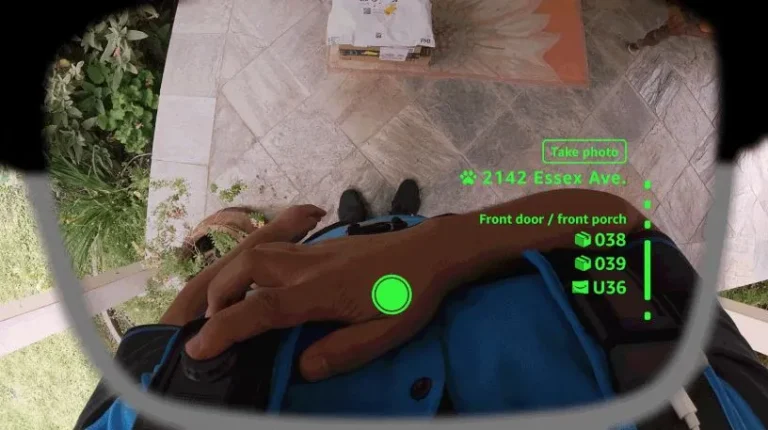
To address concerns about the safety of drivers and other motorists on the road, Amazon clarified that the new equipment will only activate once the vehicle is completely parked. The glasses are equipped with cameras that guide drivers step by step to the customer’s door safely.
“Finding a porch can be easy in suburban areas, but drivers often get lost in apartment complexes with multiple units or in businesses with confusing entrances,” the company explained.
Currently, drivers use a mobile app to assist them during deliveries. However, the goal of the new glasses is to provide a hands-free technology that offers more direct guidance. To achieve this, the smart glasses display essential information directly in the driver’s field of view, allowing them to scan packages, follow step-by-step directions, and capture proof of delivery without checking their phone. The device also features a controller designed to attach to drivers’ vests.
Developed in collaboration with hundreds of delivery drivers, the glasses also use artificial intelligence and computer vision to detect potential hazards, such as pets or uneven sidewalks, and share that information to improve future deliveries.
With this technology, Amazon hopes that future versions will be able to detect a dropped package, notice the presence of a dog in a yard, or flag when a house number doesn’t match the delivery address.
Amazon implements new technology as a tool for support, not replacement
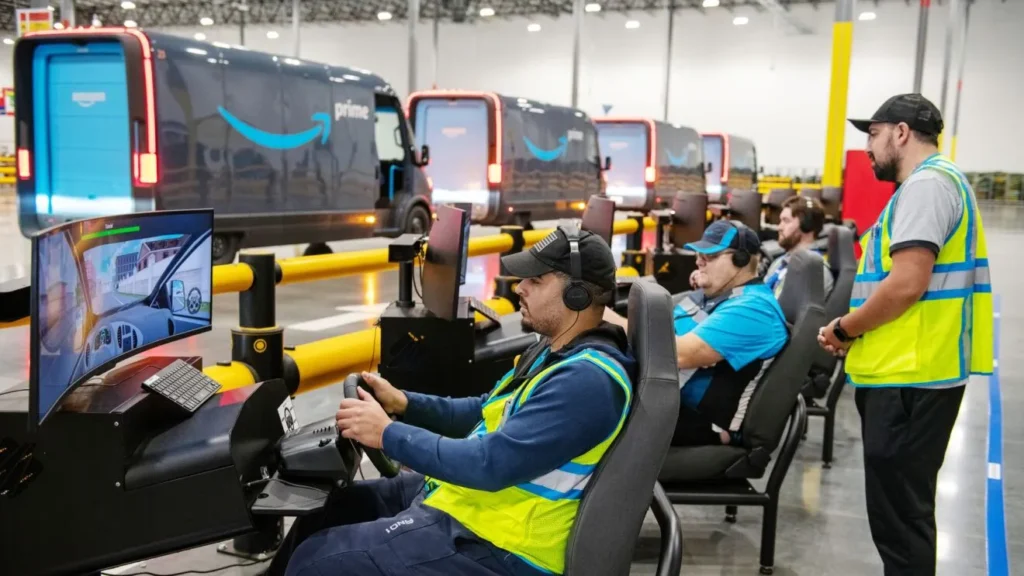
The company made the announcement during a press conference held at a warehouse south of San Francisco, where executives also introduced a new robotic arm system for package handling called Blue Jay, an AI-based tool named Eluna designed to help warehouse managers solve problems, and immersive virtual reality modules for driver training.
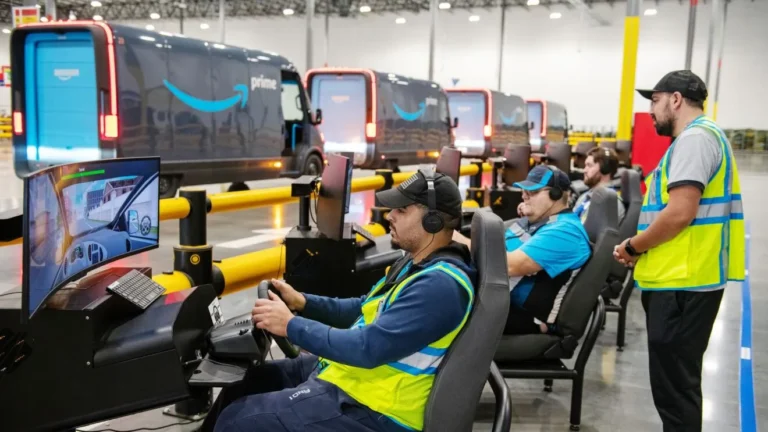
The latter consists of a virtual reality system that prepares delivery drivers for real-world challenges before they hit the road. The program, known as the Enhanced Virtual Learning Driving Experience (EVOLVE), is a driving simulator recently launched at Amazon’s facilities in Colorado, Maryland, and Florida. The simulator provides trainees with immediate feedback on their performance and encourages them to develop practical defensive driving skills in a safe, standardized virtual environment. Amazon expects 40 iLMDA (Integrated Last Mile Driver Academies) centers to offer the EVOLVE experience by the end of 2026.
The innovations implemented by Amazon Inc. undoubtedly keep the company at the forefront, as it has been for years. They not only reflect its ongoing commitment to improvement but also demonstrate how technology can serve as a tool to support workers, rather than replace them.

California: Scammers Impersonate FMCSA’s Motus System, Putting Trucking Companies’ Data at Risk
The Federal Motor Carrier Safety Administration (FMCSA) is warning trucking companies about four fraudulent websites impersonating its new federal registration system. Scammers are using emails that demand urgent updates to redirect carriers to fake portals. The warning also applies to California motor carriers.
Do You Know How Much Money Your Truck Has Lost Sitting Idle in 2026?
Hours spent waiting at warehouses and distribution centers continue to cost American truck drivers time and money. Federal research has estimated more than $1 billion in annual lost driver income, while the FMCSA explores new ways to address detention time and its impact on road safety.

The Incredible Story of a Grave in the Middle of an Indiana Road
On a rural road in Indiana, drivers must navigate around a grave that has remained in the same location since 1831. The story of Nancy Kerlin Barnett, her family, and an unusual engineering decision has turned this stretch of pavement into one of the state’s most famous roadside curiosities.
Autonomous Trucks: Who Places the Warning Triangles When There’s No Driver?
A federal exemption allows warning triangles to be replaced with cab-mounted beacons on certain autonomous trucks. The decision addresses how to warn approaching traffic when no one can step out of the cab.

Diesel in the USA: Which States Suspended the Tax—and Which Still Charge It?
Georgia, Ohio and North Carolina have introduced temporary fuel tax relief. Texas, Indiana, Illinois and Utah have different measures, with limits that truckers should understand before calculating potential savings.

Indiana and Ohio Pave the Way for Autonomous Trucking
Backed by an $8.8 million investment and federal transportation funding, Indiana and Ohio are developing a corridor to test automated trucks in real-world freight operations. The project aims to improve highway safety, logistics efficiency, and interstate autonomous vehicle operations.
All content and original artwork, unless otherwise noted, is protected by copyright. Saint George uses certain images under license from various licensing vendors for this purpose. Any unauthorized commercial reproduction or distribution of copyrighted materials is prohibited.