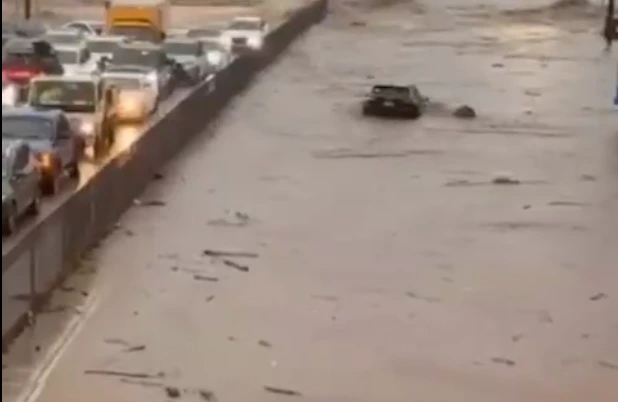
Flash floods triggered by a violent storm on July 14 cut off major highways across New York and New Jersey, leaving roads underwater and exposing the growing vulnerability of the nation’s transportation network.
A violent storm slammed the U.S. Northeast on the night of Monday, July 14, triggering devastating flash floods across New York and New Jersey. Overflowing rivers and record-breaking rainfall submerged highways, swamped cities, and paralyzed transportation systems — once again exposing the fragility of the nation’s aging infrastructure.
Tri-State Emergency: Roads Collapsed, Subways Suspended
Torrential rain hit Queens, Brooklyn, and the Bronx, forcing shutdowns along major corridors such as I-80, I-95, and the Garden State Parkway. Access routes to Manhattan were overwhelmed, while in New Jersey, Bergen, Essex, and Hudson counties recorded over 4 inches (100 mm) of rain in just a few hours.
Governor Phil Murphy declared a State of Emergency after critical failures across multiple roadways and transit hubs. The NYC subway system suspended at least five lines due to flooding, while emergency crews conducted water rescues, responded to widespread power outages, and battled failures in urban pumping stations.
Intense flooding and heavy rain swept across parts of the Northeast on Monday, prompting New Jersey Gov. Phil Murphy to declare a state of emergency and causing suspensions on New York City’s subways.
— The Washington Post (@washingtonpost) July 15, 2025
Read more: https://t.co/Zegwn82K1h pic.twitter.com/pKV5M5vx1W
Not Just the Northeast: Flood Emergencies in Kentucky, Illinois, and Southern Texas
This week’s disaster is just the latest in a string of extreme weather events hitting different parts of the country:
Kentucky & Illinois
• Historic swelling of the Ohio and Mississippi Rivers forced evacuations in both rural and urban zones.
• Dozens of state highways were closed near Paducah, KY and Springfield, IL, with washed-out bridges and submerged farmland.
Texas & Louisiana
• Tropical storms from the Gulf dumped over 8 inches (200 mm) of rain on Beaumont, Houston, and Lafayette.
• Major trucking routes, including I-10 and Loop 610, faced closures — disrupting freight logistics and delivery chains.
WATCH THE WATER MAKES MORE SENSE NOW.. FLOODING IN NEW JERSEY pic.twitter.com/KDfjxqrxxB
— David Nino Rodriguez (@ninoboxer) July 15, 2025
Extreme Weather Meets Outdated Systems
According to the National Weather Service (NWS), an “Omega Block” atmospheric pattern stalled storm systems over the same regions for days. This phenomenon, intensified by climate change, supercharges rainfall due to elevated atmospheric moisture levels.
Infrastructure experts warn that many U.S. cities simply aren’t built to handle this volume of water. Aging drainage networks, poor floodplain planning, and undersized sewer systems are buckling under the pressure.
Widespread Impacts: Roads, Rail, and Air Travel Disrupted
The storm’s ripple effects are being felt nationwide:
• Over 15 interstate highways — including I-10, I-64, I-80, and I-95 — faced full or partial closures.
• Pavement collapses were reported in rural parts of Illinois and West Virginia.
• Amtrak halted critical routes along the Northeast Corridor, from Washington to Boston.
• Major airports (JFK, LaGuardia, Newark, O’Hare) experienced hundreds of flight cancellations due to flooded access roads and poor visibility.
• Rural towns reported destroyed culverts, impassable backroads, and washed-out bridges.
Ongoing Warnings and Safety Recommendations
The NWS has active flood watches and warnings across more than 10 states. Authorities urge residents and drivers to:
• Avoid all travel through flooded zones.
• Never attempt to drive through standing water.
• Monitor updates from official sources (DOT, FEMA, NWS).
• Prepare for detours, possible evacuations, and service disruptions.
Economic Toll and Supply Chain Strain
The economic impact is already being felt:
• Trucking and logistics companies report widespread delays, route changes, and surging costs.
• Agriculture, construction, and tourism industries face mounting losses from road damage and power disruptions.
• Food, fuel, and medical supply shipments are at risk in areas cut off by long-term secondary road closures.
A National Wake-Up Call: Build Now or Sink Later
What used to be considered once-in-a-decade disasters are now annual events. Civil engineers and urban planners agree: America must invest in resilient infrastructure now — including stormwater defenses, permeable pavement, emergency drainage systems, and climate-adaptive road design.
Summer 2025 is another warning sign. The storms are getting stronger. The systems are getting weaker. And unless action is taken, more of America’s roads, bridges, and communities will find themselves underwater.

OPEC: What the United Arab Emirates Exit Means for U.S. Fuel Costs and Logistics
The departure of the United Arab Emirates from the Organization of the Petroleum Exporting Countries is reshaping the global oil market, introducing price volatility and creating new challenges for diesel costs, freight operations, and fleet planning across the United States.

Trucks only: Georgia plans dedicated commercial vehicle lanes on I-75
The Georgia Department of Transportation has begun developing a project that plans to add commercial vehicle lanes on I-75.

Tesla Semi moves toward scale
Tesla’s electric truck is already on the road—now the real challenge is scaling production for the freight industry

New US transportation map: adapt without wasting time
The U.S. government has implemented sweeping changes to regulations governing freight transportation, affecting everything from who can be behind the wheel to mandatory in-cab technology. This is an effort to strengthen safety and operational transparency.

The Longest Straight Road in the World: A Challenge for Drivers
Highway 10 in Saudi Arabia, the longest straight road in the world, stretches over 250 km without curves across the desert

Route 66 Turns 100: A Year of Celebrations Across America
The U.S. Route 66—widely known as The Main Street of America, The Mother Road, and Will Rogers Highway—is marking a full year of centennial celebrations throughout 2026