From New Jersey to China, we invite you to explore these fascinating facts about the widest highways in the world to date.
Getting stuck in traffic often makes us wish there were more lanes to allow cars to move more freely. But have you ever wondered which is the widest highway in the world?
Although there’s some debate over which one takes the top spot, whether by number of lanes or physical width, some of the contenders might surprise you. From New Jersey to China, we invite you to explore these fascinating facts about the widest highways in the world to date.

The Widest Highways in the World
New Jersey Turnpike, United States – 18 lanes
This highway was inaugurated in 1951 and spans 188 km. Not all of its stretch features 18 lanes; in some sections, the number ranges from 4 to 14. However, in the segments that connect to Exits 14 and 15E, the number of lanes expands to 18, earning it a notable place on this list.

King’s Highway 401, Canada – 18 lanes
Stretching 828 km, this is the most heavily trafficked highway in Canada. It was opened in 1953 with just two lanes, but due to its high usage, the Canadian government decided to expand it in 1963, reaching up to 12 lanes in some of the busiest sections.
One of the most congested segments is near Toronto Pearson International Airport, where 6 additional lanes were added to relieve traffic. As a result, that section of the highway reaches a total of 18 lanes.

Naypyidaw Highway, Myanmar – 20 lanes
The government of Myanmar built a 20-lane highway to connect the Parliament building with the main city. With a total length of 586.7 km, it was inaugurated in 2010. However, the road does not meet international standards for design, construction, or safety, and has recorded a high number of accidents since its opening.

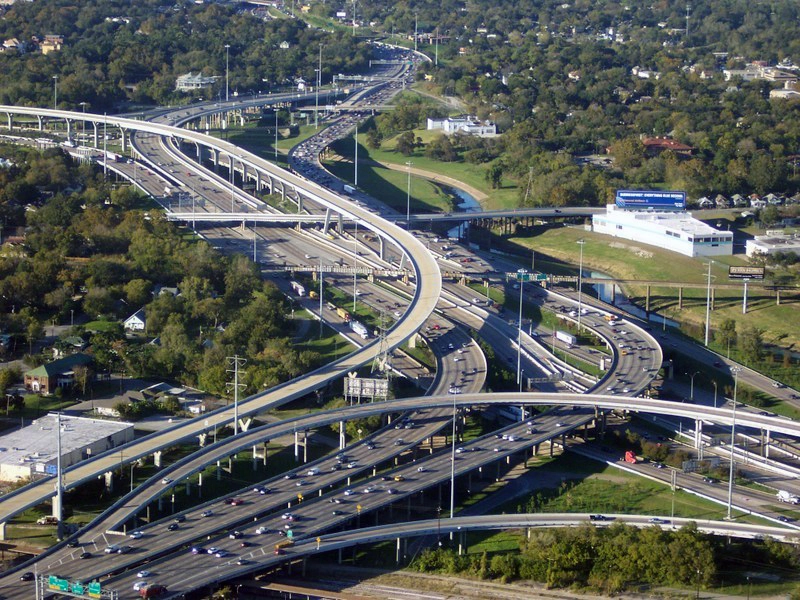
Interstate 10, United States – 26 lanes
Known as the Katy Freeway, the I-10 was originally built in the 1960s with between 6 and 8 lanes. However, growing traffic exceeding 200,000 vehicles per day, led to its expansion, adding another 8 lanes and bringing the total to 16.
In the early 2000s, special lanes such as HOV (high-occupancy vehicle) and express lanes were added to ease congestion. Today, the Katy Freeway stretches 1,412 km across Texas and features 12 main lanes, reaching up to 26 lanes in some of its widest sections—making it one of the widest highways in the world.

G4 Beijing–Hong Kong–Macau Expressway, China – 50 lanes
While 50 lanes may seem like a record, the G4 Expressway in China reaches this number only at the toll plaza. The rest of the highway, which spans 2,272.65 km, typically features 20 lanes (10 in each direction). Even so, it remains one of the widest highways in China and plays a crucial role in the country’s road network.

Determining the world’s widest highway depends on several factors. If total lane count—including service roads—is considered, the Katy Freeway in Texas takes the lead. However, Toronto’s Highway 401 is a strong contender with its 18 continuous lanes in some sections. Meanwhile, the G4 Expressway in China deserves an honorable mention for its record-setting toll plaza width.
So, which one is the winner?

California vs. Washington: regulatory dispute over trucks in the U.S.
California, the most populous state in the country, wants to remove diesel trucks from its roads. Washington wants exactly the opposite. In between, thousands of fleets are left unsure about which engine to buy.

Volvo Pushes Beyond Diesel with New Hydrogen Combustion Truck Trials
Volvo Trucks is once again taking the lead, beginning road tests with heavy trucks equipped with hydrogen combustion engines.

Trucker Fashion: A Revolution Born on the Road That Still Sets the Trend
Trucker fashion remains relevant due to its authenticity, its seamless integration into streetwear, and its reinterpretation by luxury brands, consolidating itself as a revolution born on the road that evolved from a work uniform into a global cultural symbol

North Dakota among states regaining non-domiciled CDL authority
North Dakota will reissue approximately 150 of the 526 CDLs and CLPs for non-resident drivers that were active during the FMCSA audit.

The Growing Threat of Chameleon Fleets
A CBS ‘60 Minutes’ investigation exposes the rise of ‘Chameleon Fleets’ in the U.S. trucking industry.

US transportation begins to show signs of recovery
With tonnage at record levels and rates on the rise, carriers are leading the expansion of the logistics market. If the forecasts hold true, years of uncertainty could be over.