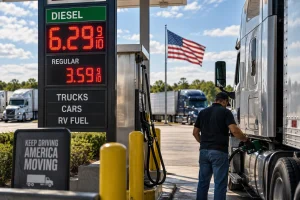
The USDOT and FMCSA have started to implement a series of key reforms aimed at reducing regulatory burdens and improving working conditions for truck drivers.
The U.S. Department of Transportation (USDOT), under the leadership of Sean Duffy, has begun implementing new measures aimed at improving the transportation industry and addressing the recurring issues that affect the sector. In collaboration with the Federal Motor Carrier Safety Administration (FMCSA), the USDOT has released a fact sheet outlining upcoming changes planned for the industry.
These changes were announced recently, complementing the BUILD program grants presented by Duffy on July 15. Among the most notable updates are adjustments to speed limiters, electronic logging devices (ELDs), hours-of-service (HOS) regulations, and funding to expand truck parking availability.
Below, we take a closer look at what the USDOT and FMCSA have planned for the trucking industry.

USDOT and FMCSA: improving the transportation industry
One of the most significant decisions is the removal of the regulation requiring speed limiters on heavy-duty vehicles—a rule widely opposed by drivers and organizations such as the Owner-Operator Independent Drivers Association (OOIDA). The agency acknowledged that the regulation lacked a clear and compelling safety justification.
Another important change concerns electronic logging devices (ELDs). The FMCSA has decided not to extend the ELD mandate to trucks manufactured before the year 2000, as these vehicles were not designed to integrate with modern technology. As a result, drivers of older trucks will continue using paper logs to meet hours-of-service requirements—an adjustment that addresses both technical and operational concerns.
In addition, the FMCSA aims to eliminate unnecessary regulations, which led to nearly 25,000 non-critical violations in 2024 alone. Although the specific rules to be eliminated have not been disclosed, a significant reduction in bureaucratic red tape is expected. At the same time, the agency has reaffirmed its commitment to combat illegal double brokering practices, which directly impact drivers’ earnings.
Regarding driver welfare, more than $275 million will be invested to expand truck parking infrastructure—an issue widely acknowledged across the industry.
Finally, the FMCSA has launched two pilot programs related to hours-of-service (HOS) rules, which could offer drivers greater flexibility to rest according to their actual needs. Additionally, improvements will be made to the DataQ system to simplify the correction of inaccurate records related to inspections or accidents, thus strengthening fairness and accuracy in drivers’ professional histories.

USDOT and FMCSA on major industry updates
The FMCSA and USDOT have started to implement a series of key reforms aimed at reducing regulatory burdens and improving working conditions for truck drivers. Among the initiatives proposed by Duffy are:
- Improving transportation safety
- Accelerating the execution of transportation projects
- Investing in infrastructure that promotes economic growth
- Strengthening partnerships with states and other stakeholders
These goals reflect a commitment to the transportation industry that many in the sector have long awaited. The only thing left is to ensure these promises are fulfilled in a timely and effective manner.

OPEC: What the United Arab Emirates Exit Means for U.S. Fuel Costs and Logistics
The departure of the United Arab Emirates from the Organization of the Petroleum Exporting Countries is reshaping the global oil market, introducing price volatility and creating new challenges for diesel costs, freight operations, and fleet planning across the United States.

Trucks only: Georgia plans dedicated commercial vehicle lanes on I-75
The Georgia Department of Transportation has begun developing a project that plans to add commercial vehicle lanes on I-75.

Tesla Semi moves toward scale
Tesla’s electric truck is already on the road—now the real challenge is scaling production for the freight industry

New US transportation map: adapt without wasting time
The U.S. government has implemented sweeping changes to regulations governing freight transportation, affecting everything from who can be behind the wheel to mandatory in-cab technology. This is an effort to strengthen safety and operational transparency.

The Longest Straight Road in the World: A Challenge for Drivers
Highway 10 in Saudi Arabia, the longest straight road in the world, stretches over 250 km without curves across the desert

Route 66 Turns 100: A Year of Celebrations Across America
The U.S. Route 66—widely known as The Main Street of America, The Mother Road, and Will Rogers Highway—is marking a full year of centennial celebrations throughout 2026