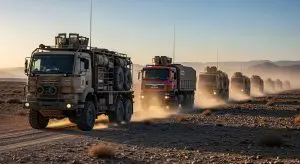
With plans to commence production in 2027, this partnership lays the foundation for the development of the world's first scalable autonomous transportation system.
Continental and Aurora Innovation, in an exclusive collaboration, have successfully concluded the initial phase of designing the Aurora Driver, a Level 4 autonomous driving system according to the SAE standard.
With plans to commence production in 2027, this partnership lays the foundation for the development of the world’s first scalable autonomous transportation system. In less than a year since the start of their collaboration, Continental and Aurora have completed the pre-project and design phase, marking a significant step towards large-scale manufacturing of autonomous transportation systems.
The collaboration leverages Continental’s expertise in automotive development and manufacturing to ensure that the Aurora Driver’s design meets the highest standards, providing value to customers over a million miles. This strategic partnership aims to enable Aurora to deploy autonomous trucks on a large scale after the initial driverless launch, scheduled for late 2024.
Aurora, through this alliance, emphasizes prioritizing safety, a critical aspect in autonomous vehicle development. Continental, with its outstanding engineering team, addresses the need for redundancies to develop an industrialized backup system. Scheduled for production in 2027, this system will offer additional safety by taking over operations in case of a failure in the primary system.

With a dual engineering approach, the goal is to minimize exposure to potential single points of failure, ensuring the reliable and safe operation of autonomous vehicles. Continental and Aurora have outlined a four-year plan for the commercialization of autonomous trucks. The pre-project and design phase, already completed, focused on defining the detailed system architecture, key requirements, and technical specifications.
In 2024-2025, the construction and testing phase will commence, with Continental leading the construction of the initial hardware versions. Rigorous testing will take place at the New Braunfels, Texas facilities, with global assessments.
The finalization phase is scheduled for 2026-2027, involving the start of production and integration. In this phase, Continental will take on the responsibility of industrializing and validating both the future hardware of the Aurora Driver and the backup system.
Once the phases are completed, the fully developed hardware will be sent to Aurora’s affiliated truck manufacturers for integration into ready-to-operate autonomous vehicles. Simultaneously, a maintenance network will be established, and a comprehensive service manual provided to address the evolving needs of Aurora’s customers during this critical phase.
According to the plans set by Aurora and Continental, thousands of trucks equipped with the Aurora Driver will be ready to autonomously transport goods throughout the United States by the year 2027.

U.S. labor market raises red flags on Wall Street
The U.S. labor market closed 2025 with clear signs of weakening, as evidenced by the latest employment data released in December. In the latest episode

DOT finds half of North Carolina CDLs were issued illegally
The DOT warns that half of North Carolina’s CDL licenses are irregular after a federal audit uncovered serious compliance failures. The findings directly affect truckers, fleets, and transportation companies, raising urgent questions about road safety, legal operations, and the future of the trucking industry.

California’s Unhealthy Air: Impacts on Trucking and Freight
Unhealthy Air Quality in California: What Repeated Pollution Alerts Mean for Trucking and Freight Operations

Global Road Freight on Track to Hit USD 5 Trillion by 2033
Global Road Freight on Track to Hit USD 5 Trillion by 2033 as e-commerce growth, supply chain restructuring, and technology adoption accelerate demand for road-based cargo transport worldwide.

California misses DOT deadline risking $160 million in federal funding
The state of California has reached the deadline set by the DOT to take action regarding the situation involving the number of non-domiciled CDLs issued

Health on Wheels: How to Prevent the Most Common Conditions on the Road
Health on wheels matters for anyone who spends long hours on the road. How to prevent the most common physical and mental conditions and maintain healthier routines while working behind the wheel.