State news impacts transportation in different ways.
In Michigan, a bill is advancing in the Legislature and seeks to authorize high-occupancy vehicle lanes on Interstate 75 that runs through Oakland County.
In this state, flexible routes are used since it does not have this type of lanes. For this reason, the Senate Committee on Transportation and Infrastructure voted days ago on a project that authorizes the state Department of Transportation to build new lanes. It can only be used on lanes that have been built with federal funds.
California
Gavin Newsom, governor of California, vetoed legislation that sought to approve the presence of driverless autonomous trucks on the state’s roads. The Department of Motor Vehicles was already analyzing this change to implement the modification.
Now Newsom detailed that the law that is already in force “provides sufficient authority to create the appropriate regulatory framework.” And he added that the DMV: “continuously monitors the testing and operations of autonomous vehicles on California roadways and has the authority to suspend or revoke permits as necessary to protect public safety.”

North Carolina
The passage of Tropical Storm Ofelia through the state generated the emergency that suspends regulations for commercial motor vehicles. The order, already issued, will be valid until October 22.
The rule details that: “certain measures are necessary to ensure the protection and safety of North Carolina residents and to coordinate emergency response among state and local entities and officials. The prompt restoration of public services is essential for the safety and well-being of the residents of the state.
Thus, the HOS, size and weight, and permits do not apply to excepted commercial vehicles that provide relief services. In this case, it covers those vehicles that transport: fuel oil, diesel oil, gasoline, kerosene, propane, liquid petroleum, gas, food, water and medical supplies to all residences and businesses.
It also applies to the transportation of birds, livestock and crops. “The storm’s path has been difficult to predict and we want to ensure that farmers, first responders and utility crews have the tools they need to prepare for severe weather,” Governor Roy Cooper said in an official statement.

$170 billion at stake: 1,500 companies demand tariff refunds
Companies have challenged the global tariffs imposed by President Donald Trump, asking federal courts to reactivate proceedings to begin the refund process. The companies that
In brief: enforcement measures target speeding, CDL training gaps and more
Major enforcement actions across the U.S., including speeding, CDL fraud, and chain violations Colorado launches Speed Enforcement Program The Colorado Department of Transportation (CDOT) has

Chinese Vehicles Raise Espionage and Remote Sabotage Concerns
Investigations into Chinese technology in connected vehicles warn of espionage risks, massive data transmission, and potential remote access vulnerabilities that concern U.S. transportation and security

Between the Court and the Fed: the market redefines its roadmap for 2026
Trade policy in limbo as markets price in 2026 rate cuts and Supreme Court strikes down Trump tariff plan. In the latest episode of the
New 10% U.S. import tariff takes effect amid legal and market uncertainty
The implementation of these new tariffs has generated global uncertainty among exporters, increasing confusion around U.S. trade policy. The United States has implemented a new
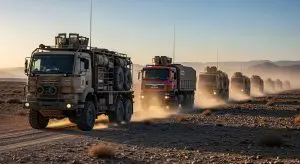
Military Trucks That Moved a Base in Syria
Convoys of advanced HEMTT and PLS military trucks carried armored vehicles, prefabricated base structures, mobile workshops and heavy equipment during the U.S. withdrawal from northeastern